









Fujino’s first real defeat happens on a school newspaper page. Her four-panel manga has made her a minor celebrity among classmates, and Furi Nanase plays that confidence with the loose posture of a child who has never considered talent a temporary condition. Then Kyomoto’s work appears beside hers. The backgrounds are denser, the linework surer. Fujino hears a classmate call her drawings average, and the film quietly changes the terms of her childhood.
Hirokazu Koreeda’s live-action Look Back, adapted from Tatsuki Fujimoto’s one-shot manga, understands rivalry as a form of recognition. Fujino does not resent Kyomoto because the other girl is irrelevant. She resents her because Kyomoto exposes the distance between being praised and becoming good.
That distinction becomes visible through labor. Fujino studies art manuals, redraws obsessively, then abandons the pursuit when effort fails to close the gap. Koreeda and cinematographer Senzo Ueno rarely dramatize this with aggressive camera movement. They let pages accumulate. Pencils move. Time passes.
The irony arrives when Fujino finally visits the reclusive Kyomoto to deliver her diploma. A cartoon slips beneath the bedroom door, Kyomoto realizes who is standing outside, and the feared rival bursts forward as an awestruck fan, calling her “Fujino-sensei.” Competition collapses in seconds. Vanity survives, naturally.
Learning to Draw Together
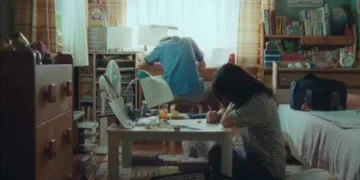
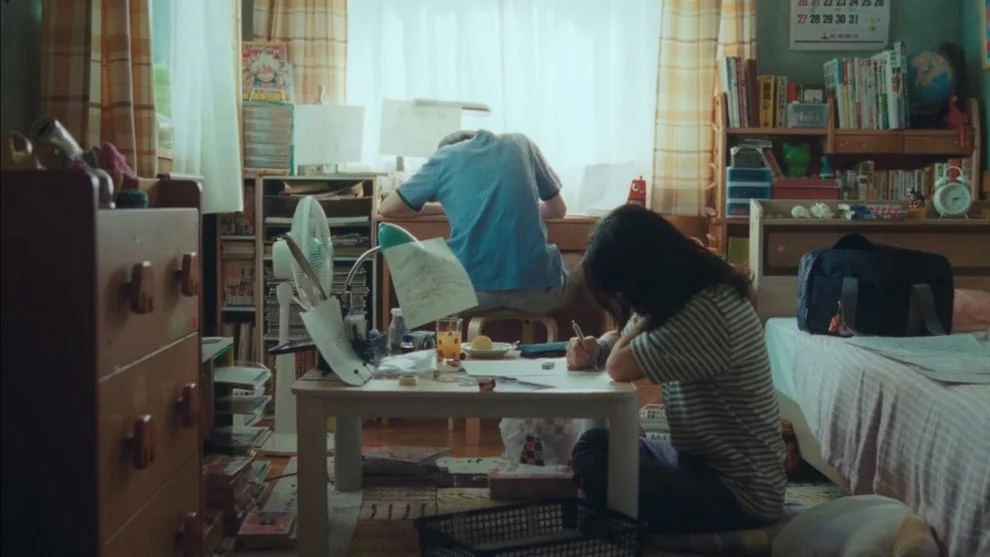
Their partnership works because Koreeda makes collaboration spatial. Fujino handles characters while Kyomoto builds backgrounds, and their bedroom workspace gradually becomes a visual diagram of dependence. Bodies bend over desks. Sketchbooks crowd surfaces. The frame holds both girls inside the same creative enclosure, often without calling attention to who occupies the stronger position within it.
The tactile details matter. A pencil cracks while Fujino is laying down a heavy vertical line, destroying hours of work. The small disaster has the tension of a thriller beat because Koreeda has already taught us what every finished page costs. Later, the move toward digital tools subtly changes the physical relationship between artist and image. Less scratching. Fewer vulnerable sheets of paper. The work becomes cleaner, faster, colder.
Their first major one-shot earns the attention of a manga editor played by Masaki Suda, but the better scene comes afterward. Fujino and Kyomoto see their names in print through a snowy shop window. Ueno keeps the glass between them and the camera, turning publication into something they can finally see yet still cannot quite touch. Recognition has arrived from the outside world. The girls remain pressed together inside their own.
Nanase and Rokka Okada give those years emotional shape without overplaying them. Fujino fills space. Kyomoto retreats from it. Their chemistry works through imbalance, and Koreeda is strongest when he allows affection to emerge from that asymmetry rather than smoothing it away.
The Years Between Panels
Time in Look Back rarely announces itself. It changes the weather. Cherry blossoms give way to deep green fields, autumn gold, pale winter skies, then snow so bright that Fujino and Kyomoto appear to cross an empty page. Ueno’s seasonal photography lends the film a visual continuity that the plot itself keeps disrupting. The girls grow older, yet the landscape seems to remember them in every version.
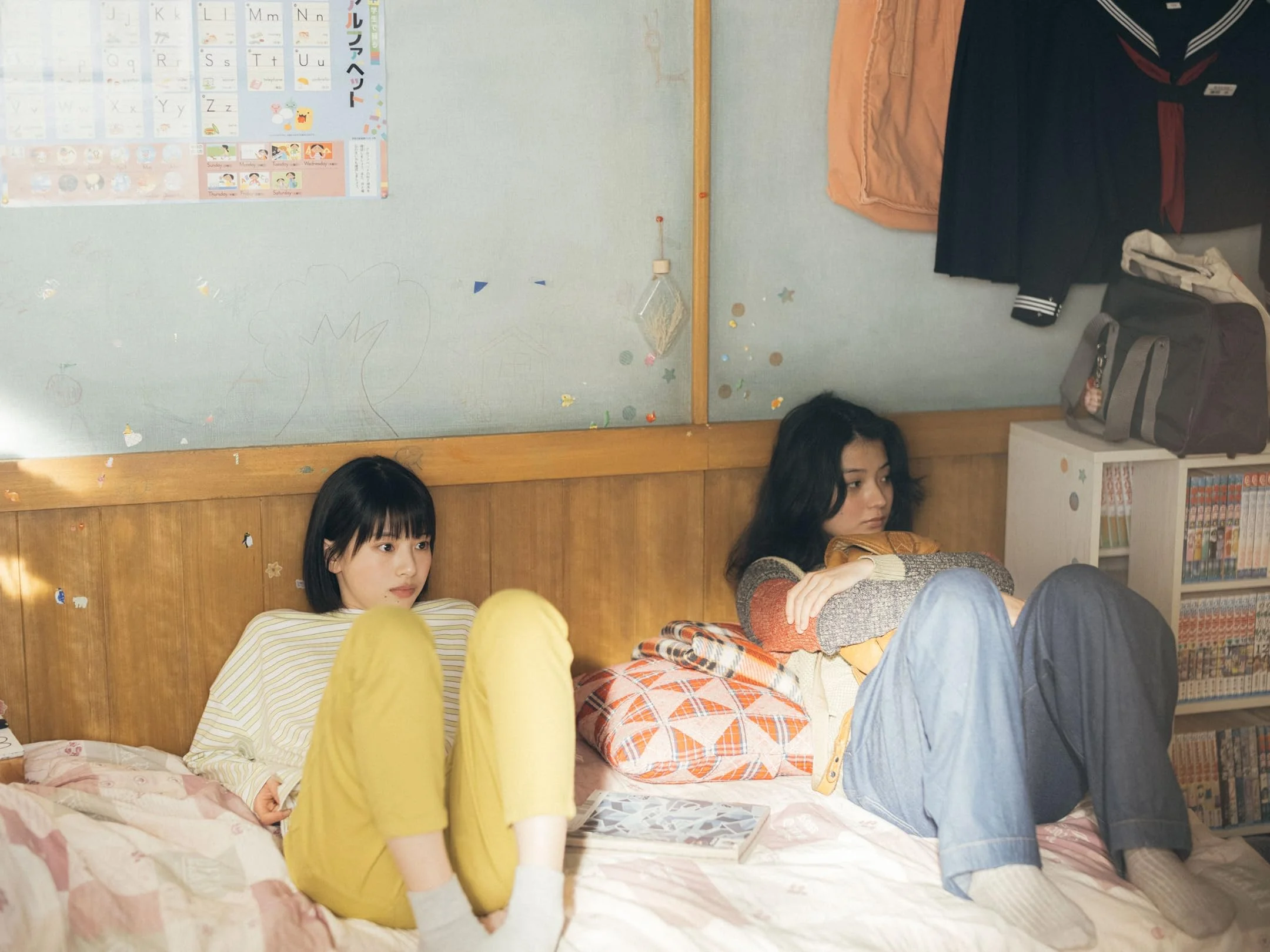
The transition to Natsuki Deguchi as Fujino and Aju Makita as Kyomoto is remarkably clean. Their gestures preserve the earlier performances without turning imitation into spectacle. Deguchi keeps Fujino’s forward momentum intact. Makita retains Kyomoto’s habit of withdrawing behind hair, posture, and silence.
That visual retreat becomes a problem for the film. Kyomoto’s choice to attend art school should redefine the friendship because she is choosing a life that does not pass through Fujino. The script gives the decision weight, and Fujino’s angry response reveals a possessiveness that has been hiding inside their collaboration.
Yet Koreeda often leaves Kyomoto at the edge of the frame emotionally too. A thread involving Fujino photographing landscapes for her friend hints at a richer exchange between how each girl sees the world, then fades before it can deepen.
Yuta Bandoh’s score occasionally behaves like a witness who cannot resist testifying. Gentle guitar passages work beautifully beside trains, fields, and quiet drawing sessions. The heavier strings are less trusting. Ueno’s images already understand what has been lost before the music explains it.
What Remains on the Page
The tragedy arrives with the speed of an edit. Years of friendship are torn apart in moments, and the sudden violence gives the film its sharpest temporal idea. Creation consumes thousands of hours. Loss requires seconds. Koreeda then fractures the chronology itself. Fujino moves through memory, imagined alternatives, and impossible revisions of the past, while familiar locations return with altered meanings.
The seaside imagery briefly slips away from naturalism, allowing the girls’ illustrated world to invade reality. Here, the film’s visual grammar becomes morally unstable. The camera can show another path. It cannot make that path true.
This is where the expanded runtime earns part of its existence. Koreeda sits with Fujino after the rupture rather than treating grief as a dramatic destination. Deguchi’s stillness becomes expressive in ways dialogue could not manage. Rooms seem larger. Empty space becomes accusatory.
The pacing still exposes the thinness of the source material in places, particularly when extended silences repeat emotional information already carried by performance and composition. Close fidelity sometimes leaves the live-action film tracing lines drawn more decisively elsewhere.
Yet the final image gives the adaptation a reason to persist. Fujino returns to the desk. The page before her cannot repair anything, and the film wisely refuses such consolation. Drawing becomes the only action left that still connects memory, guilt, affection, and time. Koreeda holds the frame long enough for that contradiction to remain unresolved.
Look Back premiered in competition at the 83rd Venice International Film Festival on September 6, 2026, ahead of its Japanese theatrical release by K2 Pictures and international distribution by GKIDS. Adapted from Tatsuki Fujimoto’s acclaimed manga, the coming-of-age drama follows two fiercely contrasting schoolgirls who bond deeply over a shared passion for drawing manga.
Full Credits
Title: Look Back
Distributor: K2 Pictures, GKIDS
Release date: September 6, 2026 (Venice International Film Festival)
Running time: 1 hour 40 minutes
Director: Hirokazu Kore-eda
Writers: Hirokazu Kore-eda (Based on the manga by Tatsuki Fujimoto)
Producers and Executive Producers: Genki Kawamura, Kenji Yamada
Cast: Natsuki Deguchi, Aju Makita, Furi Nanase, Rokka Okada, Masaki Suda, Kankurō Kudō, Kayo Noro, Ryō Ikeda
Director of Photography (Cinematographer): Ryūto Kondō
Editors: Hirokazu Kore-eda
Composer: Yūta Bandoh
The Review
Look Back
Look Back premiered in competition at the 83rd Venice International Film Festival on September 6, 2026, ahead of its Japanese theatrical release by K2 Pictures and international distribution by GKIDS. Adapted from Tatsuki Fujimoto's acclaimed manga, the coming-of-age drama follows two fiercely contrasting schoolgirls who bond deeply over a shared passion for drawing manga.
PROS
- Beautiful seasonal cinematography
- Strong young ensemble
- Tactile depiction of drawing
- Effective temporal rupture
- Graceful actor transitions
CONS
- Uneven feature-length pacing
- Kyomoto remains underwritten
- Occasionally forceful scoring
- Fidelity limits fresh interpretation