

























Mountains invite a peculiar kind of arrogance. Stand far enough away and they become objects, shapes on maps, measurements waiting to be surpassed. Come close and the language changes. Snow gives way beneath a boot. Breath becomes work.
A rope between two people stops being equipment and becomes an agreement about who is responsible for whose life. Jennifer Peedom understands this distinction better than Tenzing’s screenplay sometimes does, and her film is strongest whenever Chomolungma refuses to behave like something waiting to be defeated.
The historical destination is familiar. Tenzing Norgay and Edmund Hillary will reach the summit in 1953, and Peedom makes little attempt to disguise that inevitability. Her more meaningful choice is deciding what the ascent means from Tenzing’s side of the rope.
British expedition leader John Hunt speaks of the mountain through military language, at one point invoking a “Siege of Everest.” Tenzing speaks of Chomolungma as “her.” Asked why he climbs, he answers that he wants to know her better. The difference is not semantic. One worldview imagines height as territory. The other treats proximity as a form of understanding.
That distinction gives the film its quietest and strongest line. Hillary speaks of George Mallory as the reason the climbers have gathered there. Tenzing replies, “I was already here.” Nothing needs to be explained afterward. The sentence contains decades of expedition history, colonial presumption and erased labor without turning itself into a speech. It also exposes the tension the rest of the film keeps circling: Tenzing belongs to this landscape culturally and spiritually, yet belonging among the people around him is far less secure.
Luke Davies structures the biography across several periods of Tenzing’s life. Childhood fascination gives way to young adulthood, his relationship with Dawa, his attempts to enter the climbing world, and finally the 1953 expedition with Genden Phuntsok playing the mature Tenzing. The movement across time gives his desire the weight of repetition. He has spent years returning to the same mountain, the same dream, the same refusal to disappear when institutions or circumstances place him outside the circle.
There is something moving about that persistence, though the structure gradually turns persistence into destiny. The difference matters. A person who keeps choosing the same difficult path is interesting because another choice remains possible. A person who seems born for one historical moment risks becoming an illustration of fate. Tenzing occasionally slides toward the latter.
Flashbacks arrive during the later climb with an insistence that can make the past feel arranged around the summit rather than remembered from within it. Conflicts behave similarly. Tenzing’s demand to be recognized as a full climbing member rather than merely a Sherpa carries enormous professional and historical meaning, yet resistance from Hunt softens relatively quickly. Tension with Sherpas who consider Tenzing an outsider within their own community also gathers force before being resolved with surprising neatness.
Phuntsok keeps that neatness from becoming fatal. His performance is built from patience rather than declarations. Tenzing spends much of the expedition translating one group’s needs into language another group might accept: British organizers demand discipline and progress, Sherpa workers understand the unequal danger and recognition built into that progress, and Tenzing occupies the exhausting space between them. His authority comes through listening, bargaining, carrying responsibility and continuing upward. These are small forms of labor, easily ignored beside the spectacle of the summit. Phuntsok makes them visible.
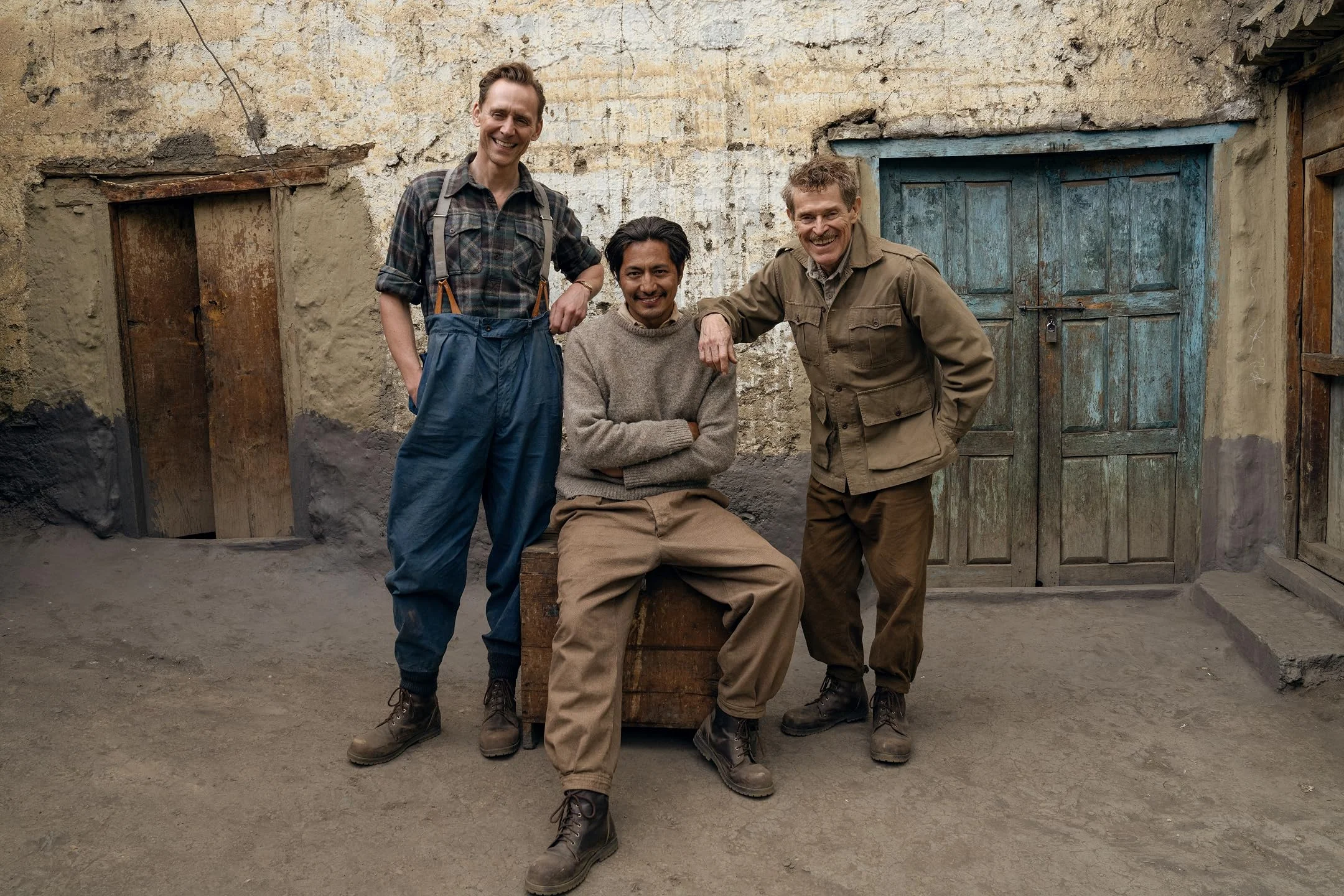
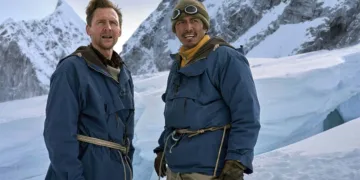
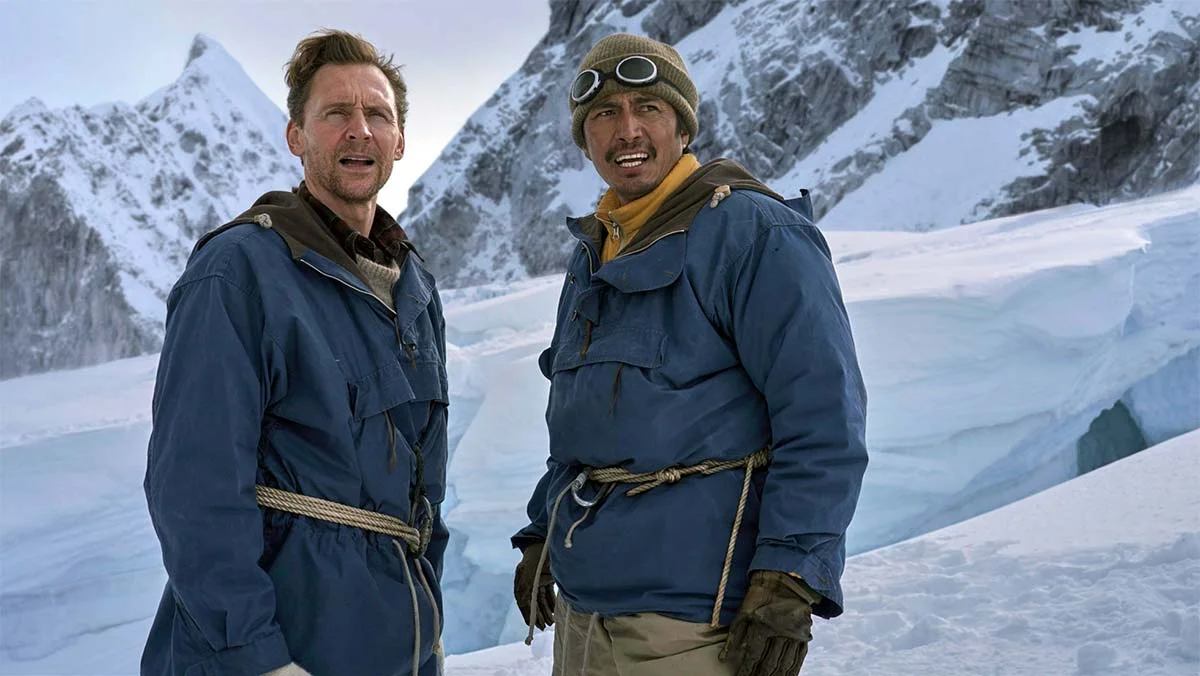
His partnership with Tom Hiddleston’s Hillary develops through the same practical grammar. They do not need an elaborate declaration of friendship. Hillary falls into a crevasse; Tenzing saves him. Trust becomes physical before it becomes sentimental. Hiddleston plays Hillary with enough restraint that the film never accidentally shifts its center toward its most internationally recognizable actor, and their scenes gain warmth from the sense that each man has measured the other where measurement matters: under pressure, attached to the same rope.
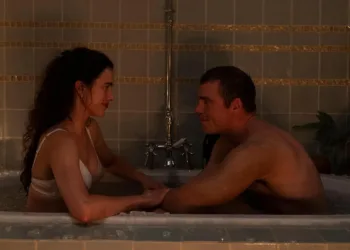
The screenplay is less generous elsewhere. Dawa represents love, sacrifice and reassurance, but she is rarely permitted the complexity granted to Tenzing’s relationship with the mountain. Caitríona Balfe’s Jill Henderson helps create opportunities for him and serves as an advocate within the climbing establishment, yet she too functions largely through what she enables for Tenzing. There is an awkward irony here. A film deeply concerned with historical recognition allows some of its women to remain instruments in another person’s becoming. Their importance is stated far more clearly than their inner lives are shown.
Peedom seems far freer once people are small against snow. Stefan Duscio’s cinematography repeatedly places bodies inside spaces that appear indifferent to human intention. Crevasses open beneath feet. Sheer drops erase any comforting sense of scale. Oxygen masks turn breathing into mechanical ritual. At one point Tenzing loses consciousness from the altitude; elsewhere Hillary hangs above a seemingly bottomless gap. The historical outcome may be secure in the viewer’s mind, yet the bodies remain vulnerable inside each individual second.
Sound does as much work as the landscapes. Boots compress snow. Breath arrives harsh and amplified through thin air. Wind strips conversation down to necessity. Rebekka Karijord’s score supplies grandeur, but the smaller noises are often more persuasive because they reduce the expedition to survival’s simplest accounting: another step, another breath, another person checking that you are still there.
That physical attention complicates the film’s tendency toward reverence. The screenplay sometimes treats Tenzing as though history had been patiently waiting for him to arrive. The mountain scenes understand something harsher. Nothing waits. Nothing guarantees passage. Chomolungma remains sacred without becoming gentle, beautiful without becoming benevolent. Tenzing can love her, study her, return to her and finally stand at her highest point, yet ownership never enters the equation.
Perhaps this is why Phuntsok’s face near the summit carries a sadness that uncomplicated triumph would have erased. A lifelong desire has been fulfilled, but fulfillment does not stop the wind, restore the dead, settle every inequality below, or explain what a person should do after reaching the place that organized so much of his life. He kneels near the top of the world, surrounded by ice and enormous silence, and for a moment achievement looks almost like another form of exposure.
Tenzing arrives in theaters and on Apple TV+ in October 2026. The biographical drama chronicles the inspiring true story of Tenzing Norgay and Edmund Hillary as they achieve the historic first successful summit of Mount Everest.
Where to Watch Tenzing (2026) Online
Full Credits
Title: Tenzing
Distributor: Apple Original Films
Release date: October 9, 2026 (United States)
Director: Jennifer Peedom
Writers: Luke Davies
Producers and Executive Producers: See-Saw Films, Apple Original Films
Cast: Genden Phuntsok, Tom Hiddleston, Willem Dafoe, Caitríona Balfe, Thinley Lhamo, Frank Dillane, Fiona Shaw
The Review
Tenzing
Tenzing finds its deepest meaning when history becomes physical: a rope pulled tight, breath thinning in the cold, another body depending on yours. Jennifer Peedom gives Chomolungma the presence of something sacred rather than something awaiting conquest, while Genden Phuntsok grounds Tenzing’s achievement in patience, labor, and responsibility. The conventional biopic structure sometimes makes his path feel ordained, and several supporting characters remain frustratingly thin. Yet the mountain resists that tidiness. Up there, achievement is never ownership. It is exposure, endurance, and the fragile privilege of returning.
PROS
- Genden Phuntsok’s quietly powerful performance
- Chomolungma framed as sacred presence
- Striking mountain cinematography
- Immersive breathing, wind, and snow soundscape
- Strong Tenzing-Hillary partnership
CONS
- Familiar inspirational-biopic structure
- Some conflicts resolve too neatly
- Dawa and Jill are underwritten
- Flashbacks occasionally feel imposed