



























Paul Schrader gives John Jorrisen a job built around asking difficult questions, then makes his private life depend on one he cannot answer cleanly. John teaches an introductory philosophy course, writes about Spinoza, and spends his days explaining ideas about morality and change to students who mostly seem to want an easy credit. The setup is almost aggressively plain.
Questions appear on classroom boards, philosophical arguments enter conversation directly, and John’s intellectual life keeps echoing whatever crisis the story has placed in front of him. I usually resist films that underline their themes this heavily, but here the obviousness has a purpose. John can name the problem long before he can face what it means.
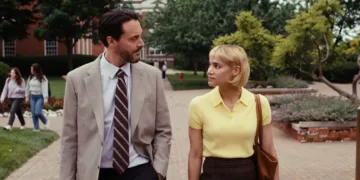
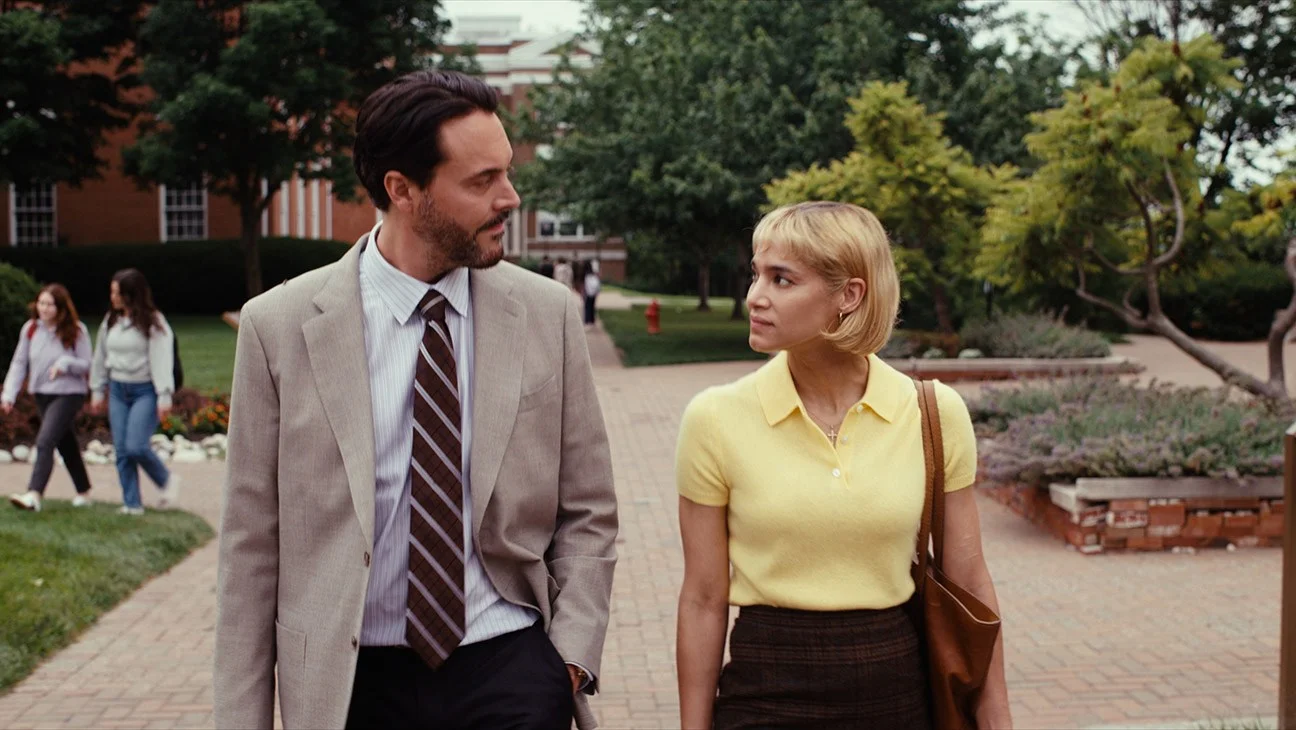
That gap gives The Basics of Philosophy its strongest tension. Jack Huston plays John with a carefully managed calm that makes him seem stable without ever making him relaxed. He is dating Rebecca Richards, a psychology professor played by Sofia Boutella, and has developed a comfortable relationship with her 14-year-old son. Yet their romance remains oddly chaste and formal.
John prefers controlled dinners, controlled conversation, controlled evenings that end before intimacy begins. Huston makes that control feel less like reserve than maintenance, as though John has spent years keeping a structure upright and knows exactly which wall cannot be touched. His father’s death finally puts pressure on that wall.
At the funeral, John sees Miguel Vasque in the congregation. The recognition lands slowly, and Schrader lets the scene operate like a thriller reveal before giving us the information that makes it horrifying. Years earlier, when John worked as a piano teacher, he sexually abused Miguel, who was 14. John’s wealthy father, Melvyn, responded by financially supporting Miguel and his family, an act that reads at once as compensation and concealment.
The film returns to the past in black-and-white flashbacks. Black-and-white is doing a simple job here: it separates memory from the present instantly, so the audience never has to puzzle over chronology. That clarity matters because Schrader is less interested in hiding what happened than in watching John try to decide what the act says about the person he became afterward.
That is where the movie’s classroom language becomes dramatically useful. John keeps circling the question of change because his entire adult identity rests on an answer. He believes the assault belonged to the past. He believes he will never repeat it. He has built a profession around reason, a relationship around restraint, and a life around the idea that one terrible act does not have to become a permanent definition. Miguel’s return turns that belief from an intellectual position into a source of fear.
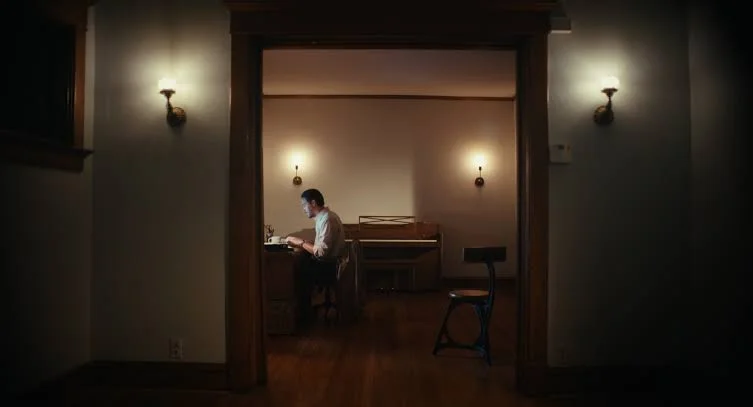
Schrader keeps the pressure surprisingly cinematic for a film this talkative. Eli Keszler’s score carries a nervous, thriller-like pulse beneath conversations that might otherwise sit still. Sean Price Williams’ cinematography also gives John’s orderly world moments of visual instability.
Much of the film is composed with the controlled framing associated with Schrader’s solitary protagonists, but bursts of stronger color and oversaturated light push certain spaces toward melodrama. The effect is useful because the images begin expressing something John refuses to do himself. His speech stays measured while the film around him grows less composed.
Huston understands that division. His performance rarely reaches for a large display of guilt. Instead, you notice small breaks in his presentation: the fixed gaze, the polished voice, the flicker of alarm when Miguel’s presence threatens to connect past and present. Even John’s work on Spinoza becomes part of that performance.
He sits writing about reason while researching Nembutal and thinking about suicide, turning philosophical discipline into something close to camouflage. A later scene in which Karl Glusman appears as Spinoza and talks with John makes Schrader’s method almost comically literal. It is an odd scene, but it also exposes the movie’s governing habit. Ideas do not remain ideas for long here. Schrader keeps giving them bodies, rooms, props, and consequences.
The difficulty comes when John starts questioning his sexuality alongside his fear of what his abuse of Miguel means. He follows Miguel into gay nightlife, enters a gay line-dancing bar, and later encounters Claude, a hustler whose characterization is pitched somewhere between sleaze, danger, and camp. These scenes are meant to extend John’s confusion about himself, but the film loses some of the precision it shows elsewhere.
The distinction matters. Adult same-sex desire has no inherent connection to abusing a child, yet the screenplay places those subjects close together because John himself is trying to explain his past. That could be a productive way to dramatize a damaged man’s self-misreading.
The problem is that Schrader does not always give the surrounding characters or spaces enough definition to keep John’s confusion clearly contained inside John. The gay bar material can feel dated and strangely artificial, and Claude is written with such eccentric shorthand that he becomes harder to read as a person than as another provocation dropped into John’s crisis.
Miguel is steadier, and Daniel Zovatto gives him a presence that complicates the film simply by refusing to behave like an extension of John’s guilt. His return carries an obvious danger for John, especially once Rebecca’s teenage son enters the moral equation.
Yet Miguel’s reasons for continuing contact are not always developed with the same care Schrader gives John’s spiraling self-analysis. That imbalance matters because a story about guilt changes depending on whose interior life receives the most space. Here, the perpetrator gets philosophy, voice, memory, fear, and metaphysical dread. The person he harmed often has to carry meaning through presence alone.
I kept returning to the film’s bluntness, because it is both what makes The Basics of Philosophy accessible and what keeps it from becoming as psychologically rich as its questions deserve. Schrader is very good at making the moral architecture visible. The whiteboard, the Spinoza manuscript, the flashbacks, John’s suicide research, and the score all point toward the same pressure: if a person has changed, how can that person know the change will hold? John can explain the logic. He can lecture on it. He can build a life that seems to prove it. None of those things settles the fear that his old self still exists somewhere inside the new one.
The queasy final stretch refuses to convert that fear into a clean lesson. The suspense comes from watching philosophy fail as a protective system: every concept John has used to organize his life now has to survive contact with Miguel, Rebecca, her son, and the knowledge John carries about himself.
Schrader loses precision when John’s confusion about sexuality spreads into the movie’s own dramatic language, but he does not let intellectual certainty repair the damage. By the final image, John still has all the language he needs to describe his predicament. What he lacks is any reliable way to prove that understanding it has changed what he is capable of doing.
The Basics of Philosophy had its world premiere out of competition at the 83rd Venice International Film Festival on September 4, 2026. The drama follows a repressed professor whose ordinary life is upended when a figure from a past transgression returns, forcing a tense reckoning with guilt and obsession.
Where to Watch The Basics of Philosophy (2026) Online
Full Credits
Title: The Basics of Philosophy
Distributor: Independent / Festival Release
Release date: September 4, 2026 (Venice International Film Festival)
Running time: 1 hour 34 minutes (94 minutes)
Director: Paul Schrader
Writers: Paul Schrader
Producers and Executive Producers: Braxton Pope, David M. Wulf, Martin Scorsese
Cast: Jack Huston, Sofia Boutella, Daniel Zovatto, Bill Pullman, Dana Delany, Shiloh Fernandez, Karl Glusman, Richard Gere
Director of Photography (Cinematographer): Sean Price Williams
Editors: Stephen Gurewitz
Composer: Eli Keszler
The Review
The Basics of Philosophy
The Basics of Philosophy works best when Paul Schrader turns John’s intellectual certainty into dramatic pressure. Jack Huston’s controlled performance, Eli Keszler’s uneasy score, and Sean Price Williams’ restrained imagery give the film a quietly threatening pulse. Its treatment of sexuality is far less precise, and Miguel never receives the dramatic depth John does. Still, Schrader’s central question about change remains unsettling because the film refuses to let understanding count as absolution.
PROS
- Jack Huston’s tightly controlled performance
- Philosophy effectively drives the suspense
- Strong score and visual restraint
- An appropriately uneasy final stretch
CONS
- Gay nightlife material feels dated and artificial
- Sexuality and abuse are handled with insufficient precision
- Miguel remains underdeveloped
- Some thematic signaling is overly literal