























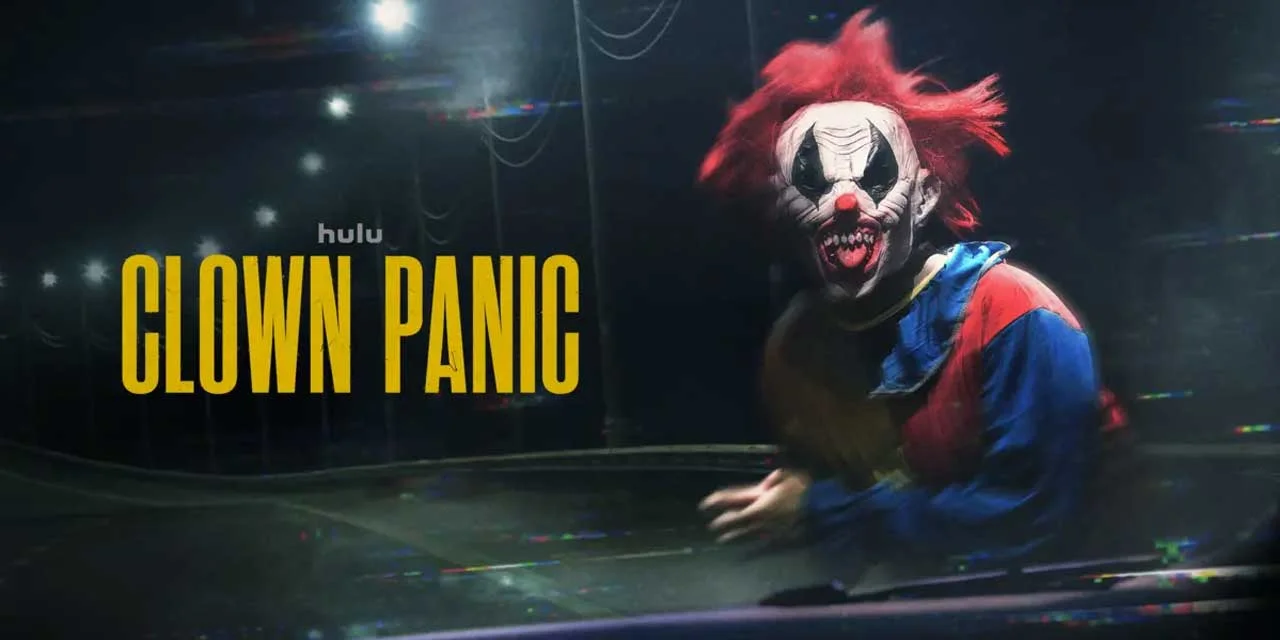

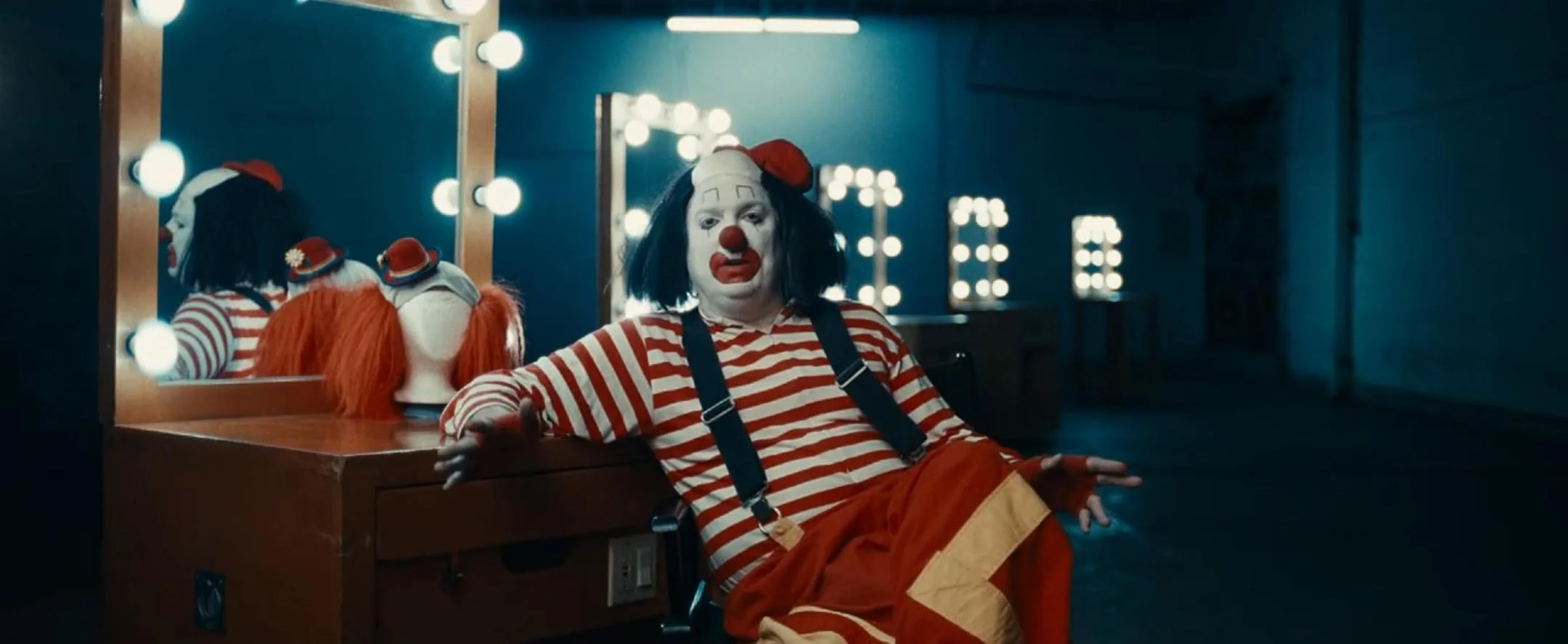
The professional clown explaining that his work consists of bringing joy has a practical reason to resist the label being given to strangers lurking near woods. His livelihood depends on a distinction that the public has stopped making. Interviewed in full makeup in Ed Perkins’ Clown Panic, he must defend a profession while wearing the very image that has become its liability. The costume identifies his expertise and supplies a reason to distrust him. Perkins finds dark comedy in these interviews, but the performers’ concern exposes a struggle over who gets to define their work.
American popular culture has supplied several competing definitions already. Bozo, Ronald McDonald, and Pennywise belong to entertainment, advertising, and horror, yet their shared appearance allows recognition to slip into association. The documentary’s references to John Wayne Gacy bring an actual murderer into this company of manufactured characters.
Such proximity helps explain how a painted face acquires menace, although it requires care: a fictional monster and a criminal biography provide different kinds of knowledge. The working performers are caught beneath this accumulation of images. Their account of clowning as an exchange with an audience has little authority against a villain recognizable before he does anything.
The 2016 scare gives that loss of control a geographical setting. Reports from children in South Carolina described frightening clowns near woods, including allegations that children were being lured toward them. Perkins places important early reports within poor, predominantly Black communities, connecting the uncertainty to experiences of being overlooked by police.
This is the documentary’s most useful resistance to treating the episode as a collection of foolish internet pranks. A report heard within a community with limited confidence in institutional protection carries pressures that disappear when it becomes a video watched elsewhere. The viewer receives a frightening image; residents must decide what response an uncertain threat deserves.
School lockdowns and the Penn State students who gathered to hunt clowns show that responses could acquire their own momentum. Closing a school gives a rumor institutional weight, even if precaution remains understandable. A crowd searching for an enemy takes another step, converting anxiety into a public activity with an apparent purpose.
Perkins’ opening assertion, “The story of the clowns is the story of America,” finds support in these differences between neglected reports, official precautions, and collective retaliation. His treatment of election-era hostility and distrust of news is less exact. The political montage establishes a climate, but the film spends insufficient time connecting that climate to the particular decisions its participants describe.
The international spread complicates the national claim productively, even if Perkins does not pursue that complication far enough. The threatening clown could travel without an explanation of South Carolina’s local conditions or American school security. Its visual vocabulary was portable, helped by the familiar horror figures the documentary invokes.
An overseas viewer could recognize the costume and reproduce the prank while encountering a different relationship between communities, authorities, and news. The film establishes circulation; it gives limited attention to those differences in reception. America supplies the documentary’s principal social setting, while the image escapes that setting faster than the investigation can account for it.
Perkins’ own images participate in this escape. Eerie close-ups, light jump scares, and reenactments accompanying witness testimony offer immediate access to fear. They can make a remembered encounter legible without requiring the viewer to accept that every reported danger was real.
Yet the horror register puts pressure on that distinction. Once a testimonial has acquired a frightening dramatization, the sensation of having seen something can outrun the knowledge that it was reconstructed. This is an awkward method for examining a panic sustained by images whose authority exceeded what anyone knew about them. The film reproduces some of that uncertainty, but does not always make the uncertainty itself available for scrutiny.
Its borrowed film and television clips create a related problem. Ghostbusters, The Simpsons, and Kojak contribute to an associative style that keeps the account moving, sometimes at the expense of staying with a witness or a social explanation. Their age is irrelevant to the weakness. Older entertainment can remain active in public memory, and inherited imagery belongs in an investigation of cultural fear.
The question is what a particular insert explains. The Jaws comparison offers a recognizable example of entertainment shaping perceptions of danger; it cannot establish that audiences previously lacked fear of sharks. Too many references deliver recognition when the argument needs a clearer connection. The accumulation repeats a cultural association without consistently explaining how it shaped the scare.
The shift toward serious consequences gives the earlier comedy a purpose, though it cannot repair every digression. Professional clowns discussing lost business initially produce the peculiar discomfort of hearing ordinary economic worries from faces designed for amusement. Later, that mismatch becomes part of the subject: public imagery has consequences for people whose identities it misrepresents.
Perkins is effective when he lets those consequences change the register of the film. He is less effective when rapid editing keeps feeding an appetite for the bizarre after the accounts have supplied reasons to slow down. The documentary’s emotional movement becomes stronger as its assortment of entertaining references becomes less useful.
The closing account of a sixteen-year-old boy’s death in Reading, Pennsylvania, brings a specificity that the national thesis sometimes lacks. No montage of American unrest can substitute for the loss described here, and the tragedy does not prove every political connection Perkins proposes. It does establish the inadequacy of remembering the scare solely as an absurd meme.
The testimony also describes devastating harm to a surviving person, refusing to let the death account for all the damage. That continuing life requires a different scale of attention from a viral sighting or a crowd searching for clowns. Perkins finally allows the consequences to occupy the space that the spectacle has repeatedly threatened to consume, including damage that persists after the public has lost interest.
Clown Panic premiered on Hulu and Disney+ on October 12, 2026. Directed by Academy Award-nominated filmmaker Ed Perkins, the documentary revisits the nationwide hysteria of 2016 that began with reports of creepy clowns lurking near South Carolina woods before escalating into viral panic, school lockdowns, and police interventions across the United States.
Full Credits
Title: Clown Panic
Distributor: Hulu, Disney+, Lightbox
Release date: October 12, 2026
Rating: TV-MA
Running time: 1 hour 24 minutes (84 minutes)
Director: Ed Perkins
Writers: Ed Perkins
Producers and Executive Producers: Simon Chinn, Jonathan Chinn, Ed Perkins
Cast: James Klüg
Director of Photography (Cinematographer): Jacques Jouffret
Editors: Alex Rodríguez
The Review
Clown Panic
Clown Panic is strongest when it restores local circumstances and individual livelihoods to an image that circulated worldwide. Its professional-clown interviews and painful closing testimony give the scare a human scale. Perkins’ larger argument about America receives less sustained investigation, while borrowed clips and horror staging sometimes reproduce the spectacle he seeks to explain. An affecting account of damaged lives, uneven as an explanation of how those lives became exposed.
PROS
- Professional-clown interviews expose the cost of a distorted public identity.
- Attention to race, poverty, and policing grounds the American setting.
- Closing testimony gives lasting harm emotional weight.
CONS
- Frequent entertainment clips interrupt investigative attention.
- Political framing lacks precise connections to participants’ decisions.
- Horror reenactments risk blurring reported fear and established danger.







