


























MegaPals awards victory to two people whose answers align. That decision changes the purpose of its word-association prompts almost immediately. Given a subject and a timer, players type as many related responses as they can, hoping to match someone else. An obvious association is useful because another person might reach it too. A stranger answer becomes a calculated attempt to meet a particular friend halfway. The scoring gives players a reason to think about the people holding the other phones.
The restriction on repeating successful matches keeps that process moving. Once a shared word has paid out, the pair needs another connection. Later prompts make those relationships explicit, asking players to imagine something such as a business two participants should run together.
Familiarity becomes usable information, but it still requires interpretation. Knowing someone’s favorite subject might suggest an answer; predicting which association they will actually submit is a different problem. MegaPals gets considerable mileage from that small gap between knowing a person and anticipating them.
Its presentation makes the results legible. Figures connect onscreen as matches emerge, turning separate submissions into a network of shared thinking. Two players can each connect with a third without connecting to one another, which gives the reveal something to discover beyond a score total.
The quiet typing phase earns its place because everyone subsequently receives evidence of what the others were thinking. Among The Jackbox Party Pack 12’s five browser-controlled games, this is one of the clearest examples of rules generating social entertainment rather than merely requesting it.
Hyperface achieves something similar through an unusually forgiving creative tool. Players choose a supplied photograph or take a selfie, then stretch, shrink, drag, and draw on it to answer a reaction prompt. Starting with an existing face removes the need to construct an image from scratch. The decision is immediately expressive: which feature should change, and how badly should it change? A poorly executed alteration can still communicate an attitude, with the distortion itself supplying much of the joke.
That makes technical incompetence productive. Drawing badly can leave an intended idea unreadable; mangling a recognizable face usually leaves something recognizable to laugh at. Selfies strengthen the effect because the identity survives the damage. Later rounds let players develop an earlier image in response to a more complicated prompt, giving an existing joke room to accumulate changes.
Even refusing to edit the photograph receives a mocking response from the game. Hyperface has an answer for several levels of creative effort, including almost none, without requiring everyone to become equally proficient with its tools.
We Forgot A Card offers firmer guidance with less interesting consequences. Early rounds establish a greeting-card theme, provide front-message choices, and pass writing duties between players before putting completed cards to a vote. Shared authorship can produce a satisfying collision between setup and response, though the prescribed material limits how far players can redirect it.
The final round, built around messages for an accompanying plush toy, gives the writing greater freedom and adds text-to-speech delivery. It is a better use of the participants’ input: the words have room to become peculiar, and the synthetic voice contributes a performance. The earlier card-making remains serviceable, but its structure does less to transform the familiar act of writing an answer and voting.
Idol Factions changes the nature of participation altogether. Two teams sort moving answers into categories by directing them along routes. Recognizing an answer is only part of the task, because it must still reach the correct destination through a board that demands attention and coordination. Categories can separate K-pop, programming languages, and movies, or test distinctions between “pair,” “pear,” and “pare.” Knowledge needs to survive execution under time pressure.
The option to send an uncertain answer to the opposing team gives that uncertainty a tactical use. Passing it away removes an immediate problem, but a correct response earns the opposition double points. The decision depends on an estimate of their knowledge alongside an admission about your own.
An incorrectly sorted answer returns at reduced value, keeping the mistake active on the board. These rules give hesitation and error consequences that players can respond to, which makes the trivia feel like an ongoing contest rather than a succession of isolated questions.

Later movement requirements, an empty position, and bombs that obstruct visibility complicate an established routing task. Attention becomes a resource: identifying a category competes with tracking where an answer needs to go. The game supports two people playing against each other, giving this particular attraction a use beyond a larger gathering.
Its concentrated problem-solving creates a different mood from Hyperface’s public reveals, and that difference helps the collection. A group can choose sustained coordination when it wants something to solve together, though the shift may interrupt an evening built around quick jokes.
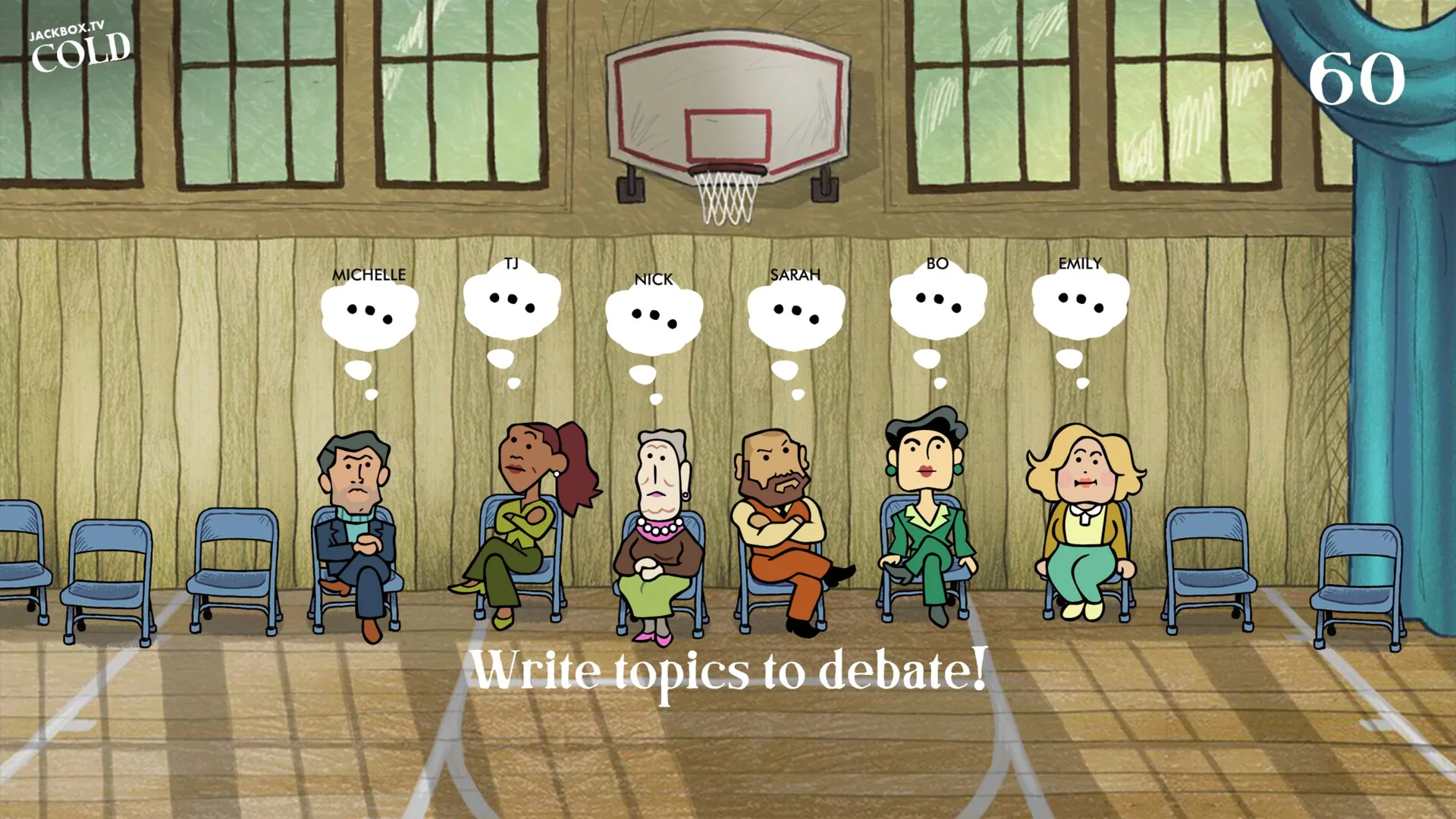
Debate and Switch asks for a much larger contribution from its players. Paired speakers defend opposing positions, the audience chooses a preferred side, and the losing player can alter part of the proposition using audience suggestions before another debate. The switch is a worthwhile intervention. It can invalidate a persuasive argument and make adaptation part of the contest, giving the initial loser a way to change the conditions rather than simply accept defeat.
The difficulty is the amount of entertainment that must happen between those interventions. A position, a timer, and an audience provide a framework, but sustaining an amusing argument aloud requires confidence and improvisational fluency.
Defending a position someone dislikes is a legitimate challenge, and audience preference suits a game about persuasion. Neither feature needs fixing on principle. Yet the tools offer limited help to someone who can produce a good written response but struggles to hold the room. Hyperface can turn an awkward input into an amusing object; Debate and Switch leaves much of that conversion to the speaker.
The Review
The Jackbox Party Pack 12
The Jackbox Party Pack 12 earns its strongest laughs by giving simple contributions interesting consequences. MegaPals turns prediction into partnership, Hyperface makes clumsy editing productive, and Idol Factions combines trivia with decisions that carry real risk. We Forgot A Card restricts its writers too tightly, while Debate and Switch depends heavily on confident performers. The collection offers several persuasive reasons to gather around a screen, with distinct demands that make choosing the right game for the room worthwhile.
PROS
- MegaPals rewards shared thinking through pair-based scoring.
- Hyperface makes limited artistic skill entertaining.
- Idol Factions adds tactical risk to team trivia.
CONS
- Early greeting-card rounds constrain creative responses.
- Debate and Switch offers limited support for hesitant speakers.