



Darren Stewart wants to give Shakespeare some competition. His plan is to turn the work of Irish-language poet Sean O’Riordan into rap, making a claim for the words he thinks deserve an audience. At The Kabin Studio in Knocknaheeny, Cork, this seems a perfectly reasonable thing for a young musician to attempt. Brendan Canty’s documentary Gealtra spends time with the children and teenagers who write and record there, and Darren’s ambition gives their activity a useful cultural scale. Literary inheritance becomes something a young person can select, adapt, and put to work.
The pleasure is in watching that work happen. Canty takes an observational approach, letting conversations and songwriting sessions carry the film’s ideas through the participants’ activity. Sophia and Heidi tackle difficult, tongue-twisting lyrics with an appetite for the challenge. Their willingness to attempt the words makes the exercise engaging before a finished song exists. Writing in Irish introduces questions of rhythm and delivery that the youngsters have to solve for themselves. The language acquires a practical purpose: they need to make it fit the music they want to perform.
Poet and rapper Séamus Barra Ó Súilleabháin helps them with that task, alongside The Kabin Studio’s Gary McCarthy. The adults provide guidance while the young musicians supply their own subjects and personalities. Bucky writes about the oppressive influence of English, giving the sessions an explicitly political dimension. Darren approaches the question through poetry and cultural prestige. Those different interests matter. They prevent the participants from becoming interchangeable representatives of a worthy initiative, all recruited to deliver the same message about Irish identity.
The Kabin Crew’s 2024 viral hit “The Spark” provides an obvious reason for an audience to be curious about the studio. Yet the writing sessions are where I found the film most absorbing. A successful recording can make youthful confidence seem effortless. Spending time with the attempts that precede performance gives that confidence a history, however partial.
Eibhlin gives this process a personal significance when she describes feeling different at school and gaining confidence through rap. Her account helps explain what participation offers beyond the satisfaction of completing a song. Rosaleen, who has moved from being a member of the group to mentoring others, supplies a different measure of change. The studio has become somewhere she can take responsibility for another person’s efforts. Canty has enough affection for these young people to enjoy their achievements without requiring every experience to become a dramatic confession.
That affection shapes the photography, too. An early image of Sophia skating beneath blue skies and green trees is presented in slow motion. By stretching movement, slow motion asks us to look longer at an action we might otherwise register and forget. Here, it gives ordinary recreation a little of the heightened presence associated with a music video. Sophia can occupy the image with the same assurance the studio encourages at a microphone. It is an inviting piece of filmmaking, and its optimism has a specific person to attach itself to.
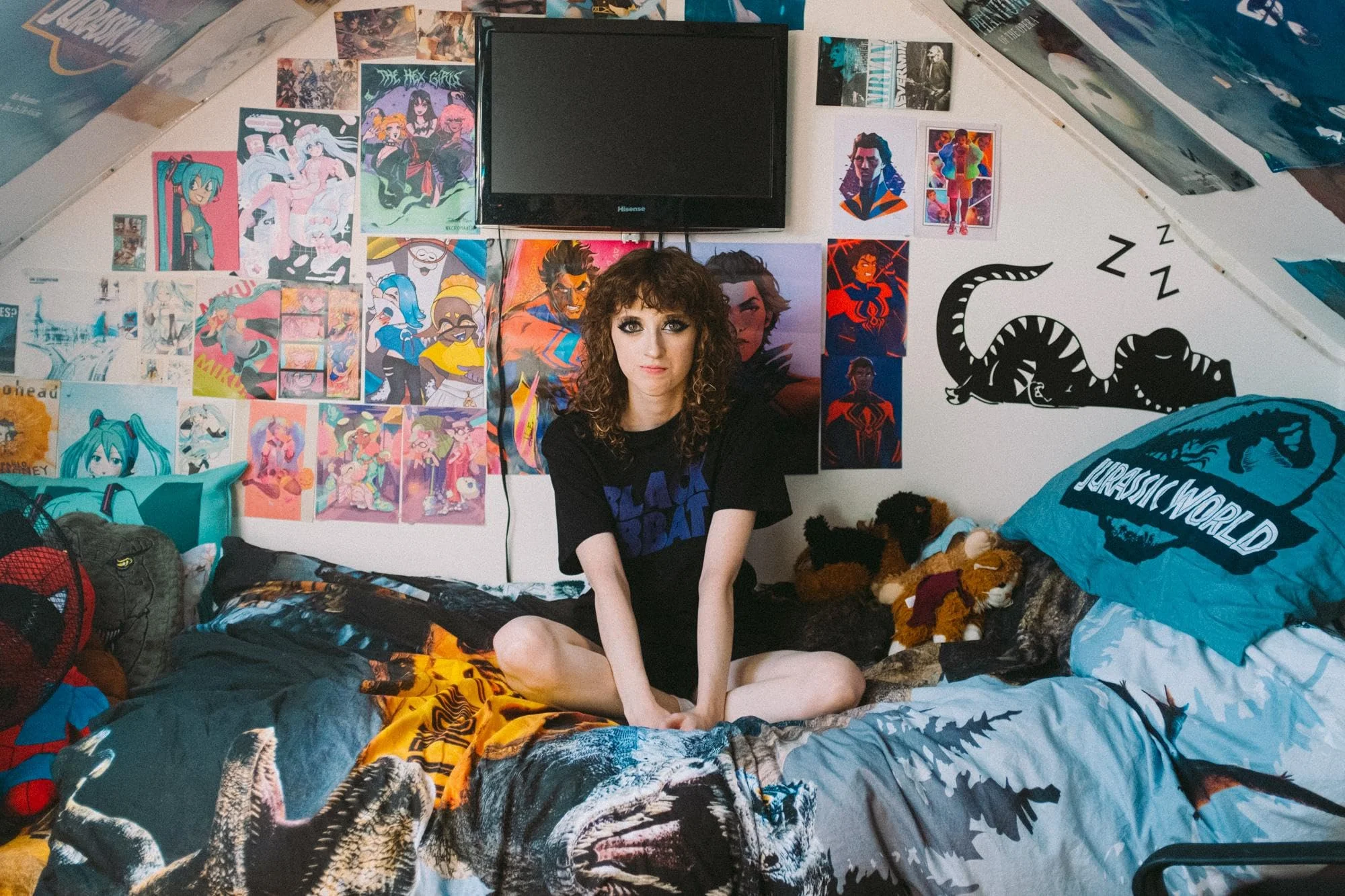
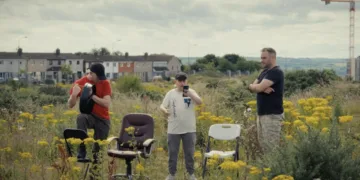
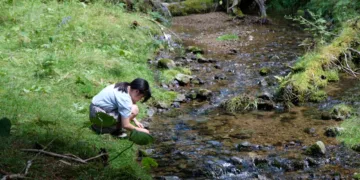
Canty extends that visual attention to Knocknaheeny’s housing estates, industrial remains, and surrounding fields. Conversations on walks past a derelict water tower or among yellow ragwort place the participants within a recognisable local world.
The scenes at home and with friends help keep their lives from shrinking to the dimensions of the recording room. These passages give the film room to breathe, though the attractive views cannot supply the community history that Canty largely leaves unexplored. We get a feeling for the surroundings without learning much about the conditions supporting the studio’s work.
The larger difficulty is how the film arranges its people. Moving between several participants allows Canty to establish a group with different interests and degrees of experience. Each return, however, has to recover the thread of an individual story.
At 70 minutes, Gealtra has a modest running time but can still feel circuitous. Eibhlin’s account of confidence, Rosaleen’s new responsibilities, and Darren’s artistic intentions suggest developments that would reward sustained attention. The film keeps widening our acquaintance with the group when following one experience further could give those developments greater weight.
The closing performance of “Failte Go Knocka,” or “Welcome To Knocka,” brings the individual efforts into a shared public form. After the attention given to finding words and attempting difficult lyrics, performing together becomes a further creative task: everyone contributes to something that has to hold as a song. The title also gives the performance a direction. These youngsters have spent time telling us what participation means to them; now they are addressing listeners through a welcome to the place they call home.
Gealtra premiered at the Galway Film Fleadh in July 2026 before its Irish theatrical release on August 14, 2026, via Wildcard Distribution. Directed by Brendan Canty, the Irish documentary follows a group of young people from Cork as they embrace the Irish language and use rap music and poetry to find their personal creative voices.
Full Credits
Title: Gealtra
Distributor: Wildcard Distribution, Feel Good Lost
Release date: July 15, 2026 (Galway Film Fleadh), August 14, 2026 (Ireland)
Rating: PG
Running time: 1 hour 10 minutes (70 minutes)
Director: Brendan Canty
Writers: Brendan Canty, Séamus Barra Ó Súilleabháin
Producers and Executive Producers: Máire Ní Dhuinnín
Cast: Darren Stewart, Sophia McNamara, Rosaleen Brady, Heidi White, Aaron Hennessy, Ellen Martin
Director of Photography (Cinematographer): Colm Hogan, Roman Bugovskiy
Editors: Juangus Dinsmore, Allyn Quigley
Composer: Tom Morris, Garry McCarthy
The Review
Gealtra
Gealtra is most engaging when it lets us watch creativity being worked out: difficult lyrics attempted, inherited poetry repurposed, confidence built through participation. Canty’s affectionate photography gives the young musicians a welcome screen presence. The scattered structure leaves individual developments underexplored, and the studio’s wider circumstances remain lightly sketched. Still, the songwriting sessions make a persuasive case for Irish as a language these children can shape around their own interests.
PROS
- Engaging access to the songwriting process.
- Participants with distinct interests and ambitions.
- Expressive slow-motion photography.
- Cultural themes grounded in creative activity.
CONS
- Dispersed storytelling limits individual development.
- Little context for the studio’s wider circumstances.