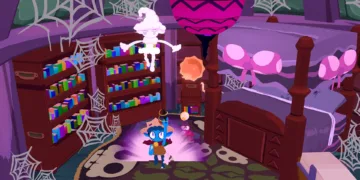















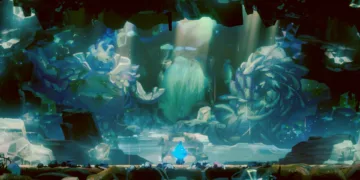

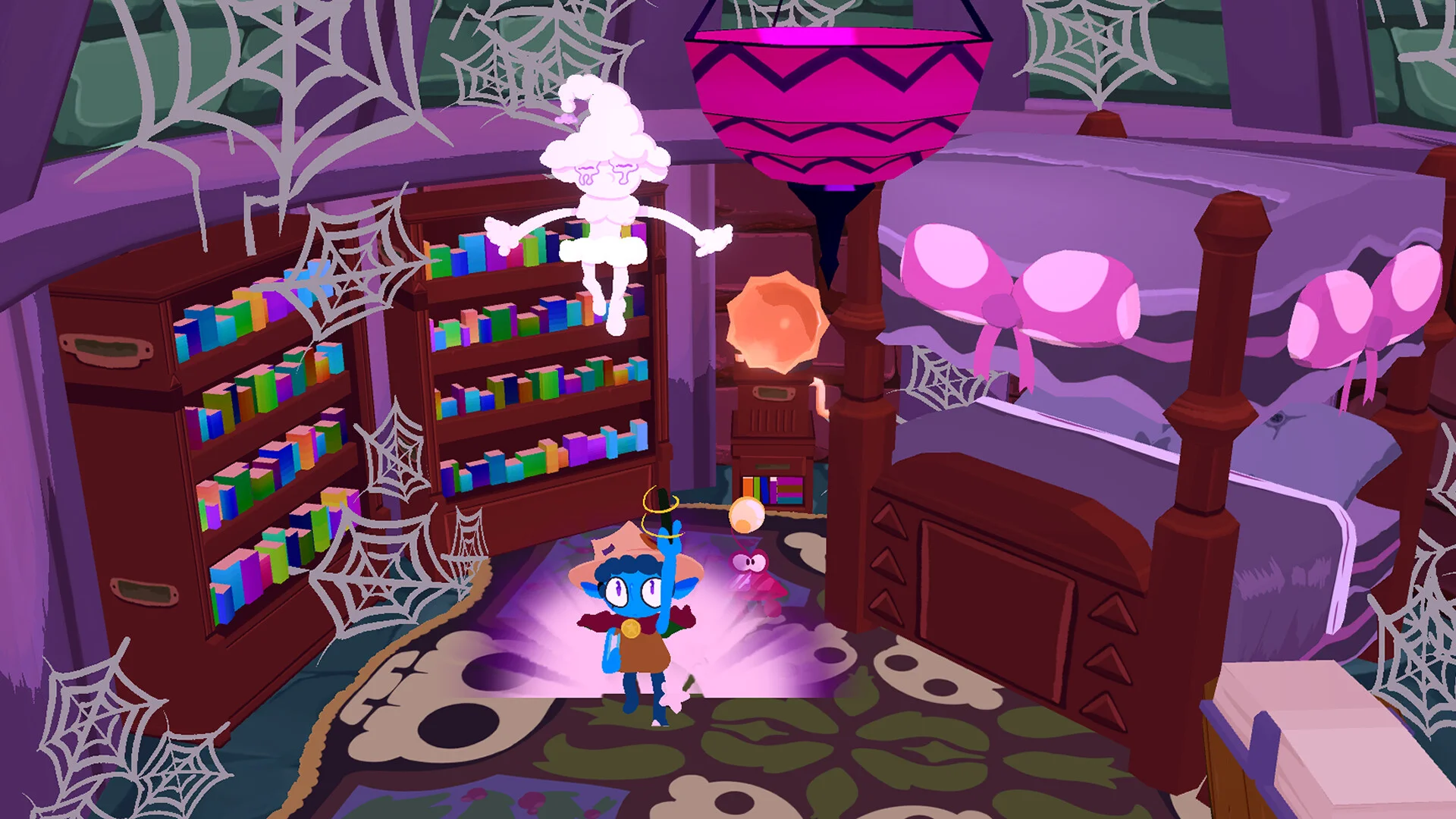

Illustrated side panels frame Rhell’s recommended 4:3 image, placing a small cartoon world inside a screen shape associated with the GameCube. UK-based developer SlugGlove approaches Japanese console history through its presentation: flat characters occupy dimensional spaces, inviting a comparison with Paper Mario, while bright colors and jaunty music make the world immediately approachable.
The format establishes a particular relationship with the player. It suggests a self-contained adventure whose peculiar inhabitants and obstacles will gradually become familiar, with each new discovery adding to the pleasure of knowing the place.
The prison gate offers an early opportunity to test that relationship. A stool can be moved into position so Rhell can climb over, but combining Push and Rotate can turn the gate itself. The obstacle accepts a change in the player’s understanding of its physical properties. A piece of scenery becomes something available for manipulation. That discovery gives Rhell: Warped Worlds & Troubled Times a persuasive introduction to magic: the spellbook teaches an action, and the room allows the player to decide what that action means.
Beyond the prison, the kingdom has lost most of its inhabitants. Its monarch apologizes for Rhell’s imprisonment and asks for an investigation into the Royal Sage’s workshop, supplying a destination without much ceremonial grandeur. Rhell’s sardonic responses and the dialogue’s casual lowercase delivery keep royal business on conversational terms.
There is little pressure to receive the disappearance as solemn drama. The mystery gives exploration a purpose, while the humor makes experimentation feel appropriate to the fiction. A kingdom whose ruler can admit an embarrassing mistake has room for a savior who solves a problem through an absurd arrangement of objects.
The spellbook contains forty collectible runes, with five slots available for each spell. Repetition alters strength: a single Push provides a nudge, while several can send the target flying. Combining different runes changes behavior, as the curved motion produced by Push and Rotate demonstrates.
This small vocabulary creates room for both careful adjustments and extravagant experiments. The important achievement is how readily an ordinary effect becomes a component in another idea. Turning something bouncy can provide transportation, but a bouncing block can also strike switches repeatedly. The same property serves movement or automation according to its placement.
Summoned scarecrows extend this logic because they can repeatedly cast spells attached to them. A scarecrow that summons further scarecrows can generate a chain to climb, turning an act of creation into a means of crossing space. This is where the comparison with The Legend of Zelda: Tears of the Kingdom becomes useful.
Both games allow success to carry the feeling of an improvised answer rather than a recognized instruction. SlugGlove’s connection to Nintendo’s design vocabulary reaches from the image into the player’s sense of ownership: the world looks authored, yet a route through it can feel personally assembled.
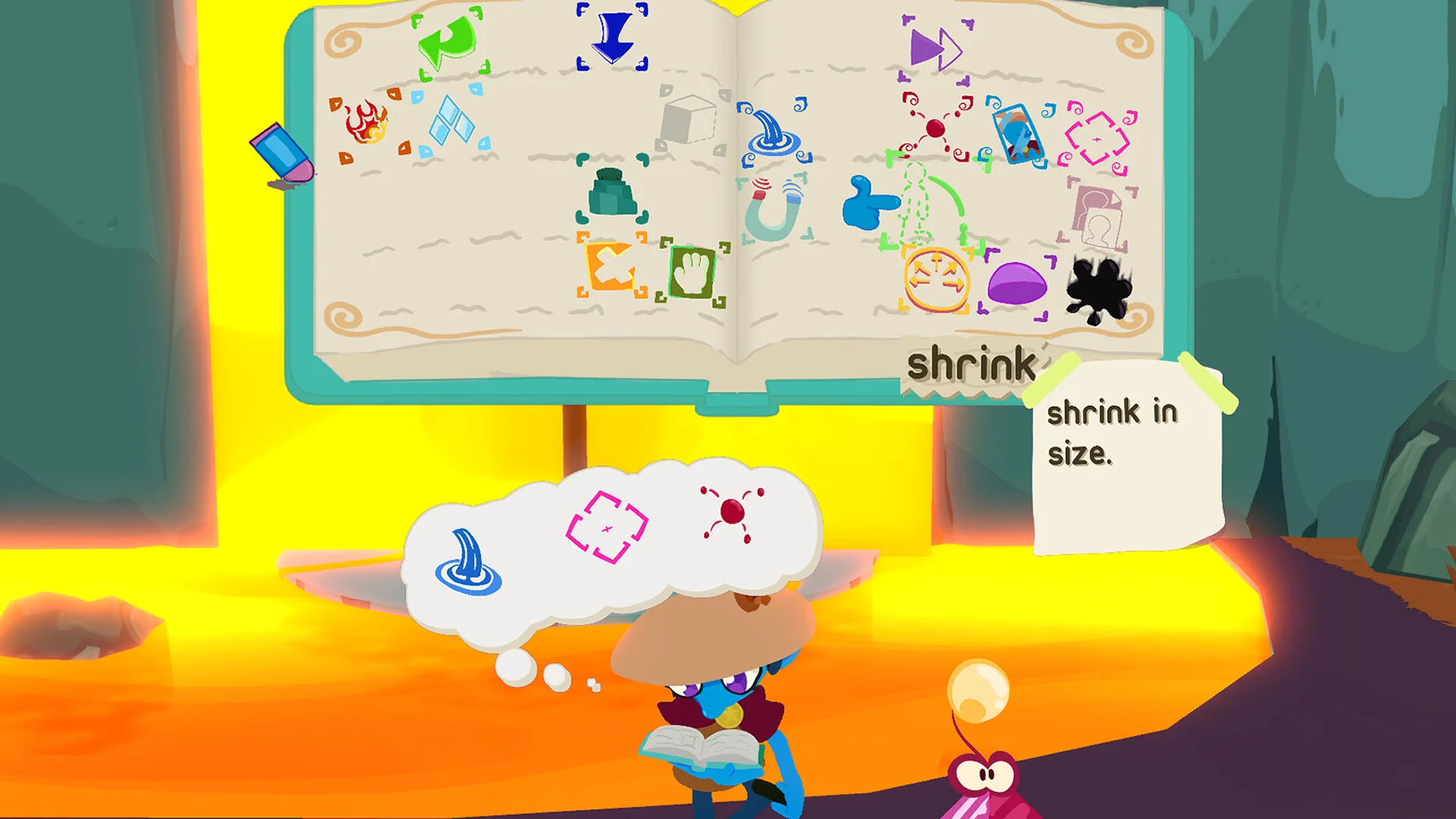
Environmental conditions keep that freedom interesting. A wooden plank may be combustible, but running water can extinguish attempts to burn it. Knowing a useful spell does not settle the surrounding problem. The player must understand the relationship between materials, effects, and location.
This gives the magic a satisfying resistance, allowing experiments to teach something about the world. The cheerful presentation helps here. Watching a peculiar combination behave unexpectedly fits the tone already established by the conversation and artwork, so a failed attempt can remain entertaining while providing information for the next one.
Exploration changes the available answers. Runes hidden behind difficult entrances can transform encounters elsewhere, and acquiring Portal can make an earlier obstacle far easier. Returning to a room becomes an opportunity to reassess its possibilities with a changed vocabulary.
The connected zones support this process through collectible counts and fast travel to visited screens. Those conveniences have a substantial role in the game’s pace: they let players pursue an idea elsewhere without demanding that they repeatedly retrace familiar ground. Leaving a puzzle unfinished can become a productive choice.
The uncertainty surrounding that choice is less satisfying. An obstacle can leave players unsure if they have overlooked a combination or lack a rune found somewhere else. Those are different reasons for being stuck, but exploration does not always make the distinction legible.
Continued experimentation can begin to feel directionless when the adequacy of the current spellbook is itself in doubt. Later tools easing earlier challenges rewards curiosity, yet it also makes difficulty uneven. The map can report that something remains to be collected; it cannot explain how long a player should keep testing an apparently unproductive idea.
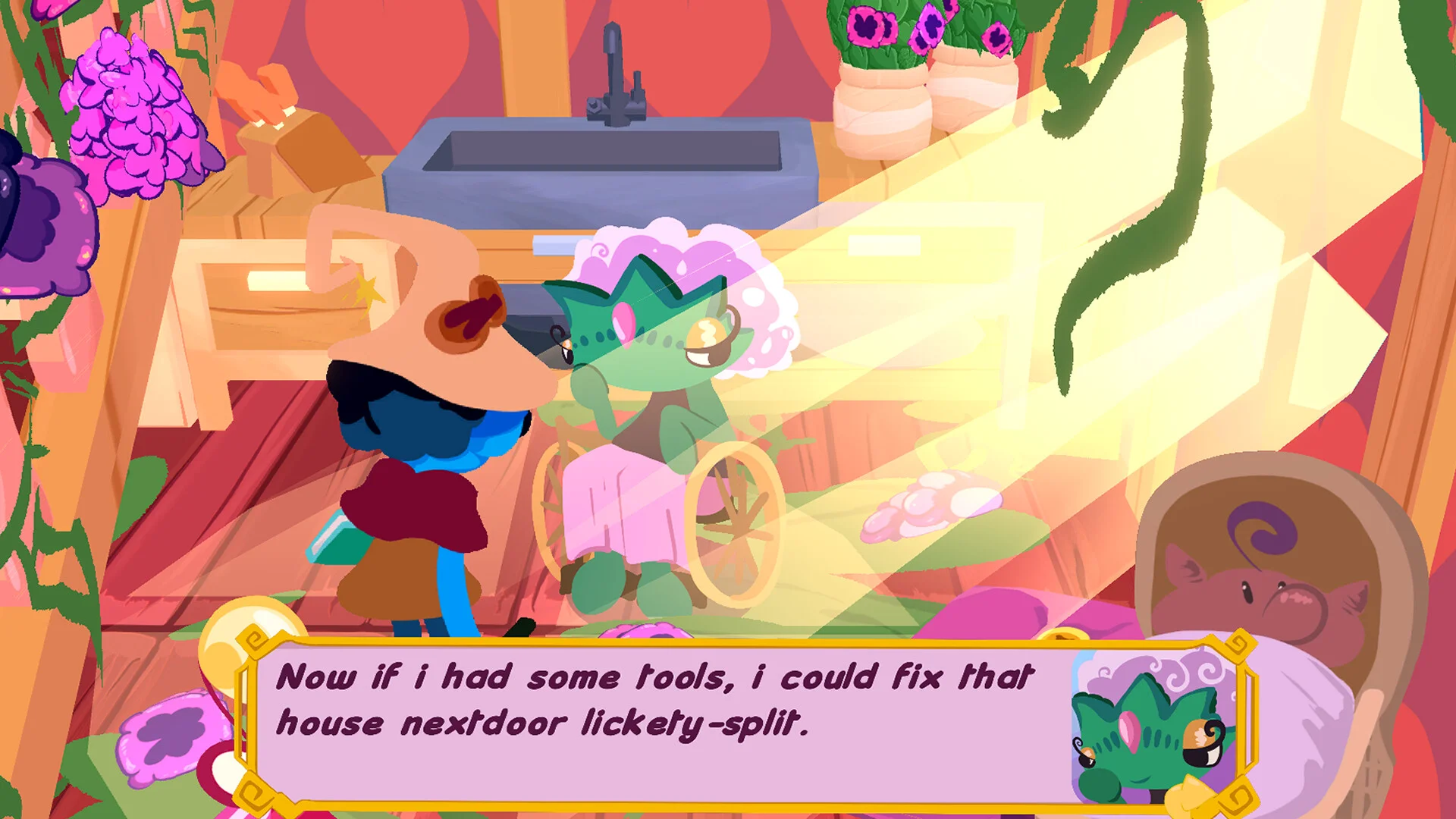
The physical controls introduce a separate difficulty. Eight-directional movement and limited adjustment in the air make precise traversal cumbersome, while restricted camera angles complicate distance judgments. Aiming can send a spell toward the wrong object.
Rune-assisted movement offers entertaining ways around awkward jumping, but the difficulty of expressing an intended action remains. The historical comparison becomes less comfortable here. Affection for a console period can make its framing and visual conventions welcome without making restricted movement equally appealing. Rhell’s imaginative flexibility frequently exceeds the precision available through its controls.
The 4:3 presentation remains a defensible aesthetic choice, particularly with the illustrated panels completing the composition, though the available widescreen option introduces presentation irregularities. More disruptive is the possibility of a collision knocking Rhell into another screen and clearing a carefully arranged group of summoned objects.
Individual objects can be removed and whole rooms reset quickly, which encourages another attempt when an experiment fails. An accidental departure creates a different burden. The player may already understand the solution and have assembled the machinery to perform it; after the collision, the task is to put those same objects back into place.
The Review
Rhell: Warped Worlds & Troubled Times
Rhell carries the welcoming visual language of Japanese console adventures into an inventive puzzle world where spells let players author their own routes. Its expanding rune vocabulary rewards curiosity, while environmental conditions give experimentation satisfying resistance. Awkward movement, unreliable targeting, and uncertainty about missing tools sometimes interrupt that pleasure. The strongest discoveries still feel personally earned, from turning a prison gate to building a staircase of self-replicating scarecrows.
PROS
- Flexible spellcraft supports inventive solutions.
- Environmental interactions reward careful observation.
- Playful presentation makes complex puzzles approachable.
- Fast travel and collectible tracking ease exploration.
CONS
- Movement, aiming, and camera restrictions impede precision.
- Missing-rune uncertainty can stall experimentation.
- Accidental screen transitions can erase prepared setups.