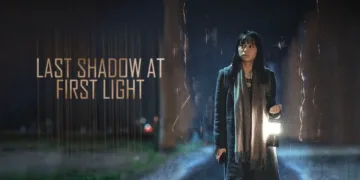
















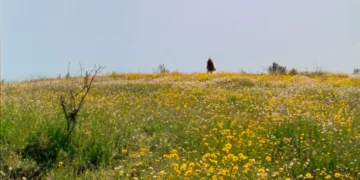










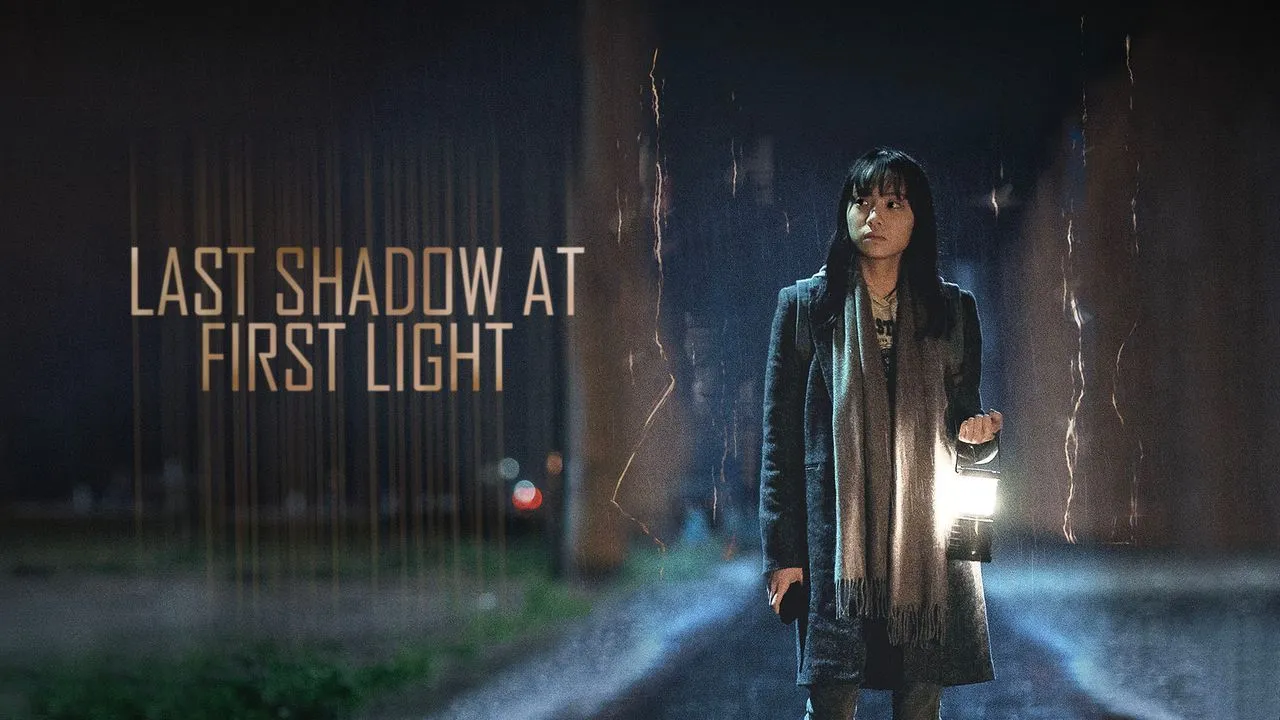

In Last Shadow at First Light, we meet Ami, a Singaporean adolescent dealing with the searing vacuum left by her mother’s strange absence. Apparently seeking answers, her journey leads her to post-2011 Tohoku, Japan, a place still scarred by the tsunami’s devastation.
The film incorporates this historical tragedy into its fabric, not just as a backdrop but as a haunting presence, a ghost in its own right. Director Nicole Midori Woodford shows the tsunami as an open wound. This living organism alters lives, memories, and landscapes rather than as an event with a specific date.
Ami’s pilgrimage takes her to her estranged uncle Isamu, a solitary man trapped in his grief. Here, the narrative begins to erode the distinction between reality and myth. The uncle’s quiet home transforms into a liminal realm where the mundane meets the uncanny, similar to Japanese yūrei films but without the horror elements.
Instead, these interactions are meditative, almost delicate, as if the spirits are unsure of their place in a world shaped by loss. This interplay between the visible and the unseen reflects how trauma persists: not always visible, but certainly present.
The plot’s subtle twists are based on moments of disclosure that feel more like whispers than shouts. A hauntingly ambiguous letter, a quick glimpse of a woman in the waves—each piece of the story feels purposefully empty, forcing the viewer to fill in the blanks. The film has already broken down conventional storytelling limits by the time Ami and Isamu face their shared history. It’s more of a mosaic of grief, connection, and the irresistible pull of the past than a chronological narrative.
The Living, the Lost, and the Liminal
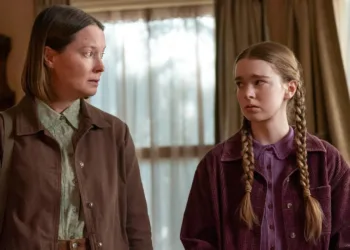
At first look, Ami appears to be the traditional quiet protagonist—a teenager plagued by grief but propelled by a tenacious quest to unravel the strands of her mother’s absence. On the other hand, Woodford constructs her grief with a particular that feels universal: the kind of sorrow that dwells in the shadowlands between yearning and resignation.
Ami’s journey is about more than just locating her mother; it’s about confronting the unfillable vacuum left behind (which, unfortunately, is both intensely personal and collectively resonant in the tsunami-ravaged Tohoku region). Her evolution is subtle, even annoyingly, as if the film wants us to realize that growth isn’t always linear or visible. By the end, she has been moderated rather than transformed, with her determination reshaped into a quiet resilience.
Isamu, on the other hand, is a compelling counterforce. Ami wants answers, whereas Isamu represents avoidance—grief crystallized into lethargy. He is a man who has withdrawn so far into his anguish that he has become almost ethereal, a figure more at ease among the dead than the living. His flaws are obvious (emotional unavailability, stoic detachment), but his presence is essential to Ami’s journey. Isamu does not so much guide Ami as reflect her potential destiny, providing a cautionary story of what occurs when loss is allowed to define a life.
The supernatural components, such as ghostly apparitions and unexplainable happenings, serve as manifestations of grief rather than literal hauntings. Are these sights genuine, or are they the product of a mind overwhelmed by absence? The film wisely refuses to respond, instead embracing uncertainty as a form of storytelling. In this way, the supernatural becomes an extension of Ami’s personality, a reminder that grief is its kind of ghost: ubiquitous, unshakeable, and very personal.
Echoes of Absence: Grief, Healing, and the Space Between
Light, Between Grief is a fog rather than a storm. It lingers, obscures, and disorients, enveloping the characters in unresolved trauma. The film’s depiction of loss is remarkably honest—there are no cathartic breakdowns or histrionic encounters with the past. Instead, grief is depicted as a quiet, consuming power that subtly shapes lives so that even the characters appear oblivious to its full influence.
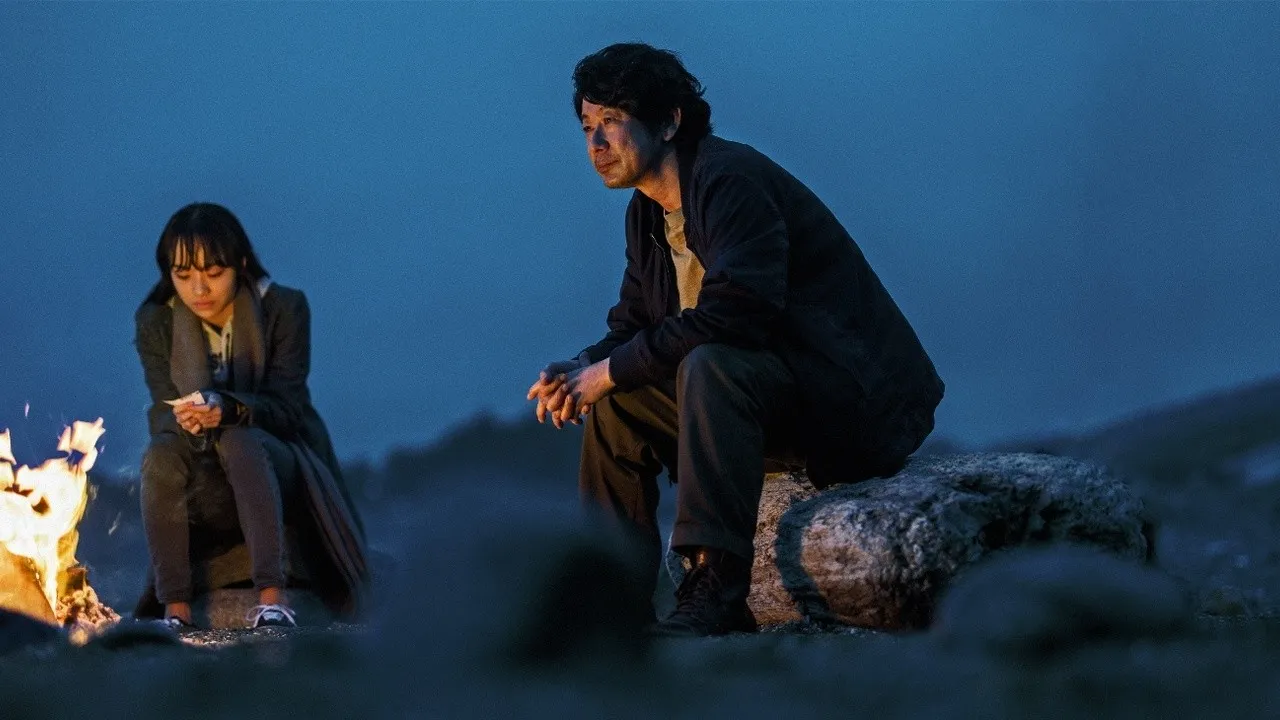
Ami’s search for her mother is literal and figurative, as she seeks closure in a world that offers none. Isamu, on the other hand, represents the long-term toll of trauma, his emotional isolation a quiet memorial to the lives swept away by the tsunami.
However, this is not a nihilistic film. Beneath its dismal tone is a thread of cautious hope that runs through its exploration of healing and communication. The end of the film implies—albeit hesitantly—that connection is the first step toward healing. Ami’s hesitant chats with Isamu, while stiff and frequently painful, are modest acts of defiance against the silence surrounding both of their lives.
Even the supernatural elements—those brief, ghostly encounters—can be interpreted as attempts at communication, a link between the living and the dead, memory and reality. In one particularly moving scene, Ami watches a spectral figure fade into the sea, a moment that feels less like a farewell and more like an acceptance that certain answers may never come.
The film’s themes strike a profound chord with the audience, not because they provide easy answers but because they reflect the intricacies of real-life grief. Who among us hasn’t felt the weight of unsaid words or the agony of an unfillable void? By refusing to tie its themes together neatly, the film compels us to sit with our discomfort, reflect on our losses, and the ways we seek (or avoid) healing. It’s both an emotional and intellectual experience, a reflection on the fragility and resilience of human connection.
Shadows in Motion: The Craft of Last Shadow at First Light
Nicole Midori Woodford approaches Last Shadow at First Light with deliberate arthouse sensibility that dares the audience to lean in—or risk missing out. Her directing is restrained, meditative, and sometimes almost maddeningly slow (maybe a deliberate choice to mirror the lazy, unrelenting weight of grief).
Woodford’s influences are clear, whether it’s the quiet existentialism of Japanese filmmakers like Kore-eda or the ghostly minimalism of Apichatpong Weerasethakul. Yet, she carves out a voice that feels uniquely her own. Her concentration is less on the spectacle of loss and more on its aftermath, the subtle ways death alters time, memory, and perception.
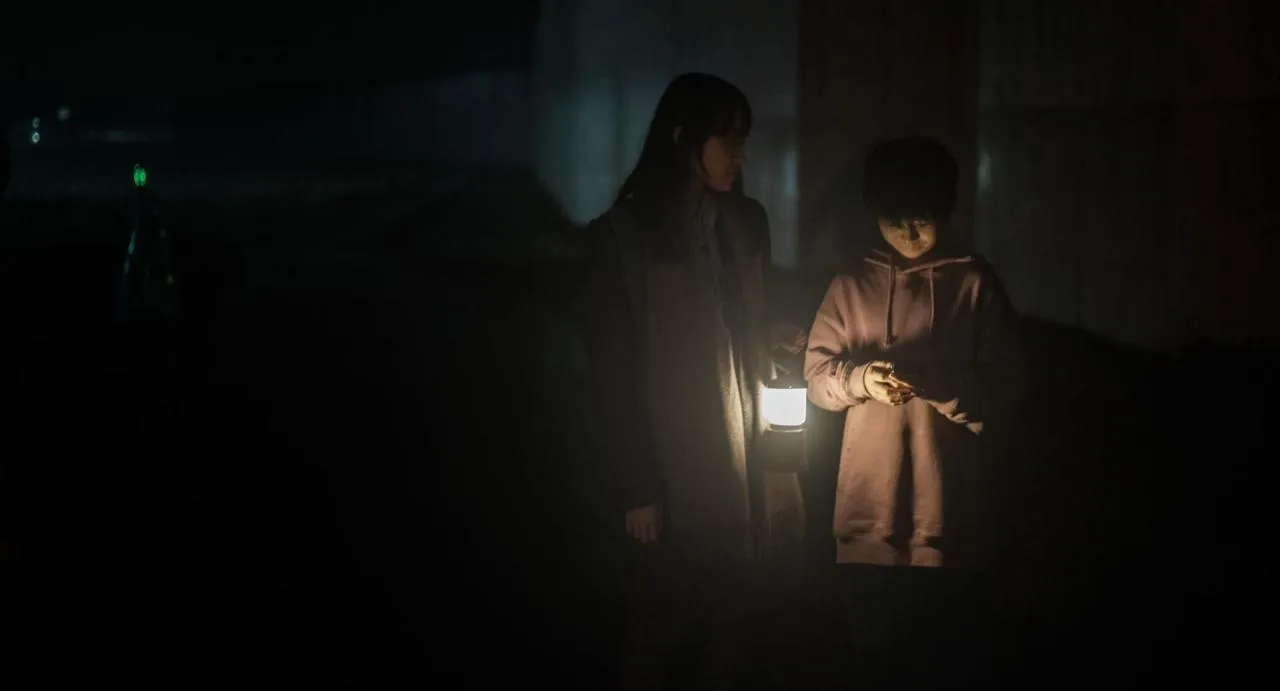
Visually, the film is a master study in understated storytelling. The muted palette—soft greys, desaturated blues, and an almost continuous curtain of cloudy skies—reflects the narrative’s emotional tone. Every frame feels meticulously constructed as if the camera era is grieving.
This dismal style is punctuated by repeating visual elements, including the boundless expanse of the ocean (equal parts cradle and cemetery), the fragility of paper cranes, and the interplay of shadows that appear to have their own lives. These visuals stay not because they demand attention but because they silently slip into the mind, much like the memories the characters seek.
The editing also contributes significantly to the film’s speed. The pacing is slow, almost languorous, which may challenge some viewers’ patience. However, this is not a film that rushes to make its point. The slow pace reflects how grief distorts time, stretching moments into eons.
Cutaways to minor, quiet details (a breath of wind, a flickering light) give the film a poetic ambiguity. If anything, these choices indicate that Woodford is more interested in conveying a feeling than in telling a story. Whether for better or worse, she succeeds.
Ghosts of the Wave: Cultural Reverberations in Last Shadow at First Light
The 2011 Tohoku tsunami lingers over Last Shadow at First Light like a phantom, its devastation influencing the physical landscape and the characters’ emotional geography. The disaster was a watershed moment in Japanese history, displacing nearly 450,000 people and leaving indelible marks on the country’s collective consciousness.

Woodford does not sensationalize this tragedy; instead, she allows the aftermath to stew in the background, a quiet yet powerful force. The film conveys the persistent weight of such an event—how it permeates daily life, alters identities and priorities, and turns survivors into hesitant archivists of loss. In this way, the tsunami serves as a metaphor for personal grief, connecting Ami’s journey to a larger, national one.
The portrayal of Japanese culture is sophisticated and deeply respectful. From the precise folds of paper cranes to the rituals of remembrance, the film captures the subtle ways in which Japan negotiates with its ghosts (both literal and metaphorical). Woodford avoids exoticism, instead emphasizing the cultural significance of silence and restraint. Nonetheless, little human moments—a shared meal, a tentative conversation—are rendered globally relevant, emphasizing the shared language of loss.
As an international co-production, the film benefits from its cross-cultural DNA. While profoundly steeped in Japanese history and aesthetics, the themes of grief and healing transcend national borders. This global appeal broadens its impact by allowing audience members from various walks of life to reflect on how they grapple with absence. It’s a contradictory reminder that, while grief may feel isolated, it is conversely one of humanity’s most unifying feelings.
The Art of Stillness: Pacing as a Double-Edged Sword
The pacing of Last Shadow at First Light is deliberate—slow, steady, and almost invisible at times. This sluggish speed will surely test the patience of some viewers (the “when does something happen?” camp), but it feels fully deliberate.
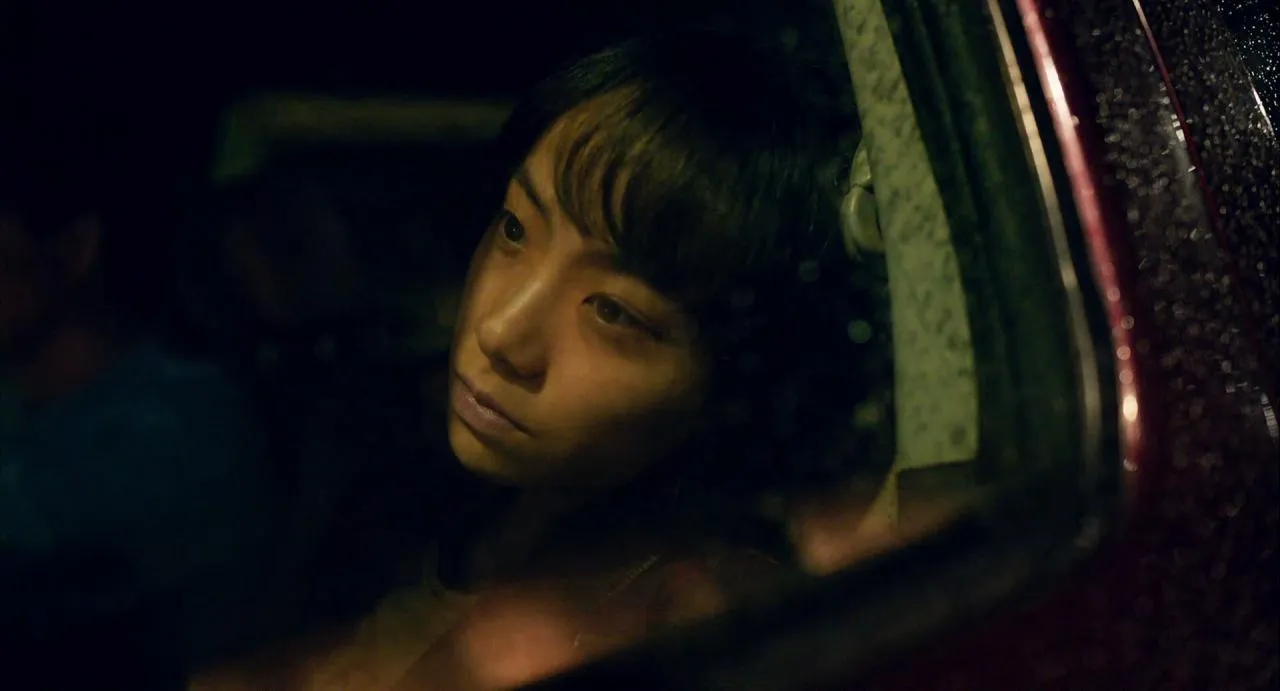
Woodford uses the film’s slow pace to reflect the lived experience of grief, in which time appears to stretch indefinitely and moments of clarity or resolve feel agonizingly rare. The narrative leans into this cadence, offering brief moments of tension—an unnerving encounter, a letter fragment—before returning to its meditative silence. It’s a film that ebbs and flows rather than builds to a climax, much like grief.
This strategy has a polarizing influence on viewer engagement. The absence of standard narrative momentum might feel like being lost at sea with no horizon in sight for some, so the slow pace may be alienating. But the film offers rewards—small, dazzling epiphanies hidden inside its stillness—to those willing to endure its quiet demands. It’s a cinematic litmus test: impatient viewers may leave, but the patient will be absorbed in an emotional current long after the titles roll. This film asks you to sit with it, sometimes awkwardly, but on purpose.
Ripples Beyond the Screen: A Lingering Reflection
Last Shadow at First Light is a film thrives on subtlety, weaving its exploration of grief, memory, and connection via a tapestry of restrained performances, evocative visuals, and a tempo that dares the audience to slow down.
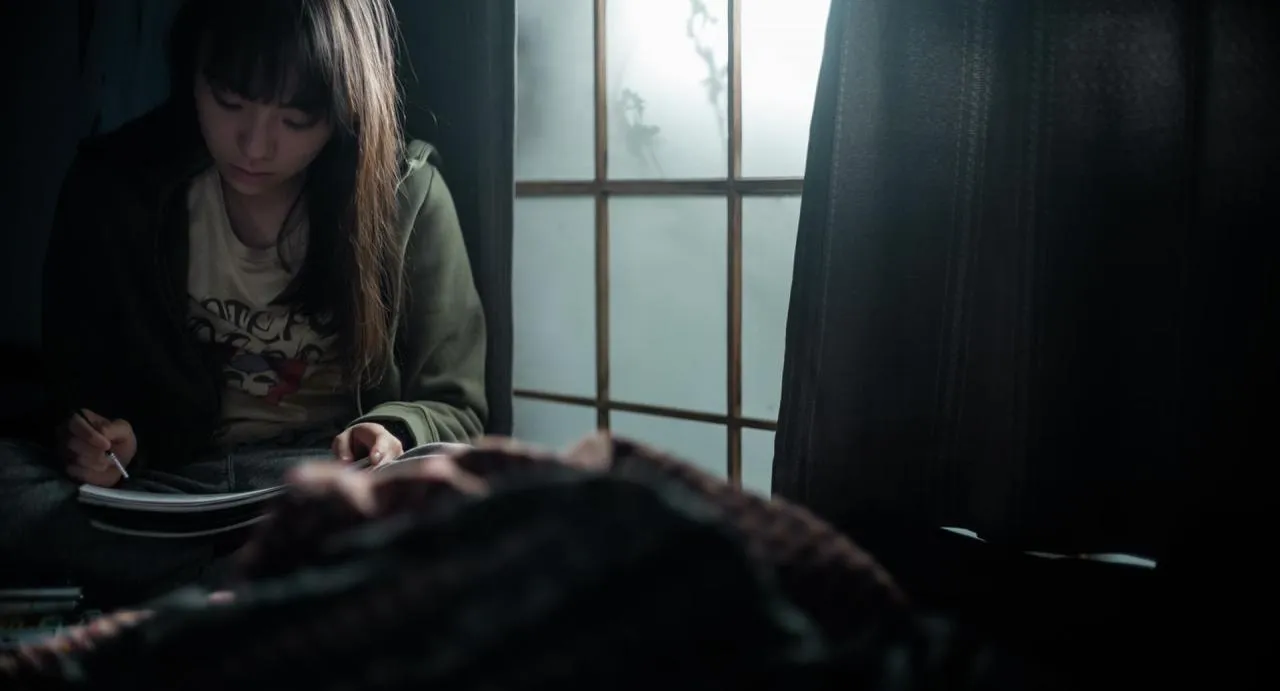
Nicole Midori Woodford’s deliberate directing, combined with its thematic depth—from the haunting aftermath of the 2011 Tohoku tsunami to the universal anguish of unresolved loss—makes for a cinematic experience that is as much about feeling as it is about comprehending.
This is not a film for casual viewers or those seeking neat endings. It is intended for the patient, the reflective, and possibly those who have experienced what it is like to sit with the quiet weight of absence. For them, this film will linger—like the tide or a shadow at first light.
The Review
Last Shadow at First Light
Last Shadow at First Light is a meditative exploration of grief, memory, and the eerie echoes of loss that blends restrained storytelling with powerful visuals. While its slow pacing may turn off some, the film rewards those willing to sit with its quiet intensity. Nicole Midori Woodford tells a highly personal but widely relevant story rich in cultural depth and emotional uncertainty. It's a cinematic poem, at times painfully obtuse yet undoubtedly moving. This film offers a meaningful, if hard, experience for viewers seeking depth over spectacle.
PROS
- Thoughtful exploration of grief and trauma
- Evocative cinematography and visual symbolism
- Nuanced portrayal of Japanese culture and rituals
- Subtle supernatural elements that enhance emotional depth
- Themes and pacing that reward patient and introspective viewers
CONS
- Extremely slow pace may alienate some audiences
- Ambiguity in storytelling may feel frustrating or unresolved
- Limited appeal for viewers seeking traditional narrative structure