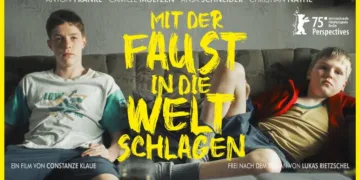













A pair of youths—bare-chested, bikes in tow—slip into the placid waters of an abandoned quarry, sunlight dancing on their heads like a cheap promise. It’s a moment of pure wonder (and mild peril), a child’s Olympus hidden amid crumbling industry.
Set in East Saxony, 2006, Punching the World follows 12‑year‑old Philipp and his nine‑year‑old brother Tobi as they navigate the pitfalls of post‑reunification malaise. Their family’s half‑built house stands as monument and millstone: hope and hubris cohabiting under a leaking roof.
The tone flirts with pastoral lullabies—soft pastels, lazy camera pans—until unseen fractures begin to hiss. What felt like a carefree country idyll reveals itself as a “ruinscape” (my coinage), where broken dreams lie just beneath the surface.
Adapted from Lukas Rietzschel’s novel by first‑timer Constanze Klaue, the film marries intimate sibling dynamics with wider cultural tremors. A debut that bears the scars of its setting, Klaue’s lens asks why economic collapse often seeds social collapse.
This is more than a childhood story; it’s an inquiry into how boredom and neglect sow darker impulses. And, yes, there’s a dry laugh to be had when your toilet is a plastic bucket in the garden—precisely the kind of detail that lingers long after the credits roll.
Echoes of Collapse and Quiet Rebellion
The landscape of post‑reunification East Saxony feels less like a setting and more like a silent protagonist—an economy in freefall, its factories shuttered like empty cathedrals, farms surrendering to weeds. (Here, unemployment isn’t a statistic; it’s a lingering ache in every unlit storefront.)
Physical decay is everywhere. The boys’ favorite swimming hole, an abandoned quarry, shimmers with muddy allure—a “ruin oasis,” perhaps. Their half‑built family home stands half‑proud, half‑shamed: bricks piled in hopeful chaos, a monument to dreams interrupted by invisible creditors.
In this cultural vacuum, boredom morphs into resentment. Idle hands, as the proverb goes, become inscrutable impulses. The scarce prospects—no summer jobs, no youth centers—create fertile ground for misplaced loyalties. It’s not petty vandalism when a farmhouse is defaced: it’s a cry in paint, an amateur’s protest.
Tensions simmer beneath polite greetings. The local Sorbian community—West Slavic, long woven into the region’s tapestry—becomes an unwitting scapegoat. Even the plumbers, dispatched from across the Polish border, are whispered about with thinly veiled hostility. One senses that prejudice here is less ideology than a reflex born from despair.
Though most action unfolds in 2006, Klaue grants us a six‑minute 2015 epilogue, a temporal jolt. The refugee influx under Merkel’s “We can do it” doctrine appears like history bearing down on memory—unexpected, unwelcome, unavoidable.
Symbolism thrives in the film’s environments. That unfinished house is no mere backdrop; it’s the yin to the region’s yang—a fractured dream made manifest. And when the camera drifts through sun‑dappled forests or across still lakes, the contrast is almost cruel: nature’s beauty against human neglect.
It’s easy to forget that this bucolic “ruin chic” exists in tandem with political tremors—until the next stone is thrown.
Faces of Fracture: Characters & Performances
Philipp bears the mantle of eldest like a too‑heavy cloak. Thrust into unpaid caregiving (a kind of “kin‑shock”), he evolves from curious explorer—poking around abandoned quarries—to reluctant protector, and finally to a boy seduced by the promise of belonging. Franke’s performance pivots on tiny gestures: a clenched jaw, a sideways glance when Menzel whispers hateful slogans. In him, you see the force of responsibility morphing into an unsettling appetite for power.

Tobi is poetry in motion—wide‑eyed, dreamy (“One day I’ll live in a skyscraper,” he declares, half in earnest, half in protest). Moltzen captures that fragile idealism. Yet this innocence cracks when Tobi witnesses violence: admiration curdles into fear. His shifting gaze reminds us how quickly awe can calcify into trauma.
Stefan (Christian Näthe) is a study in wounded pride: once a craftsman, now an outcast, numbing himself with alcohol and an affair that feels as messy as a half‑wired circuit. Näthe renders him both pitiable and, at times, vaguely threatening. Sabine (Anja Schneider), by contrast, is stoic to the verge of mythic—nurse, breadwinner, emotional firewall. Her sacrifices flicker across Schneider’s face: fatigue etched into every line.
Uwe (Meinhard Neumann) drifts in like a specter of the Stasi past—his presence an omen of communal despair. Neumann’s haunted eyes are ruin incarnate. Menzel (Johannes Scheidweiler) is charisma distilled into a leather vest and sneering grin, a proto‑Nazi pied piper whose allure underscores how easily power‑vacuum breeds predators. Surrounding them, schoolmates and neighbors form an ambient chorus: whispers that swell into collective disdain.
Each performance stitches personal tragedy into broader social collapse—proof that these characters are less individuals than avatars of a fractured moment.
Fractured Innocence: The Arc to Extremism
Childhood in Punching the World feels like a slow‑burn prank: boys turning empty barns into obstacle courses, stealing apples from overgrown orchards, daring one another into the muddy quarry. In these “idle‑time raves” (my term for boredom‑fueled adventures), Philipp and Tobi forge a bond that’s equal parts tender and competitive—who can hold their breath longest underwater, who can dare the scariest jump.

Then comes Menzel. He isn’t the boogeyman, just a kid with swagger and a leather jacket. When Philipp first trails behind him, you sense the lure of strength in a place where power is as scarce as summer jobs. A shattered milk factory becomes the backdrop for vandalism that feels almost innocent—until stones break windows marked “refugees Welcome?” and suddenly play morphs into prejudice.
Boredom plus a craving for belonging plus a father’s absence equals a chemical reaction.
No lab coat required.
The film dissects these mechanisms coldly: unmoored youth seek anchors wherever they can find them. “Not us” becomes the slogan, branded onto every target from migrants to Slavs to anyone who speaks with an accent. It’s tribalism by default, a default that rarely defaults back.
Philipp’s inner life clenches and unclenches like a fist. On one side: family rituals—bike rides, shared ice creams—that promise normalcy. On the other: the adrenaline of group chants, the thrill of defacement. He oscillates between protector and perpetrator, and his conflict is rendered in close‑ups so tight you feel his chest compress. Meanwhile, Tobi watches, half‑consoled by childhood’s afterglow, half‑terrified by the brother he thought he knew.
A sudden leap to 2015 snaps the frame. Philipp and Tobi stand at different perches—one watching refugee buses arrive, the other turning away. It’s brief. But in that echo, you hear how youthful fractures can echo through a decade, shaping lives and fueling debates far beyond a quiet Saxon town.
Fractured Frames and Haunting Harmonies
Florian Brückner’s lens bathes the film in a pastel palette—think watercolors left out in the sun until they faint (a kind of “pastoral disquiet,” if you will). Early scenes glow with soft lighting, only to betray that warmth when wide‑angle shots reveal crumbling façades. Then the camera pulls in tight: dirt‑smudged cheeks, hesitant smiles. Intimacy and decay share the same frame.

Production design doubles as character study. The half‑built family home could be an art installation, its exposed beams and dangling wires speaking volumes about broken promises. A playground scrawled with graffiti becomes a makeshift gallery of local angst. Lakes glitter—but you notice the oil slicks at the edges. School uniforms look threadbare; jackets are patched like old grievances. Such details feel lived‑in, not staged.
Musical cues arrive sparingly. PC Nacht’s two‑note piano motif—equal parts lullaby and alarm bell—slips beneath scenes like an uninvited guest. Ambient noises matter just as much: a creak upstairs, the distant hum of a derelict factory, crickets carrying on as if nothing has changed.
Editing mimics thought: elliptical cuts land you in one vignette, then poof—you’re somewhere else, much like a child’s wandering mind. And then, without warning, the film careens into its 2015 epilogue, jolting you from languid observation to the electric charge of history finally arriving.
Patchwork Pulse: Narrative Structure & Pacing
The film unfolds as a series of self‑contained vignettes—each scene a “mini‑monologue” in the brothers’ lives (my term for moments that speak volumes in isolation). These slices of childhood—family breakfasts, daredevil swims, secret meetings—stack up until they coalesce into something far weightier than the sum of their parts, balancing intimate drama with quiet social critique.

Midway, the tone pivots. What began as impressionistic wonder—sunlit fields and first thrills—hardens into pointed social realism. The emotional arc crescendos in tandem with Philipp and Tobi’s diverging paths: one brother stepping toward belonging in antiseptic hate, the other recoiling into fear.
Then comes the temporal jolt: a leap from 2006 to 2015. It’s a rhetorical device (“history’s splash‑cut,” perhaps) that underlines long‑term fallout—refugee buses replacing bicycles. One wonders: does this epilogue land with earned gravity or with the abruptness of a dropped stone? Either way, its shock reminds us that time, like trauma, refuses to flow in neat, predictable channels.
Fractured Bonds and Lingering Echoes
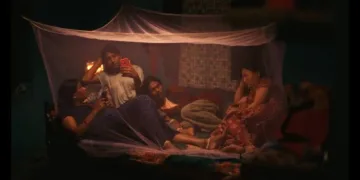
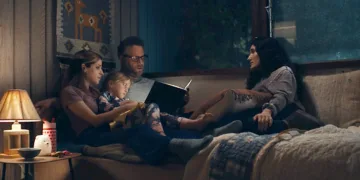
The Zschornack household is a study in parental absence: Stefan’s bruised pride and Sabine’s exhaustion leave two boys holding the pieces. Their resilience emerges in fleeting vignettes—bicycle rides through sunflower fields, lakeside cannonballs that feel like makeshift baptism (DIY therapy, anyone?). Yet each tender moment is scored by unspoken loss, as if every laugh registers as a small surrender to the void left by unmet dreams.

Belonging is the film’s heartbeat. Here, community isn’t a given but a scavenger hunt. Philipp flirts with Menzel’s band of outsiders in search of camaraderie, while Tobi clings to sibling rituals as a lifeline. Blood‑family ties ripple uneasily against the magnetic pull of ideology; the film sketches “home” not as a roof but as whatever fills the emptiness—whether that’s a brother’s arm or a neon‑spray swastika.
Economic decay and social isolation act as the fertilizer for radicalization. Boredom becomes combustible; charismatic peers like Menzel sow hate under the guise of strength (the ultimate bait‑and‑switch). It’s unsettling how structural forces can choreograph personal downfall, yet Klaue resists creating a didactic formula—she acknowledges that extremism admits no single recipe.
The half‑finished house stands as an epitaph to lost GDR promises, its unfinished beams echoing childhood scars. Memory here is both refuge and trap: the past haunts like a half‑heard lullaby. Whether those early wounds inevitably shape adult convictions remains tantalizingly ambiguous (hope and cynicism waltz together).
Today’s headlines—migration flashpoints, youth disenchantment, the rise of fringe movements—find their mirror in this microcosm. Punching the World filters universal coming‑of‑age truths through the lens of a fractured moment, suggesting that tomorrow’s debates are often seeded in yesterday’s ruins.
Full Credits
Director: Constanze Klaue
Writers: Constanze Klaue (screenplay), Lukas Rietzschel (novel)
Producers: Alexander Wadouh, Gabriele Simon, Roxana Richters, Martin Heisler
Cast: Anton Franke (Philipp Zschornack), Camille Moltzen (Tobi Zschornack), Anja Schneider (Sabine Zschornack), Christian Näthe (Stefan Zschornack), Sammy Scheuritzel (Philipp, older), Tilmann Döbler (Tobi, older), Johannes Scheidweiler (Menzel), Moritz Hoyer (Ramon), Meinhard Neumann (Uwe), Steffi Kühnert (Mrs. Wenzer)
Director of Photography (Cinematographer): Florian Brückner
Editors: Emma Alice Gräf, Andreas Wodraschke
Composer: PC Nackt
The Review
Punching the World
Punching the World offers an intimate portrait of childhood’s fragility amid societal collapse, blending poetic moments with harsh social critique. Constanze Klaue’s debut wields symbolism and subtle performances to sketch how small disappointments spiral into darker impulses. While its temporal leap feels abrupt, the film lingers as a cautionary study of belonging, memory, and unspoken wounds.
PROS
- Evocative cinematography that contrasts idyllic landscapes with decay
- Authentic child’s‑eye perspective that deepens emotional impact
- Subtle yet powerful performances, especially from Anton Franke and Camille Moltzen
- Rich thematic exploration of alienation, belonging, and radicalization
- Immersive sound design and score that underscore mood shifts
CONS
- The 2015 epilogue can feel abrupt and undercooked
- Narrative momentum falters in the second half
- Some secondary figures lack sufficient development
- Symbolism occasionally tips into heavy‑handedness