

















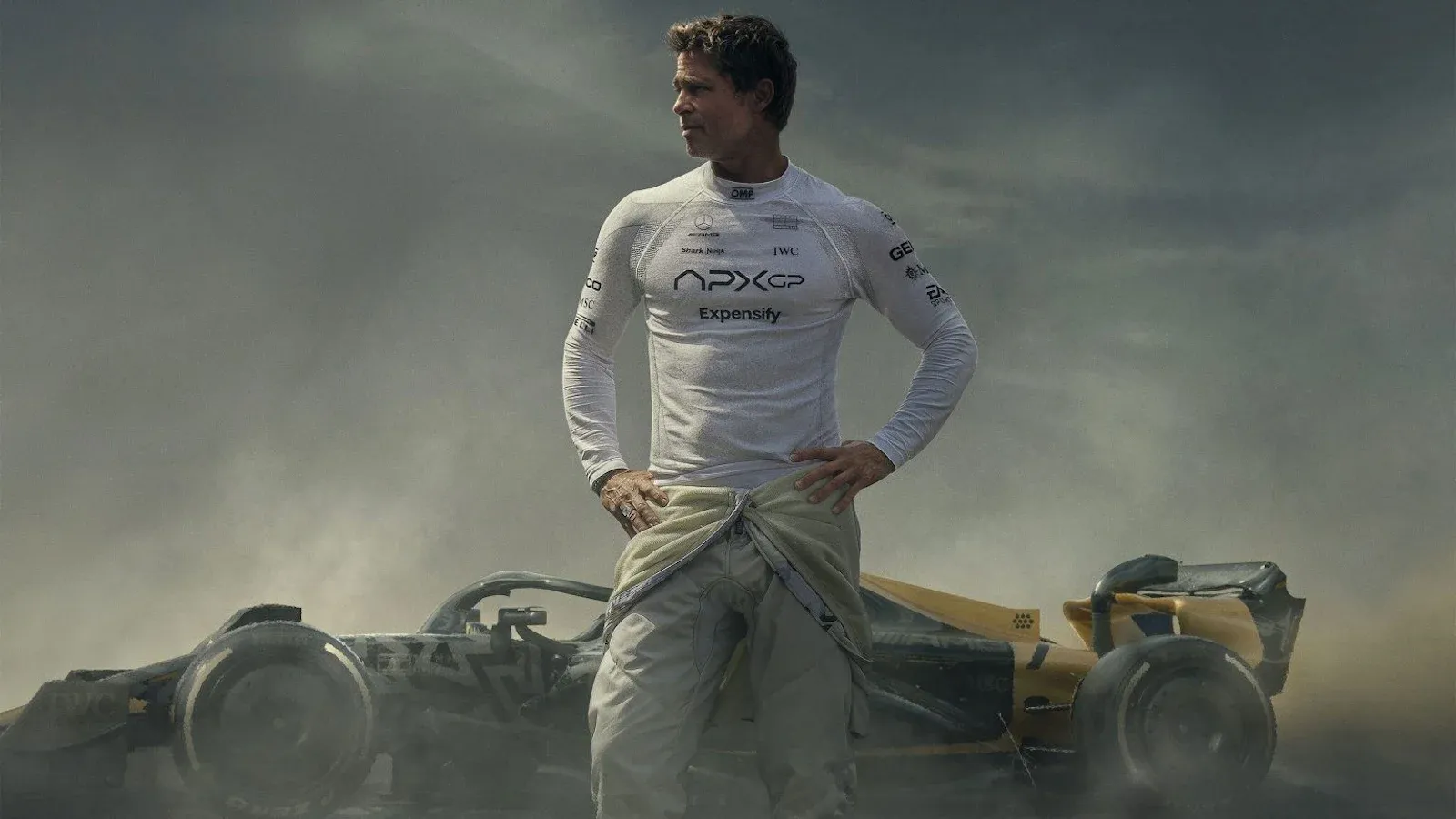

Formula One is a paradox of refined brutality. It is the scream of an engine calibrated to a microsecond, the scent of atomized tire rubber hanging in the air like a chemical threat, and the crushing G-force that turns the human body into a mere component of the machine. Joseph Kosinski’s film attempts to bottle this hyper-reality, presenting the sport with an almost fetishistic dedication to authenticity.
Into this world of bleeding-edge technology steps Sonny Hayes, a ghost from the sport’s more analog era. Played by Brad Pitt with the weary charisma of a man who has outlived his own legend, Sonny was a 90s phenom until a spectacular crash sent him into a long exile of lower-league races and personal demons. He is a walking relic, a master of intuition in an age of data.
Then comes the inciting event, a plot point straight from the playbook of classic Hollywood redemption tales. Sonny’s old friend, Ruben Cervantes, now the beleaguered owner of a flailing F1 team, offers him an impossible return. He is asked to mentor the team’s star driver, the young and brazenly confident Joshua Pearce. The proposition places the old guard directly in conflict with the new, setting the stage for a story about whether pure, unquantifiable talent can still find its line in a world governed by algorithms.
Portraits in the Paddock
Brad Pitt’s Sonny Hayes is less a character and more a piece of living mythology, a gunslinger archetype airlifted into the age of carbon fiber. He operates on a “feel” for the machine that borders on the telepathic, a trait the film presents as both a gift and a curse in a world demanding quantifiable metrics.
Pitt does not so much act the part as he radiates it; his performance is a masterclass in the deployment of that endangered species of movie-star charisma, a quiet authority that makes the well-worn narrative of the down-and-out veteran feel almost profound. (A performance that suggests true cool is not about being young, but about having survived being young.)
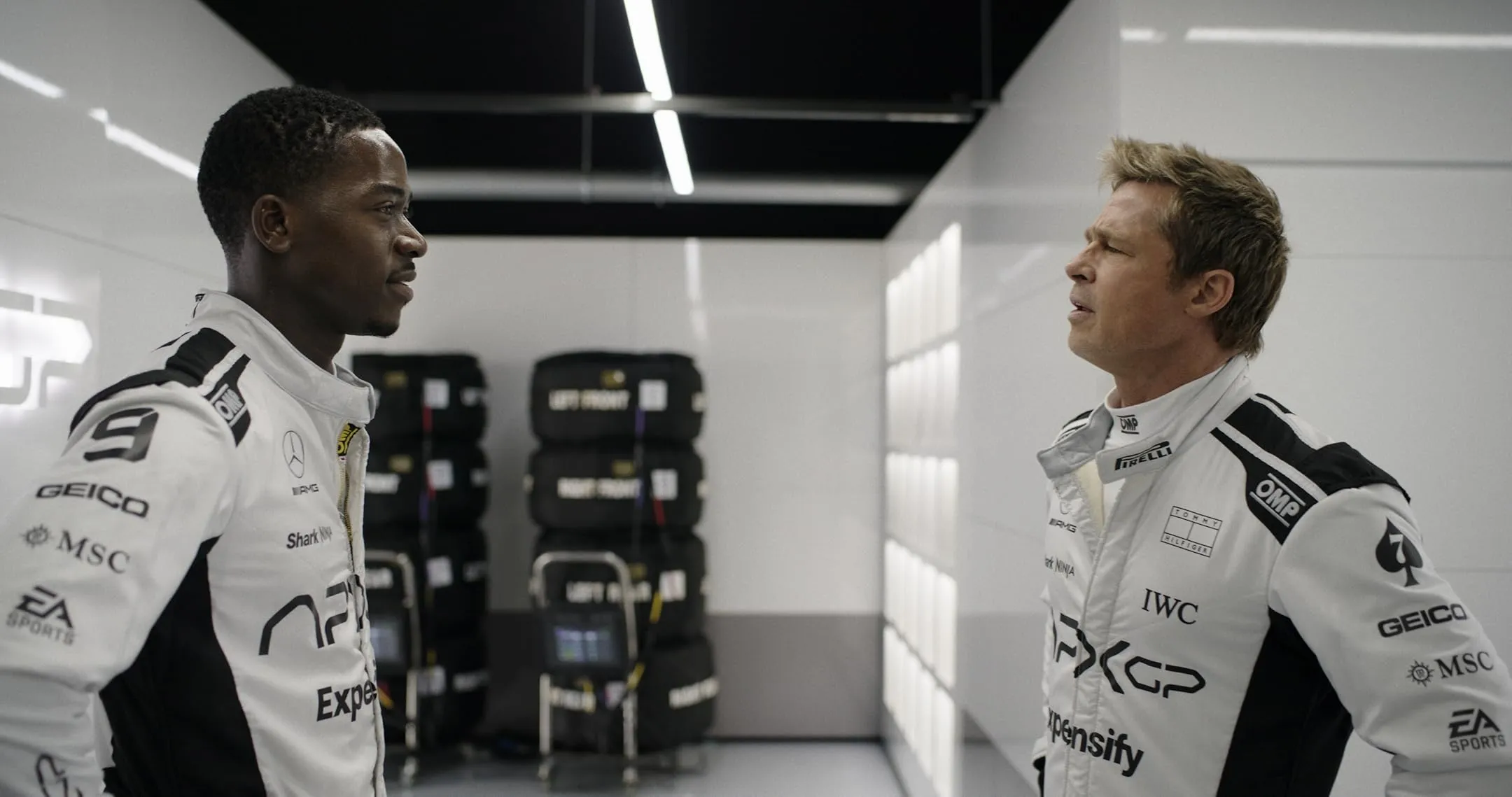
In the opposite corner stands Joshua Pearce, a driver who seems bio-engineered in a simulator. Damson Idris gives him the brittle confidence of the modern celebrity-athlete, a man whose identity is inextricably linked with his brand. His initial dismissiveness of Sonny is the logical posture of a system that believes it has rendered history obsolete. The performance finds its footing when Idris allows the anxiety to seep through—the private terror of a man whose flawless public image is one bad race away from ruin.
Their relationship is therefore a negotiation between two competing American fictions: the lone maverick and the optimized corporate asset. The film wants us to believe in their eventual truce, a neat handshake between gut instinct and graphical analysis. It is the story’s emotional anchor, a carefully managed détente between two philosophies that, outside the tidy confines of a screenplay, might never truly reconcile.
The supporting players represent the world that must manage these forces. Javier Bardem’s team owner is the face of anxious capital, needing both the legend and the brand to keep his enterprise from collapsing. It is Kerry Condon’s technical director, Kate McKenna, who provides the film’s pragmatic center. A figure of sharp, unadorned competence, she serves as the essential translator between Sonny’s mechanical poetry and the hard prose of telemetry. Her scenes with Pitt crackle with the energy of two equals engaged in the serious business of their work.
Engineered Ecstasy
Joseph Kosinski directs with the sleek, metallic precision of the machines he venerates. His aesthetic is a kind of high-gloss brutalism, a style that found its wings with fighter jets and now seeks to consecrate the Formula One car. The stated goal is authenticity, a desire to strap the audience into the cockpit so tightly that they feel the engine vibrations in their teeth. It is a quest for a specific kind of truth, the physical truth of extreme velocity, divorced from any messy human context that might slow it down.
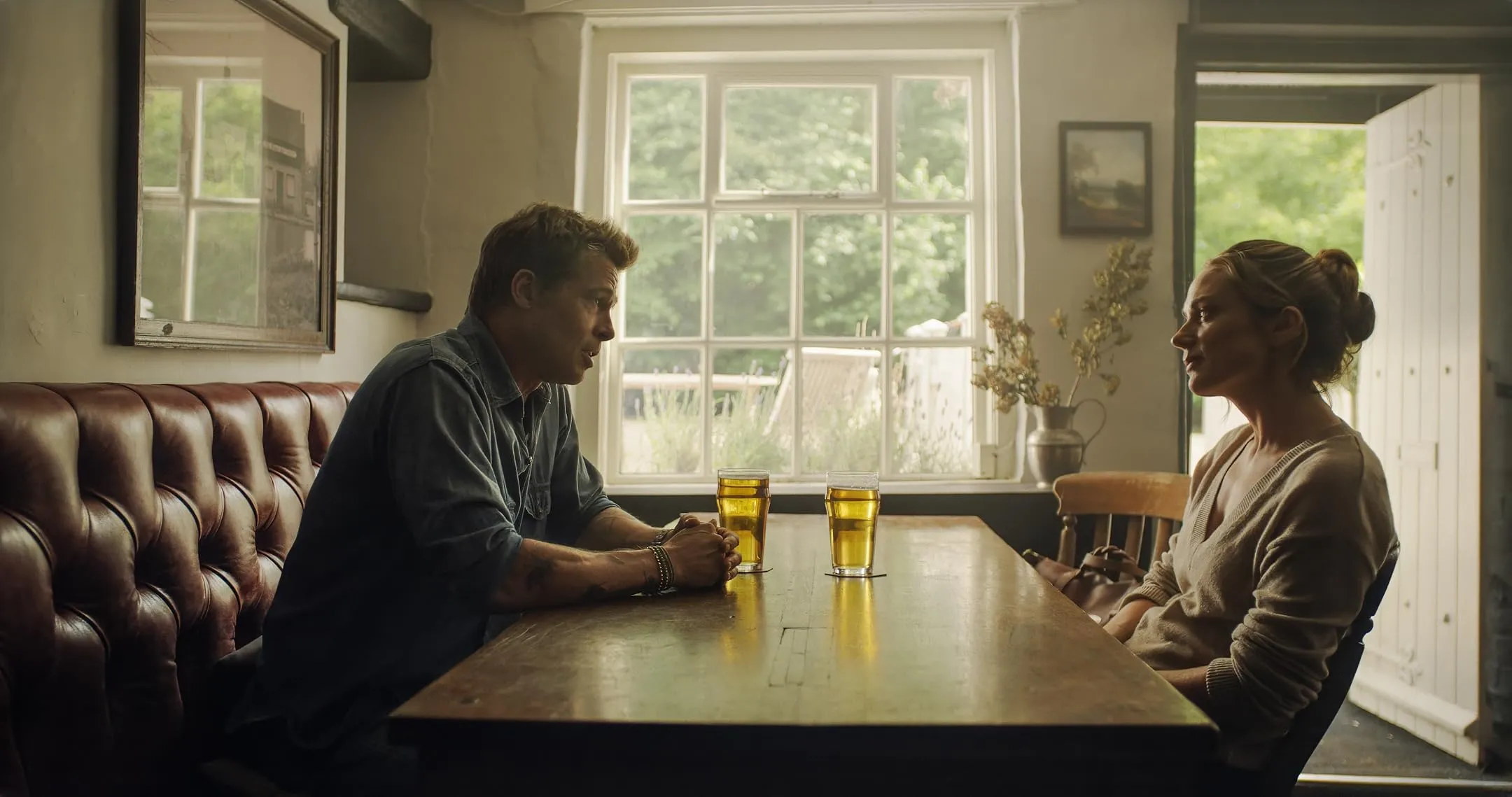
The execution of this vision falls to cinematographer Claudio Miranda, who wages a brilliant campaign of optical invasion. Custom-built cameras are embedded within the chassis, peering over shoulders and staring back at the driver’s face, creating a state of techno-claustrophobia.
The decision to film at actual Grand Prix events, with the film’s fictional team occupying a real garage, represents a fascinating collapse of fiction into reality. The movie ceases to be a depiction of a spectacle and instead becomes a participant within it, a branded entity racing alongside Ferrari and Mercedes. This is not realism; it is a form of hyper-realism, a slickly produced documentary of its own making.
This footage is then weaponized by the edit. Stephen Mirrione’s cutting is a study in controlled chaos, a rhythmic assault that finds as much tension in the frantic, three-second ballet of a pit stop as it does in a 200-mph straightaway. The sound design is not an accompaniment; it is the main event.
The engine’s shriek is an oppressive, all-consuming force, a physical presence in the auditorium. Upon this mechanical foundation, Hans Zimmer lays a score of his signature propulsive chords, a layer of emotional engineering designed to tell you precisely how to feel about the beautiful, deafening noise.
This is not a film to be watched. It is a film to be endured, a physical proposition. It is an argument for the theatrical experience made through sheer sensory overload, an assertion that some spectacles are too large, too loud, and too overwhelming for the quiet privacy of a living room.
A Mythology in Three Acts
If the film’s technical aspects represent a leap into the future, its narrative skeleton is a proud relic of the past. Let us be clear: the story here follows the sports movie blueprint with an almost religious devotion. All the sacred stations are observed: the fallen hero, the arrogant youth, the initial conflict, the montage of grudging respect, the late-act setback, and the final, winner-take-all contest. There are no surprises on this track. The pleasure is not in the shock of the new, but in the comfort of a ritual perfectly performed. It is a cinematic liturgy we know by heart.
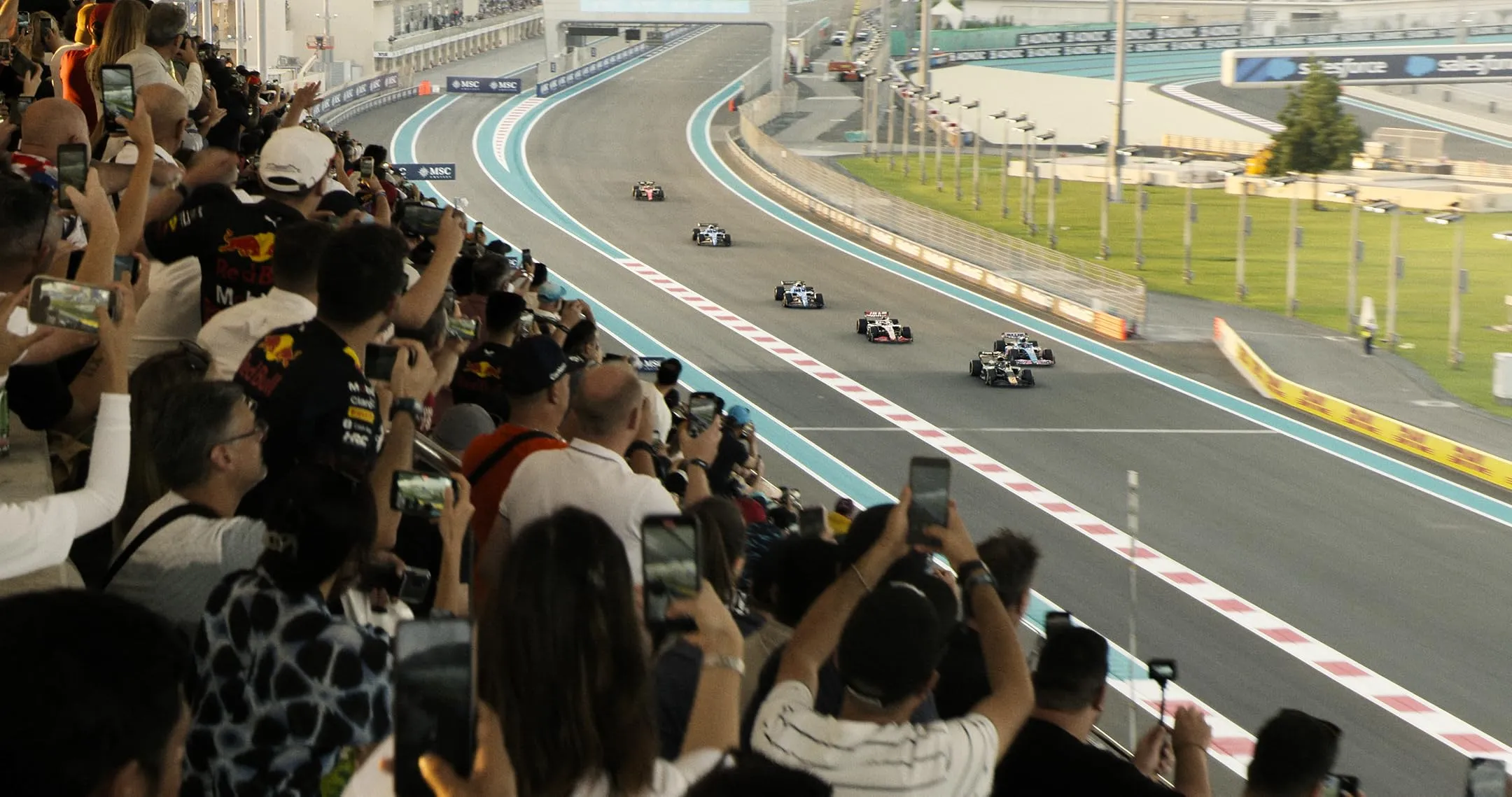
The screenplay functions accordingly. Dialogue is often stripped of subtext, serving as direct declarations of intent or backstory. Characters explain their motivations with a clunky sincerity that borders on the presentational. (Subversion is, after all, exhausting, and this film has no time for it.)
The script is not interested in the messy ambiguities of real life; it is a clean machine for delivering plot, a functional device built to support a much grander structure. It does not aim for poetry. It aims for clarity, and in that, it succeeds completely.
This narrative conservatism is, perhaps, the film’s shrewdest decision. By bolting the story to such a familiar and sturdy chassis, the filmmakers are freed to pour every resource into the elements that truly matter here: the overwhelming sensory experience and the potent character dynamics.
The simple story becomes a vessel, a deceptively plain container for the explosive chemistry of its visuals, sounds, and stars. The film makes a quiet argument that reinventing the wheel is pointless when your true goal is simply to make it spin faster and more beautifully than anyone has ever seen before.
The Last Lap’s Oversteer
For all its masterful engineering, the film suffers from a critical lack of narrative endurance. A runtime that exceeds two and a half hours is not, in itself, a flaw, but here it leads to a noticeable fatigue in the final act.
The sleek, efficient machine of the first 120 minutes begins to feel bloated, weighed down by scenes that circle the track one too many times. The film’s impeccable sense of pace, so evident in its ascendant phase, sputters when it should be accelerating toward a conclusion. It simply runs too long.
The most profound miscalculation, however, is the film’s inexplicable loss of faith in its own potent visual language. After laboring to place the viewer inside the suffocating cockpit, the movie repeatedly rips us out and places us on the sofa by employing a constant, maddening stream of broadcast-style commentary.
This narration relentlessly states the obvious, explaining on-track action that the visceral cinematography has already made perfectly clear. It is a profound failure of nerve, a concession that insults both the audience’s intelligence and the film’s own immersive achievements.
This crisis of confidence culminates in a clumsy final act. The nuanced internal conflicts are suddenly sidelined by the appearance of a generic, thinly-sketched rival, a last-minute villain introduced as if from a different, lesser movie.
Worse, the climax grinds to a halt to deliver a lecture on obscure regulations, a desperate bid to manufacture tension through exposition rather than action. The “flow state” the film worked so hard to achieve is broken. In its closing moments, a movie that celebrated instinct and feel becomes bafflingly preoccupied with explaining the fine print.
“F1: The Movie” is an upcoming sports drama film that is scheduled to be released in theaters internationally on June 25, 2025, and in North America on June 27, 2025. Following its theatrical run, the movie will be available for streaming on Apple TV+.
Full Credits
Director: Joseph Kosinski
Writers: Ehren Kruger
Producers and Executive Producers: Jerry Bruckheimer, Joseph Kosinski, Lewis Hamilton, Brad Pitt, Jeremy Kleiner, Dede Gardner, Chad Oman, Daniel Lupi
Cast: Brad Pitt, Damson Idris, Kerry Condon, Javier Bardem, Tobias Menzies, Kim Bodnia, Shea Whigham, Sarah Niles, Samson Kayo, Joseph Balderrama, Abdul Salis, Callie Cooke, Will Merrick, Lewis Hamilton, Max Verstappen, Charles Leclerc, Carlos Sainz Jr., George Russell, Sergio Pérez, Lando Norris, Oscar Piastri, Fernando Alonso, Pierre Gasly, Esteban Ocon, Valtteri Bottas, Nico Hülkenberg
Director of Photography (Cinematographer): Claudio Miranda
Editors: Stephen Mirrione
Composer: Hans Zimmer
The Review
F1: The Movie
A dazzling sensory apparatus bolted to a familiar, and ultimately wobbly, narrative chassis. It is a monumental piece of theatrical engineering that nearly outruns its own script, offering a physical experience so potent it almost makes you forgive the moments where its storytelling engine misfires. A genuine spectacle that demands to be seen on the largest screen possible, even as it stumbles just before the checkered flag.
PROS
- A technical marvel of visceral, immersive cinematography and sound.
- Strong central performances from Brad Pitt and Damson Idris.
- Authentic and thrilling on-track racing sequences.
- Mature, believable dynamic between Kerry Condon and Brad Pitt.
CONS
- Adheres strictly to a predictable and formulaic sports movie script.
- Excessive runtime leads to significant pacing issues in the final act.
- Intrusive broadcast-style narration detracts from the immersive experience.
- The climax feels clumsy and relies on a poorly developed antagonist.