
























![Kingdom Hearts Collection [I-III] Review](https://gazettely.com/wp-content/uploads/2026/10/Kingdom-Hearts-Collection-I-III-1-360x180.webp "Kingdom Hearts Collection [I-III] Review: KHII Holds Steady as Newer Entries Fluctuate 37")





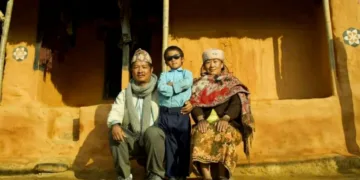
In the high, isolated altitudes of eastern Nepal, a village exists in a state of tranquil suspension, its lifeblood flowing through ancient traditions. Here, a family’s world is woven from the same bamboo that the patriarch, Maila, shapes into mats and baskets.
His life with his wife, Maili, and their young son, Bindre, is one of simple, rhythmic certainty. This fragile peace is shattered by the arrival of a road, a dusty scar carved into the mountainside. This is no mere path of gravel and dirt; it is a conduit for another world, a channel through which the future arrives with the force of an avalanche.
The road brings the rumble of a bus and the whispers of a city, introducing a promise of connection that quickly reveals itself as a threat. With this single line of infrastructure, the delicate threads holding a family and a community together begin to fray, posing a quiet, devastating question about what is lost when a world is irrevocably changed.
The Gospel of Glass and Plastic
The road does not merely connect two points on a map; it functions as a vector for a new and aggressive reality. It delivers objects that operate as idols for an age of consumption. Plastic tarps, shimmering with a cheap and soulless utility, appear in the local store, their presence rendering Maila’s intricate, breathable weavings suddenly worthless.
The skill in his hands, a knowledge passed through generations, is devalued to nothing by the sheer convenience of the manufactured. A bottle of Coca-Cola, that dark and carbonated nectar of globalism, becomes a sacrament of status, a tool for a small boy to exercise a new kind of power over his peers.
The television, with its hypnotic blue light, offers itself as a new hearth, one that radiates not communal warmth but the cold light of aspiration and envy. These are not just items of convenience. They are the artifacts of a different value system, one that measures a man’s worth by the novelty of his possessions.
This ideology of progress arrives without invitation, acting as a corrosive agent on the village’s social fabric. Community bonds, once predicated on mutual support and shared tradition, dissolve in this new atmosphere of individual acquisition.
A Family Under Pressure
The external pressures of this new world seep inward, finding their most potent and tragic expression in the family’s spiritual collapse. Maila, portrayed with a haunting quietude by Dayahang Rai, is a man hollowed out by his own obsolescence.

His journey from a proud artisan to a failed bootlegger is a slow, painful descent into a personal void. His inability to provide these new trinkets is not just an economic failure; it is an existential one, an erosion of his identity as a provider and a man. His shame is palpable, a silent weight in every scene. The chief agent of his crisis is his own son, Bindre.
The boy is a pure vessel for the desires of the modern world, his childish fascination transformed into a relentless force of demand that his father cannot possibly satisfy. Bindre is not malicious; he is a perfect, tragic mirror of the new values being imposed upon his world.
The once-tender relationship between father and son becomes a microcosm of the larger cultural conflict. It culminates in a single, shocking act of violence after Maila’s release from jail, a slap that signifies the breaking of a sacred bond under a weight too heavy for either to bear. It is the sound of a world cracking apart.
The Landscape of Change
The film’s technical craft deepens its philosophical inquiries, turning the environment itself into a silent commentator. The cinematography by Josh Herum sets the small, frantic human drama against the vast, impassive gaze of the Himalayas. These mountains are ancient and indifferent, their scale and permanence making the family’s struggle seem both profoundly tragic and cosmically insignificant.

They are silent witnesses to the folly below. Director Nabin Subba frequently juxtaposes the organic textures of the village—rough stone, woven bamboo, packed earth—with the smooth, alien surfaces of plastic and glass. This visual dissonance speaks volumes about the invasion of the artificial into the natural.
The camera moves from sweeping, god-like vistas to intimate, suffocating close-ups, mirroring the way a massive, impersonal force like modernization inflicts deep, personal wounds. In one potent image, Maila’s reflection in a still pond is shattered by a sudden disturbance, a perfect visual metaphor for his fractured selfhood. Subba’s deliberate, observational pacing is a choice of profound gravity. It refuses to offer easy moral judgments, forcing the viewer to simply watch as a way of life quietly, inexorably unravels.
A Road to a Village is a 2023 Nepali drama that explores the impact of modernization on traditional village life in the mountains of eastern Nepal. It premiered at the Toronto International Film Festival on September 7, 2023. The film has been praised by critics for its affecting storytelling and stunning visuals. The film had a limited theatrical release in the USA on June 21, 2024. It had a theatrical release in Nepal on June 7, 2024, and in the UK on July 25, 2025.
Full Credits
Director: Nabin Subba
Writers: Nabin Subba, Mahesh Rai
Producers and Executive Producers: Amod Rai
Cast: Dayahang Rai, Pashupati Rai, Prem Subba, Kulchandra Neupane, Prasan Rai, Raj Thapa
Director of Photography (Cinematographer): Josh Herum
Editors: Kwan Pung-Leung
Composer: Heidi Li
The Review
A Road to a Village
A Road to a Village is a visually stunning and philosophically resonant film that observes the slow, heartbreaking erosion of a traditional world. It functions as a quiet requiem for a way of life undone by the promises of modernity. While its deliberate pacing and bleak outlook demand patience, the film offers a profound and deeply humane meditation on the unseen costs of progress, capturing the universal tragedy of a man made obsolete by the very future he is meant to embrace.
PROS
- The film beautifully captures the majestic Nepalese landscape, using the environment to deepen its thematic weight.
- Dayahang Rai delivers a subtle and moving portrayal of Maila’s quiet desperation.
- The story offers a thoughtful and layered exploration of the conflict between tradition and modernization.
- Nabin Subba’s unhurried, observational style allows the emotional and social tensions to build with significant impact.
CONS
- The slow, methodical storytelling may feel sluggish to some viewers.
- The film occasionally revisits the same conflicts without advancing the plot, particularly regarding the family's arguments.
- Bindre’s persistent demands can feel one-note, making him more of a plot device than a fully developed character.







