














A certain kind of quiet settles over a life, much like the snow that blankets the small Maine town in In Transit. It is a quietude of acceptance, a stillness that can feel like peace or a slow suffocation. The film’s frozen landscape is a mirror, reflecting the suspended animation of its two central figures. We meet Lucy (Alex Sarrigeorgiou), a young woman tending bar, her days measured by a routine so steady it has become her identity.
Into this stasis walks Ilse (Jennifer Ehle), a painter of some renown, whose own life has stalled, her creative spirit chilled by a different kind of winter. When Ilse asks Lucy to sit for a portrait, the request is a stone dropped into still water. It is the beginning of a connection that will ask both women what it means to truly look at another, and what happens when that gaze is turned back upon oneself.
Geographies of Stagnation
The film’s power is rooted in its depiction of place as a psychological state. The spare visuals of snow-dusted forests and iced-over lakes are not mere backdrops; they are the external expression of an internal condition. Life in this town moves with the seasons, but winter holds a particular dominion, closing businesses and hushing the streets.
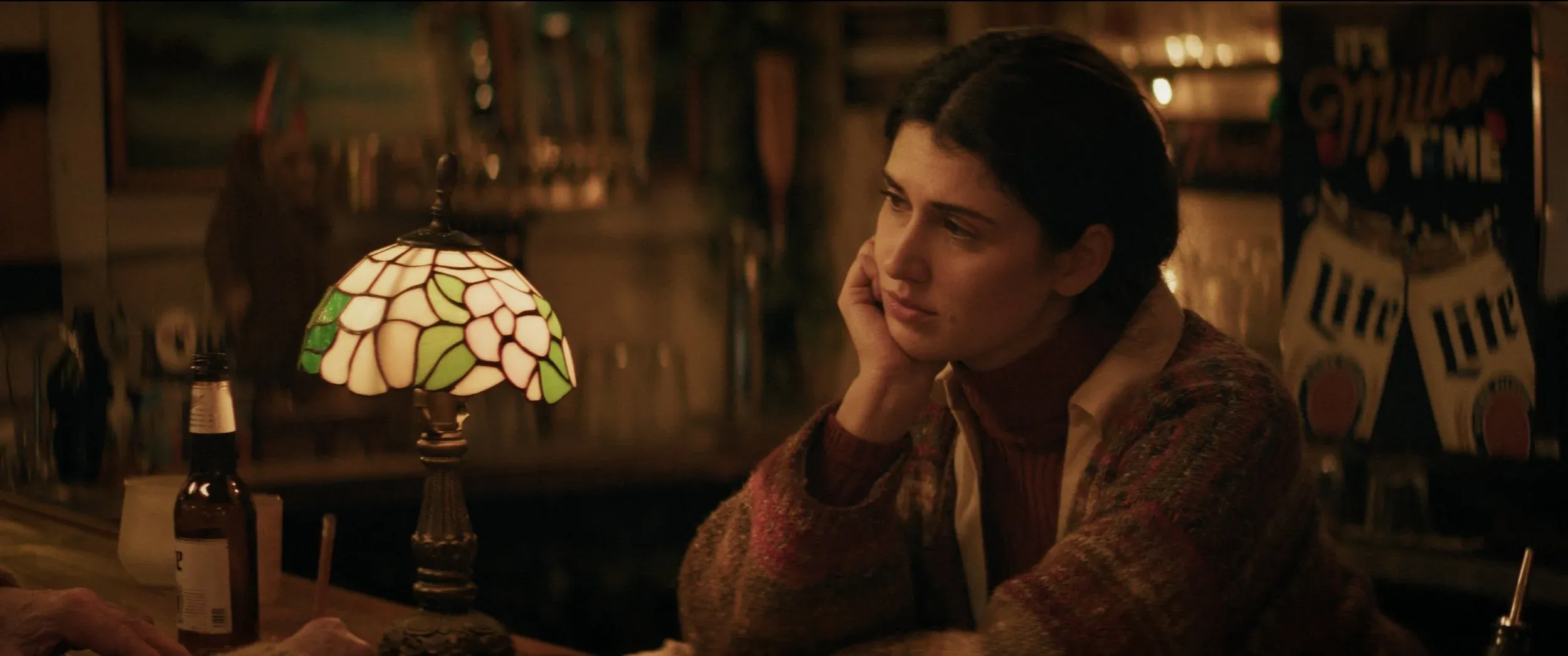
This enforced hibernation mirrors the characters’ own dormant ambitions. Lucy’s existence is defined by the familiar walls of the local bar, a place heavy with the memory of her father and the weight of unspoken expectations. Her movements are economical, her interactions with the few regulars a practiced ritual. She lives with her boyfriend, Tom (François Arnaud), in a home filled with a comfort that borders on complacency.
He dreams of buying the bar, of cementing their future in this town with a tangible investment. His plans are a blueprint for a life Lucy has not actively chosen, a future she accepts with a passivity that masks a deep, unexamined restlessness. Ilse arrives as a fugitive from her own life. Success has become a cage, her work stale and her reputation a burden.
Her retreat to this remote town is a search for an unfamiliar reflection, a way to break the impasse of a self she knows too well. She is a study in contained loneliness, her worldly confidence a thin veneer over a profound sense of drift. Tom exists as a point of contrast, his straightforward emotional world highlighting the complex, unspoken territory Lucy and Ilse begin to explore. His desires are clear and grounded, a stark counterpoint to the formless yearning that draws the two women together.
The Crucible of Creation
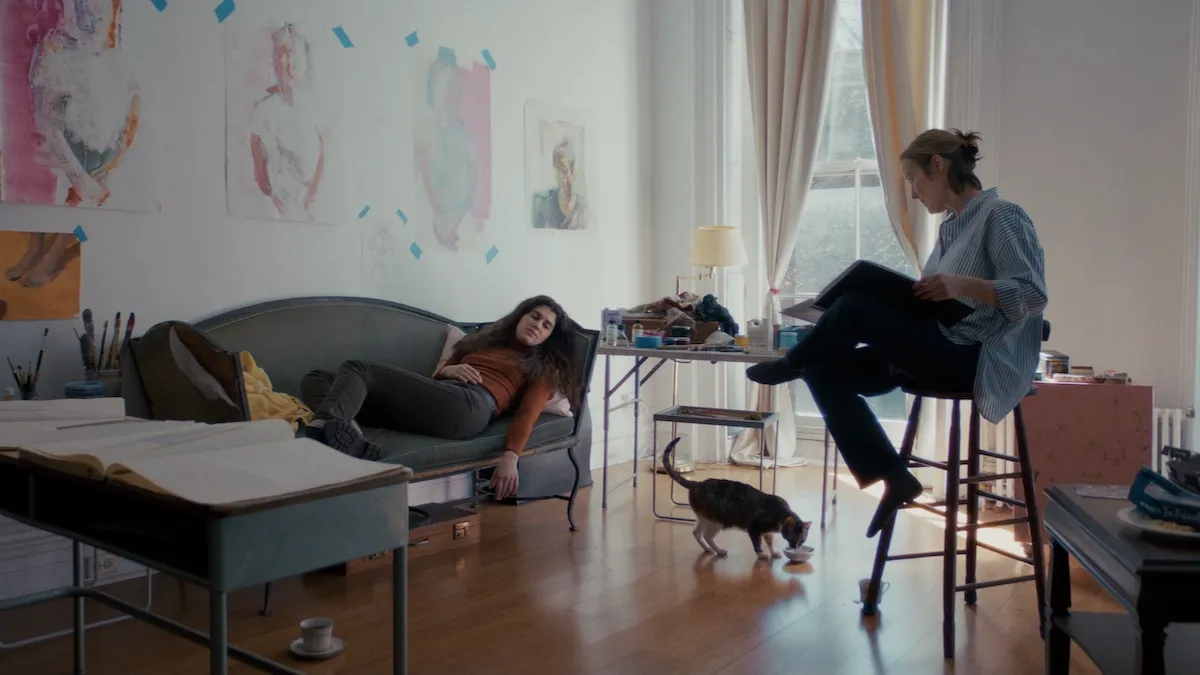
The painting sessions form the heart of the film, a space where the act of creation becomes an act of revelation. Within the four walls of Ilse’s rented apartment, the outside world and its demands fall away. Here, the relationship between artist and subject dissolves into a more profound exchange between two consciousnesses. The film poses a question: what does it mean to be seen?
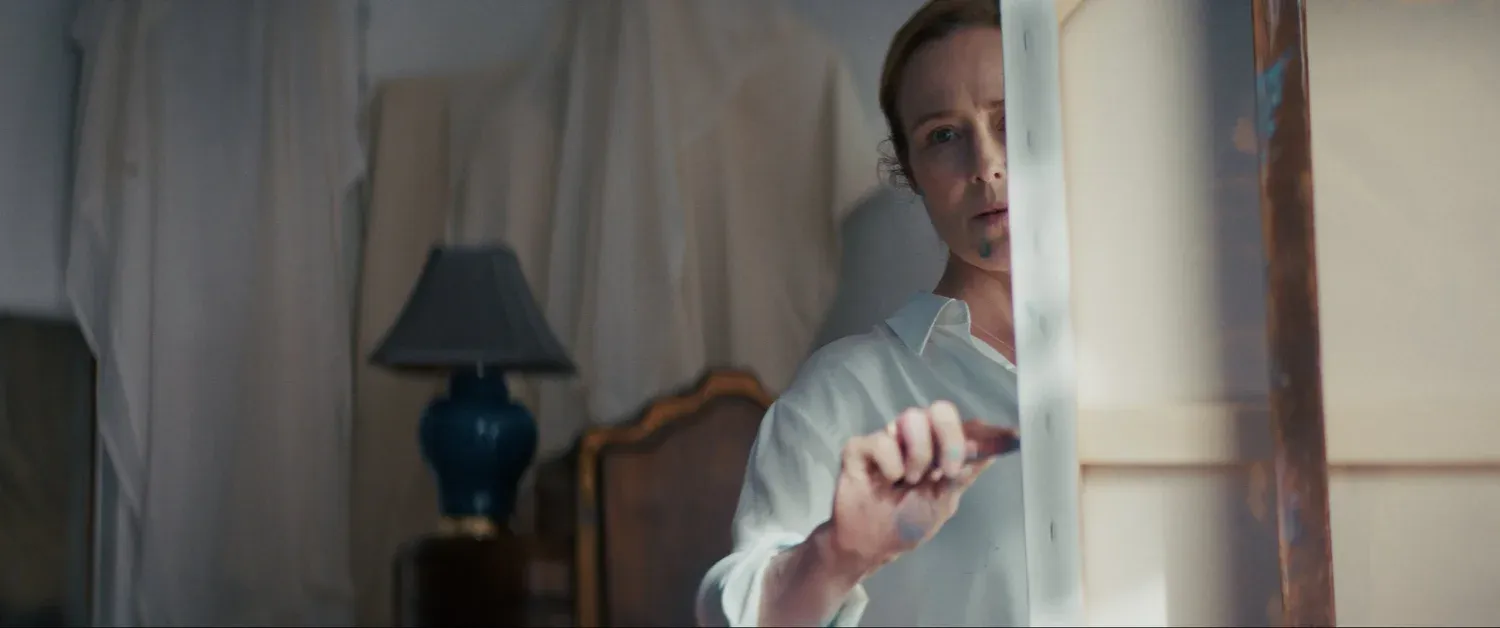
For Lucy, sitting in Ilse’s gaze is a radical experience. She is perceived outside the context of her small town and her relationship, perhaps for the first time. This recognition awakens her to her own profound dissatisfaction, giving shape to a discontent that was previously just a hum beneath the surface of her days. For Ilse, the act of looking is what reanimates her; in the planes of Lucy’s face, she finds a way back to her own artistic vitality.
The process is both selfish and symbiotic. Jennifer Ehle portrays Ilse with a potent mixture of artistic authority and deep-seated need, her worshipful gaze at Lucy revealing as much about her own emptiness as it does about her subject’s allure. Alex Sarrigeorgiou gives a finely calibrated performance, her quiet exterior gradually revealing the seismic shifts occurring within.
Her stillness is not vacancy but a gathering of strength. Their bond is built not on grand declarations but on the charged space between them, on held glances and subtle shifts in posture. The unspoken becomes the very medium of their connection, a language of pure perception that is more intimate than any conversation.
A Quietly Composed World
Director Jaclyn Bethany’s approach is one of patient observation. Her camera holds on faces, allowing internal changes to register without comment, mirroring the painter’s steady contemplation of a subject. The film’s pacing is deliberate, forcing the viewer to inhabit the characters’ sense of suspended time. This slowness is not emptiness; it is filled with the weight of unmade decisions and the gravity of a dawning awareness.
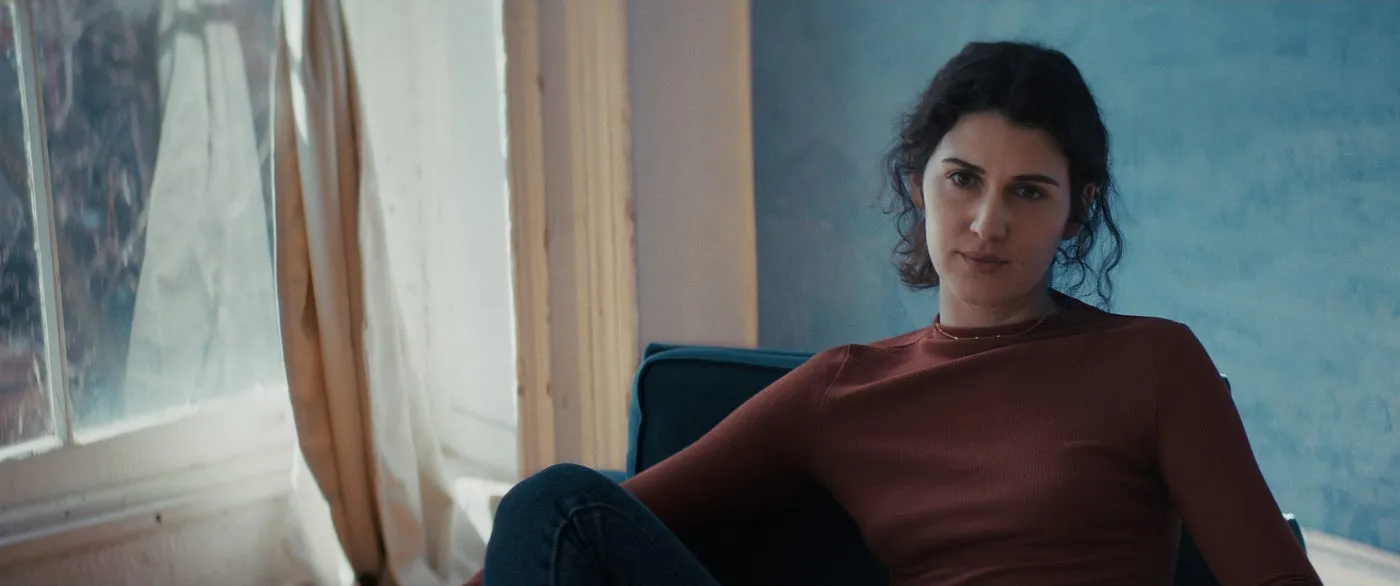
The film’s visual language is precise. The cool, muted tones of the outside world, all blues and grays, give way to the warm, contained light of Ilse’s studio. This sanctuary, illuminated by a soft, golden glow, becomes a space where a different kind of truth can emerge. The cinematography creates a clear distinction between the life that is lived and the life that is felt.
Juan Pablo Daranas Molina’s piano-heavy score is a wistful echo of the characters’ inner states, a sound that is both melancholic and hopeful, never dictating emotion but instead tracing its delicate contours. The screenplay, from Sarrigeorgiou herself, is notable for its economy.
It trusts the silence. It understands that the most significant questions about a life are rarely spoken aloud; they are lived in the quiet moments of decision and transformation. The film’s construction is as careful and considered as one of Ilse’s brushstrokes, a testament to a filmmaking style that values nuance over noise.
The 2025 drama film In Transit, directed by Jaclyn Bethany and starring Alex Sarrigeorgiou, François Arnaud, and Jennifer Ehle, premiered at the Edinburgh International Film Festival on August 17, 2025.
Full Credits
Director: Jaclyn Bethany
Writers: Alex Sarrigeorgiou
Producers and Executive Producers: Jaclyn Bethany, C.C. Kellogg, Alex Sarrigeorgiou, Sarah Keyes, Tara Sheffer
Cast: Alex Sarrigeorgiou, Jennifer Ehle, François Arnaud, Theodore Bouloukos, Andrew Garman, Tre Ryder
Director of Photography (Cinematographer): Sam Tetro
Editors: Shannon C. Griffin
Composer: Juan Pablo Daranas Molina
The Review
In Transit
In Transit is a beautifully restrained and intelligent film that finds profound meaning in quietude. It is a patient study of how a single human connection can illuminate the vast, unspoken landscapes of our inner lives. While its deliberate pace and emotional subtlety may not resonate with all, it is a deeply felt piece of filmmaking, anchored by two superb central performances. It succeeds as a moving meditation on art, identity, and the transformative power of being truly seen.
PROS
- Strong, nuanced lead performances from Jennifer Ehle and Alex Sarrigeorgiou.
- Sensitive and patient direction that trusts the viewer.
- Atmospheric cinematography that effectively mirrors the characters' internal states.
- An intelligent, economical screenplay that excels in its use of subtext.
- Palpable chemistry between the two leads.
CONS
- The deliberately slow pacing may feel uneventful for some viewers.
- Its focus on internal, subtle shifts might be perceived as emotionally distant.
- The plot is minimal, relying almost entirely on character dynamics.