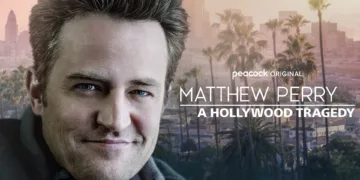






















For a generation, Matthew Perry was an architect of modern sarcasm. As Chandler Bing on Friends, his line readings became a kind of cultural shorthand, a way to signal affection through wit. I remember watching in my university dorm, where entire conversations were built from Chandler-isms. That persona, the funny one, was so pervasive that his public struggles with addiction felt like a glitch in the broadcast.
The story was always there, one he courageously told himself. The documentary Matthew Perry: A Hollywood Tragedy arrives promising a definitive look at that story, framing itself as a final chapter that might offer some understanding of his premature death. It positions itself as an important examination of a beloved figure lost too soon.
An Echo in the Archives
The film’s narrative structure is less a construction and more an assembly. It builds its foundation almost entirely from Perry’s 2022 memoir, Friends, Lovers, and the Big Terrible Thing, functioning as its visual companion piece. Watching the documentary after reading the book feels like experiencing a faint echo.
We see the familiar beats: his childhood as an unaccompanied minor flying between parents, the dizzying ascent with Friends, and the painful timeline of his addiction. The film reminds us that when Chandler was heavier, Perry was drinking; when he was thin, it was pills. This information, while tragic, is not new.
The film’s primary technique is to layer Perry’s own voice, reading from his audiobook, over a collection of archival footage. I recall highlighting passages in his book that felt painfully honest; seeing those same words used as narration over a slow-motion paparazzi shot feels like a diminishment of their power. The editing relies on this simple juxtaposition, pairing Perry’s confessions with generic B-roll of Los Angeles or repetitive red-carpet clips.
The effect is a strange collage that lacks cinematic dynamism. Technically, it represents a particular kind of modern documentary, one produced quickly for the streaming market, which prioritizes content aggregation over original storytelling. This “asset-based” approach, building a film from what is already available, results in a product that feels safe and superficial, telling us a story we have already heard without a fresh perspective.
The Empty Couch
A documentary about a life is defined by the people who show up to talk about it. Here, the central figures are conspicuously absent. Perry’s family and his five main Friends co-stars do not appear in new interviews, leaving a quiet but immense void at the film’s center. In their place is a rotating cast of commentators who offer expertise without intimacy.

We hear from entertainment journalists from publications like The Hollywood Reporter, a retired LAPD detective, and various authors and lawyers. Their contributions are professional and informed, but they come from a distance. They discuss Perry as a case study in celebrity, a tragic headline. The visual framing of these interviews reinforces their detachment; they are shot in sterile, impersonal settings, positioning them as objective observers.
Morgan Fairchild, who played Chandler’s mother, offers warm but limited recollections from her time on set, her connection being purely professional. Hank Azaria appears briefly in a social media clip, a heartfelt but borrowed tribute that underscores the production’s inability to secure direct participation. This filmmaking choice creates a cold, forensic atmosphere.
The soundscape is filled with a low, ominous score meant to create tension, yet the emotional core is missing. The film talks about Perry extensively but never manages to give a sense of who he was from the perspective of those who knew him best, a choice that fundamentally shapes the viewing experience into an investigation rather than a remembrance.
An Unfinished Story
The documentary finds its focus in its final act, shifting decisively into a true-crime procedural. It meticulously details the police investigation into the source of the ketamine that led to Perry’s death, identifying the network of doctors, dealers, and an assistant who were ultimately charged. A district attorney explains the legal pursuit of accountability for overdose deaths.

This section is clear and direct, yet it feels like a detour from the actual subject. The film presents sensational tidbits, like text messages revealing a doctor’s predatory attitude, but treats them as dramatic plot points instead of entryways into a deeper critique of medical corruption. By concentrating on the mechanics of his death, the film avoids a meaningful exploration of the systemic issues of fame, addiction, and professional ethics.
It offers a simple narrative of blame that is much neater than the complicated reality of a lifelong disease. The entire approach feels both premature and opportunistic. The editing is frequently interrupted by on-screen disclaimers stating that the accusations are “alleged,” a constant reminder that the legal story is still unfolding.
This makes the documentary feel like an unfinished news report, not a definitive film. It fails to provide the insight it promises, leaving one with the sad irony of a man who brought so much laughter being remembered in a film with so little soul. A more fitting tribute might have explored his own efforts to help others, a legacy of generosity this film leaves unexplored.
The documentary Matthew Perry: A Hollywood Tragedy premiered on Peacock on February 25, 2025. It is exclusively available for streaming on Peacock in the US.
Full Credits
Director: Robert Palumbo
Cast: Matthew Perry, Morgan Fairchild, Katy Forrester, Martin Estrada, Greg Kading, Deborah Walker
The Review
Matthew Perry: A Hollywood Tragedy
Matthew Perry: A Hollywood Tragedy offers a hollow echo of a story already told. By substituting genuine insight with recycled facts and distant commentary, the film feels more like a hastily assembled news report than a thoughtful tribute. It mistakes procedural detail for emotional depth, ultimately failing to honor the complex life of the man at its center.
PROS
- Organizes publicly known information about Perry's life and struggles into a single timeline.
- Provides a clear summary of the criminal investigation into the source of the ketamine.
- Features audio excerpts from Perry's memoir, allowing his own words to frame parts of the narrative.
CONS
- Presents almost no new information or original reporting.
- Lacks interviews with family, close friends, or primary Friends co-stars.
- Feels emotionally detached and exploitative in its approach.
- Offers a superficial look at complex issues like addiction and the pressures of fame.
- The narrative is premature, created before the associated legal cases were fully resolved.