
















There is a particular kind of story Hollywood tells about itself, usually involving a maverick artist battling a system. The story of Francis Ford Coppola is a foundational text in that genre. With Megadoc, we get a different narrative, one less about battling a studio and more about battling time, relevance, and the practical limits of one’s own fortune.
Coppola’s quest to make Megalopolis, a project gestating for decades, saw him liquidate $120 million of his winery assets. Mike Figgis’s documentary is not the post-mortem of that film’s reception. It is the real-time chronicle of the attempt. The film wisely focuses on Coppola himself, an artist staking his legacy on a final, grand gesture. It captures the fragile moment of creation, when a project is pure potential, before the world has had a chance to render its verdict.
The Chaos Theory of Filmmaking
On the set of Megalopolis, work is a dirty word. Coppola’s governing philosophy is one of creation through experimentation, or as he puts it, “Play gives you everything.” Megadoc shows this principle in action, with long rehearsal periods where actors like Aubrey Plaza and Dustin Hoffman engage in improvisational games that feel more like abstract theater exercises than preparation for a sci-fi epic.
The atmosphere is loose and exploratory, a stark contrast to the sterile Atlanta soundstages, previously home to Marvel productions, where much of the film was shot. The documentary’s narrative is built on this contrast between the industrial machine of modern filmmaking and one man’s attempt to subvert it from within.
Figgis structures his observations methodically, allowing the viewer to connect Coppola’s abstract ideas to the tangible reality of the shoot. His camera is an inquisitive observer, and he punctuates the footage with dryly presented facts. An on-screen title noting the catering budget has exceeded $1.6 million lands with the force of a punchline, a small detail that speaks volumes about the project’s scale.
It all seems to build toward one of Coppola’s own observations, captured mid-shoot: “Cinema is the only art that kills what it’s trying to preserve.” The documentary becomes a study of that paradox, watching a director use an immense, rigid apparatus to chase something spontaneous and alive.
When Play Becomes Toil
The trouble with a process built entirely on freedom is that it eventually collides with the need for structure and the friction of human personalities. The central conflict documented in Megadoc is the escalating tension between Coppola and actor Shia LaBeouf. This is not a simple disagreement; it is a fundamental clash of methods.

Scene after scene shows LaBeouf, who admits he was “persona non grata” in the industry, repeatedly challenging the director on blocking, motivation, and movement within a scene. His performance seems to require a level of antagonism that exhausts Coppola, who complains he is “too old and grouchy” for such behavior.
This narrative thread reaches its climax when LaBeouf calmly reads an email from Coppola directly to the camera, in which the director calls him “the biggest fucking pain in the ass of any actor I’ve ever worked with.” The fallout from the creative chaos was not limited to actors.
Figgis documents the critical moment when Coppola fired his visual effects supervisor, a decision that prompted the mass resignation of production designer Beth Mickle and her entire art department. The documentary includes trade paper headlines reporting on the production’s disarray, showing how the on-set story was already being shaped by outside forces.
A Story Without an Ending
As an observer, Mike Figgis is uniquely suited to this project. A filmmaker himself, he navigates the set with an insider’s understanding, capturing candid moments that a different documentarian might miss. His approach is one of careful neutrality. Megadoc never argues for the genius of Megalopolis, nor does it frame its troubled production as an outright disaster.

It simply presents the story of its making, letting the footage speak for itself. The obvious point of comparison is Hearts of Darkness, the chronicle of Apocalypse Now’s torturous birth. That film, however, was a retrospective look at a production that resulted in an undisputed masterpiece. Megadoc has no such neat resolution. Its story ends before its subject’s premiere, making its central tension the deep uncertainty of the artistic process.
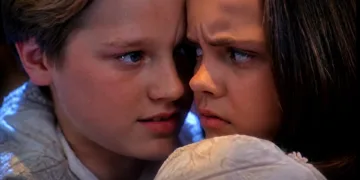
This is a story without a third act. The film also reveals its limitations through omission, never touching the allegations of on-set misconduct that later surfaced against Coppola. By including archival clips from earlier attempts to mount the film, one featuring a young Ryan Gosling, the documentary paints a fuller portrait of a decades-long obsession. It shows Coppola not as the brash warrior of the 1970s, but as a dedicated, thoughtful artist who has earned the right to fail on his own terms.
Megadoc is a feature documentary directed by Mike Figgis about the creation of Francis Ford Coppola’s film, Megalopolis. It had its world premiere at the 82nd Venice International Film Festival on August 28, 2025. The film was acquired by Utopia for North American distribution and is scheduled for a limited theatrical release starting September 19, 2025.
Full Credits
Director: Mike Figgis
Writers: Mike Figgis
Producers and Executive Producers: Tara Li-An, James T. Mockoski, Anahid Nazarian, Barrie M. Osborne, Darren M. Demetre
Cast: Francis Ford Coppola, Eleanor Coppola, Adam Driver, Aubrey Plaza, Nathalie Emmanuel, Dustin Hoffman, Giancarlo Esposito, Chloe Fineman, Shia LaBeouf, Laurence Fishburne, Jon Voight, Talia Shire, Robert De Niro, George Lucas, Fred Roos, Spike Lee, Martin Scorsese, James Remar
Director of Photography: Mike Figgis
Editors: Joe Beshenkovsky, Mike Figgis, Derrick Scocchera
Composer: Mike Figgis
The Review
Megadoc
Megadoc is a fascinating and essential document for anyone interested in the realities of filmmaking. It succeeds as an unfiltered portrait of artistic ambition, capturing the chaotic, expensive, and deeply personal process of a master director risking everything on a singular vision. While its narrative is inherently incomplete and it sidesteps controversy, the film provides a rare, candid look at the friction between creative ideals and logistical realities. It is a compelling study of process, even if the final product remains a question mark.
PROS
- Provides unprecedented, candid access to Francis Ford Coppola's creative process.
- Offers a compelling, real-time look at on-set conflicts and problem-solving.
- Maintains a neutral, observational tone that respects the viewer's intelligence.
- Serves as a valuable historical document of a unique and ambitious production.
CONS
- Feels somewhat incomplete, as it concludes before the premiere and reception of Megalopolis.
- Avoids addressing the more serious allegations of on-set misconduct against Coppola.
- The focus on process might be less engaging for viewers not already invested in Coppola or filmmaking.