

















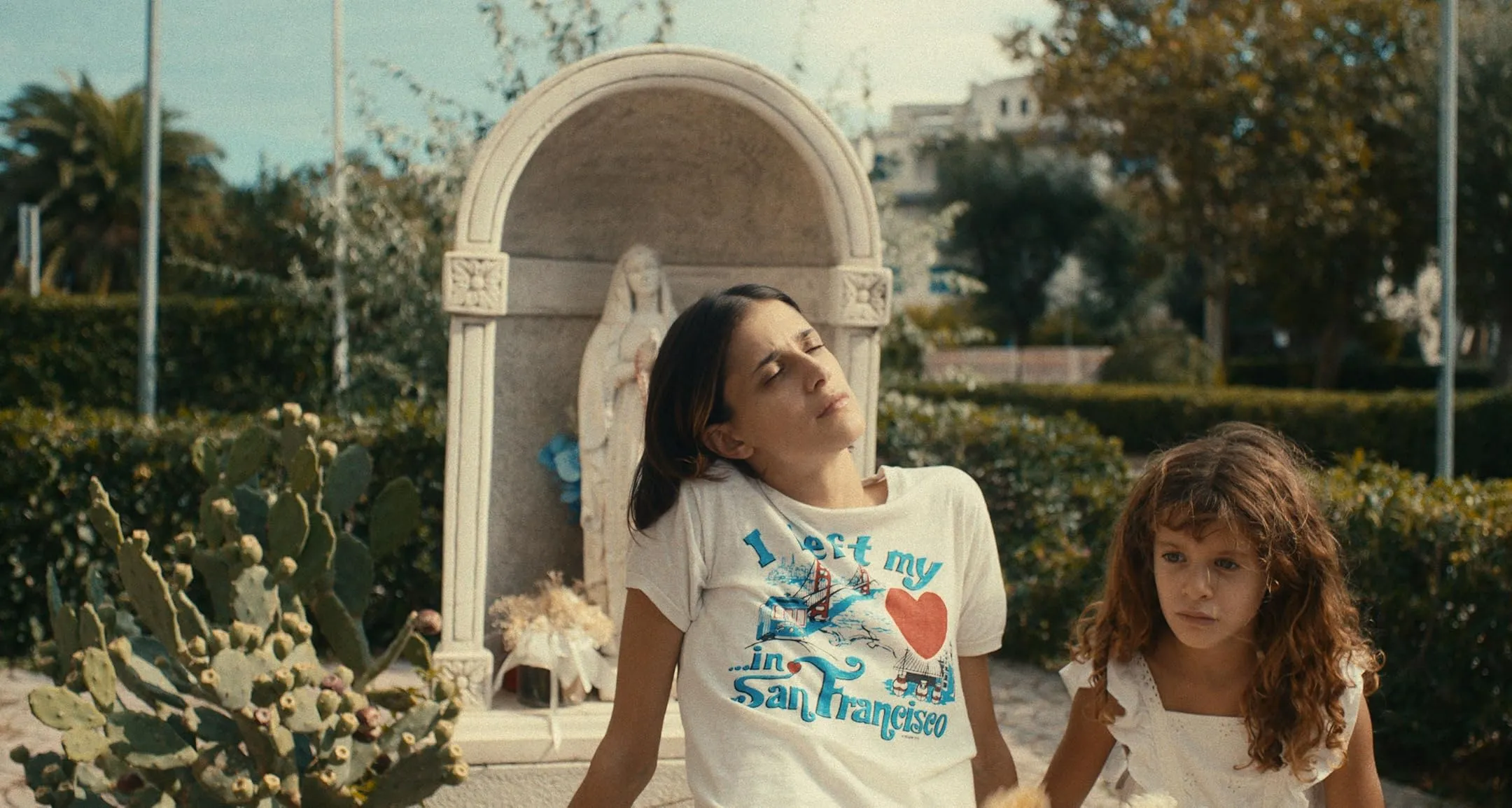

Carolina Cavalli’s film begins not with a bang but with the flat, fluorescent hum of modern ennui. Its protagonist, Holly, is a study in suspended animation, a 28-year-old woman whose internal landscape is as barren as the fast-food parking lot where her life pivots. Portrayed by Benedetta Porcaroli with a deep psychic stillness, Holly moves through a world drained of affect.
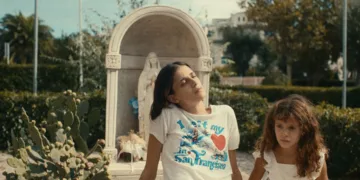
The inciting incident is a moment of pure, deadpan absurdity. A child, Arabella, materializes. She is seven, sharp-witted, and utterly convinced that Holly must abduct her. The reason, a delusion Holly readily accepts, is that Arabella is Holly’s past self, an untainted original in need of saving from a life path already gone wrong.
The girl’s motive is simpler: her author father, a self-involved Chris Pine, denied her tacos. Thus, a pact is forged, a bizarre road trip predicated on a shared psychosis, one part existential rescue mission and one part childish tantrum.
The Captor and the Collaborator
The film’s entire architecture rests on the dynamic between its two leads, a complex negotiation of power that functions as a kind of psychological feedback loop. This is not a simple kidnapping; it is a folie à deux, a shared madness where each participant validates the other’s delusion. Porcaroli’s performance as Holly is a masterwork of minimalism.
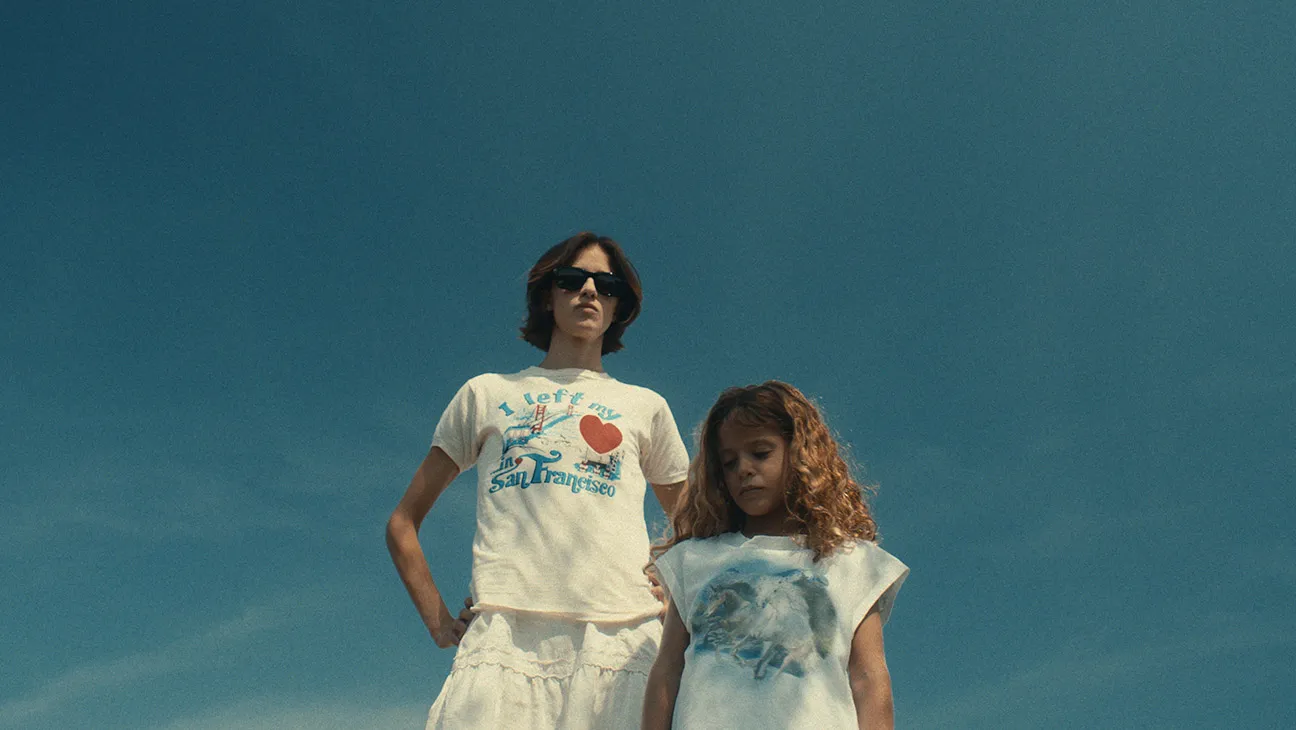
Her face is a blank screen onto which the audience, and Arabella, must project a motive. She is less an active agent than a vessel for a desperate, unformed desire for ontological repair. She does not see a child; she sees a chance to edit her own life’s text. In this, her stillness becomes a key technique, forcing the viewer into the position of analyst. In contrast, Lucrezia Guglielmino’s Arabella is the narrative’s engine.
She is a trickster figure, a pint-sized catalyst whose sharp intellect and bratty demands expose the absurdities of the adult world. Her comic timing is immaculate, but beneath it lies a chilling pragmatism. She understands Holly’s need and exploits it for her own ends. Their interactions are the film’s strongest asset, a strange push and pull of control.
The supporting cast orbits this central dyad like bewildered planets. Chris Pine’s Oreste is a perfect portrait of artistic solipsism, a man so lost in his own celebrity he is blind to his daughter’s reality. He is the negligent creator, a fitting father for a girl who chooses a stranger to rewrite her story.
An Italy of the Mind
Cavalli’s direction establishes a world that is geographically specific yet feels entirely unmoored. The camera captures the Po Valley lowlands with a static, dispassionate gaze, systematically stripping the Italian landscape of its expected romance and vibrancy.
This is a non-place, an Italy of the mind composed of anonymous motels, concrete churches, and sterile shopping centers. The visual strategy is to create a stand-in for a mythical US-Mexican borderland, complete with fictional town names that evoke a sense of displacement. This is a direct commentary on cultural rootlessness, a world where everywhere looks like nowhere in particular.
Lorenzo Levrini’s cinematography reinforces this feeling through formal, often rigid compositions that trap the characters in the frame. The lighting is flat and unforgiving, eschewing the dramatic shadows of classic noir for the banal glare of natural light, suggesting there are no dark corners to hide in, only an overexposed, empty present.
The production design is a key accomplice in this project. Interior spaces are a riot of visual non-sequiturs: garish wallpapers clash violently, and a room is tiled with a random piano key motif. This is the visual noise of a fractured consciousness. The sound design complements this, with a Spaghetti Western-influenced score providing a wry, anachronistic commentary on a journey with no heroic destination.
The Weight of Whimsy
A film that frames child abduction as farce and mental illness as a character quirk is taking a significant philosophical risk. It wades into deep ethical gray zones, asking its audience to suspend moral judgment in favor of tonal consistency. For much of its runtime, the gamble works.
The screenplay poses a difficult question: if identity is merely a narrative we construct, what are the ethics of radical revisionism? Holly’s attempt to overwrite her past by hijacking a child’s future is a disturbing, fascinating premise. The film’s primary flaw is a failure of nerve in its narrative structure.
As the story progresses, it loses its tight focus on the central duo’s psychological vortex and drifts into the more conventional territory of a police procedural. The introduction of a bumbling cop and his investigation feels like a concession, an attempt to ground the film’s high-concept absurdism in a recognizable plot.
This shift dissipates the carefully built tension and slackens the pace. What began as a taut and unsettling character study becomes a meandering road trip punctuated by mildly amusing but distracting subplots.
The initial intellectual provocation is diluted. In the end, the film is held together almost entirely by Lucrezia Guglielmino’s performance. In a world of aimless adults, her character is the only one with a clear, albeit selfish, objective. She is the story’s only true north, and when the narrative strays from her, it loses its way.
The Kidnapping of Arabella is a 2025 Italian drama-comedy film directed by Carolina Cavalli. It had its world premiere in the Horizons section of the 82nd Venice International Film Festival on August 28, 2025. The movie was produced by Elsinore Film, The Apartment, and Piperfilm.
Full Credits
Director: Carolina Cavalli
Writers: Carolina Cavalli
Producers and Executive Producers: Annamaria Morelli, Antonio Celsi, Massimiliano Orfei, Luisa Borella, Davide Novelli
Cast: Benedetta Porcaroli, Lucrezia Guglielmino, Chris Pine, Marco Bonadei, Eva Robin’s
Director of Photography: Lorenzo Levrini
Editors: Babak Jalali (as co-screenwriter), Babak Jalali
The Review
The Kidnapping Of Arabella
While its confident, deadpan style and two exceptional lead performances establish a fascinating psychological inquiry, The Kidnapping of Arabella cannot sustain its initial momentum. The film’s bold premise is ultimately diluted by a faltering narrative structure that retreats from its most challenging questions. What remains is a stylish, intellectually stimulating, yet frustratingly uneven piece of work that is admirable for its risks, even if they do not entirely succeed.
PROS
- A controlled and distinctive deadpan directorial style.
- Superb lead performances from Benedetta Porcaroli and an outstanding Lucrezia Guglielmino.
- An intelligent, philosophically rich premise exploring identity and loneliness.
- Striking cinematography and production design that create a unique, placeless world.
CONS
- The narrative loses focus and drive in its second half.
- Inclusion of conventional subplots detracts from the potent central relationship.
- The farcical approach to difficult subject matter is a tonal risk that may alienate some viewers.
- Uneven pacing causes the film's energy to dissipate before its end.