
























There’s a specific kind of quiet that hangs over English seaside towns in the off-season. I remember it from childhood trips: a feeling of faded grandeur, of a place holding its breath. Harry Sherriff’s debut feature, Misper, bottles this feeling perfectly.
The film opens in one such town, centering on the cavernous and decaying Grand Hotel. We are quickly introduced to the inciting event: a bright, wry young employee named Elle vanishes without a trace. From this familiar starting point, the film immediately veers away from the expected path. This is not a whodunit. It is not a police procedural.
Misper is a patient, deeply atmospheric study of the aftershock, focusing on the quiet anxieties that ripple through the lives of the colleagues she left behind. The central question is not what happened to Elle, but how the living are supposed to go on when a piece of their mundane world is violently torn away.
A Portrait of a Man Unmoored
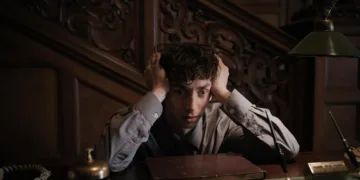
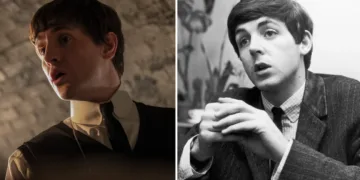
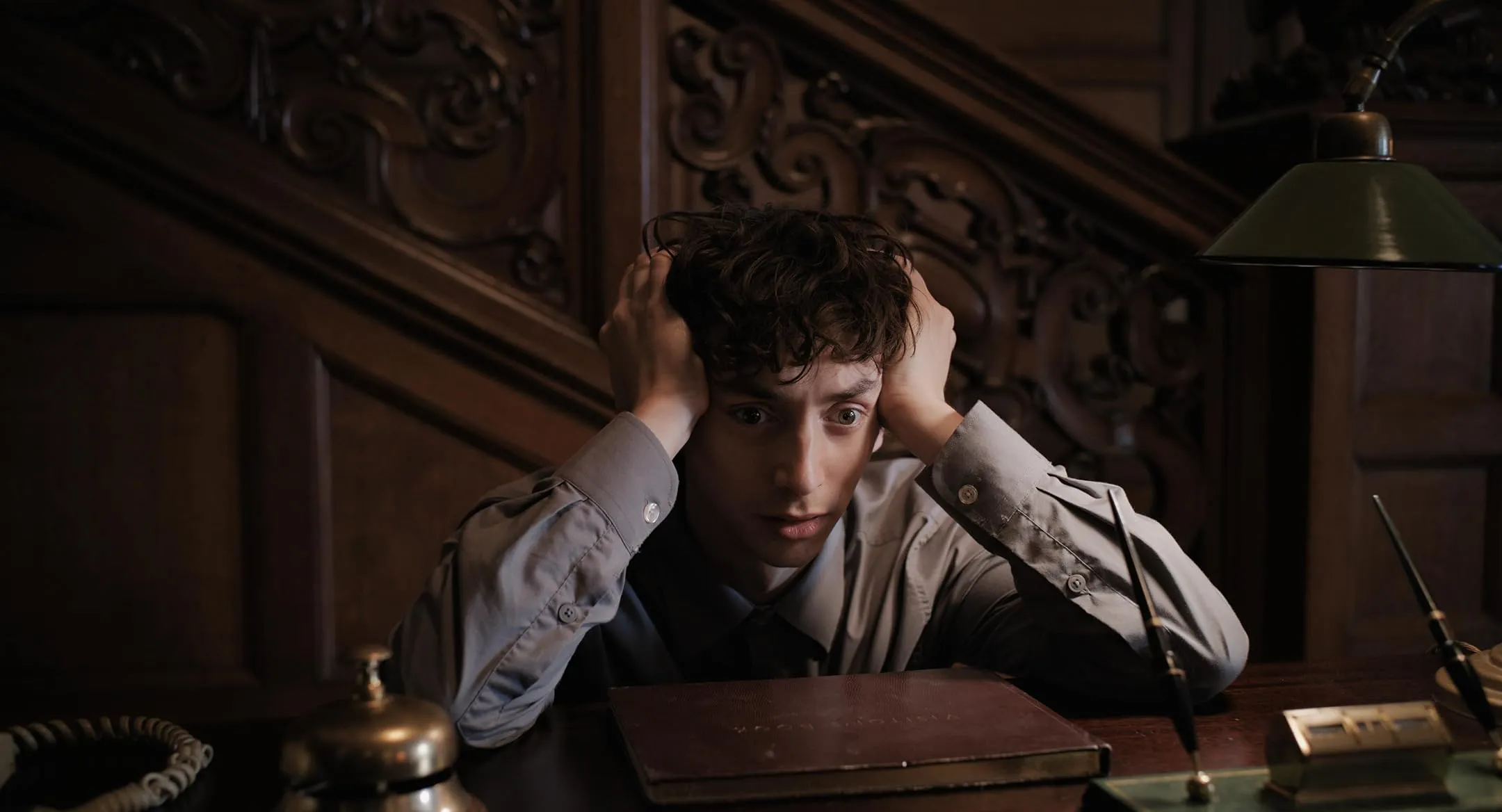
The film anchors its exploration of grief in Leonard, the hotel’s painfully shy concierge. Played with a brilliant, nervous energy by Samuel Blenkin, Leonard is a man whose small life was given a spark by his gentle, unspoken crush on Elle. Their few scenes together before she disappears are masterclasses in awkward chemistry, filled with the kind of hesitant pauses that suggest a connection about to bloom.
Her sudden absence is therefore not just a workplace disruption; it is the erasure of a future he was only just beginning to imagine. This loss acts as a psychological catalyst, sending him into a tailspin that Blenkin portrays with remarkable physical subtlety. His performance avoids loud outbursts, opting instead for a creeping dread visible in his hunched shoulders and a perpetually wide-eyed gaze that seems to be looking at a ghost just over our shoulder.
Leonard becomes a man adrift in his own life, his grief slowly curdling into a paranoid obsession that makes him both sympathetic and slightly unsettling. The film uses his perspective to explore what happens to a person denied closure, trapping him in a state of suspended animation. He haunts the halls of the hotel as if he were the ghost, unable to move forward or backward.
The Architecture of Decay
The Grand Hotel is far more than a simple setting; it is the film’s emotional core, a character in its own right. Its physical state, a mess of peeling wallpaper in muted beiges, stained carpets, and vast, empty corridors, directly mirrors the psychological stagnation of its inhabitants. This is a place where time has stopped, and the film’s technical elements beautifully reinforce this feeling.
Cinematographer Bart Bazaz’s camera often remains static, framing Leonard in a doorway or at the end of a long hall, making him appear small and trapped. When the camera does move, it glides with a deliberate, haunting slowness, enhancing an oppressive atmosphere where the building’s silence is as potent as any sound. The sound design is spare, focusing on the ambient creaks of the old building and the distant cry of gulls, which only amplifies the characters’ isolation.
This pervasive gloom is expertly punctuated by a dry, distinctly British sense of humor, which highlights the absurdity of trying to maintain normalcy. At the same time, Misper dips its toes into psychological horror. Quick, nightmarish flashes suggest Leonard is being haunted, but the film wisely leaves it ambiguous whether the ghost is Elle’s or simply a manifestation of his own fracturing mind.
The Anti-True Crime Story
In an age saturated with true-crime podcasts and documentaries that often sensationalize violence, Misper presents a quiet and necessary counternarrative. My own fascination with the genre is often tempered by its tendency to reduce victims to plot points.
This film is a direct and thoughtful response to that trend. By deliberately pushing the police investigation and the morbid details of Elle’s fate to the absolute periphery, the film makes a powerful statement. It is deeply uninterested in the mechanics of the crime and wholly invested in the human cost for those left on the margins of the tragedy.
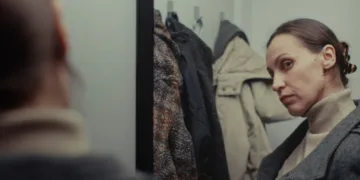
The movie examines the authentic, messy reality of loss, a sharp contrast to the neatly packaged stories we consume. The supporting cast provides a grounded spectrum of reactions, showing how a single event refracts through a community: the manager’s pragmatic concern over filling shifts feels jarringly true, while the sincere, understated sorrow of other colleagues provides the film’s emotional anchor.
As a debut from director Harry Sherriff, Misper is an exceptionally confident and controlled piece of independent filmmaking. It uses a familiar genre setup to explore a more profound and resonant story about memory and the difficult, uncertain process of finding a new normal.
Misper is a crime drama film that premiered at the Edinburgh International Film Festival on August 19, 2025. It is described as a darkly comedic take on a missing person story. The film was directed by Harry Sherriff and produced by Fresh Orange Productions and Oskein. Currently, the release date for general distribution is August 19, 2025, and there is no information available on streaming platforms.
Full Credits
Director: Harry Sherriff
Writers: Harry Sherriff, Laurence Tratalos
Producers and Executive Producers: Tom Leatherbarrow, Simon Orange, Laurence Tratalos
Cast: Samuel Blenkin, Christine Bottomley, Emily Carey, Daniel Ryan, Oliver Ryan, Sunil Patel, Livvie May, Rosalind Adler, Jordan Brookes, Iona Champain, Nichola June
Director of Photography (Cinematographer): Bart Bazaz
Editors: Andy Sowerby
Composer: Nir Perlman
The Review
Misper
Misper is a confident and haunting debut that smartly uses a crime premise to explore something far more resonant: the quiet, unnerving space grief leaves behind. Anchored by a superb central performance and a powerfully oppressive atmosphere, it’s a film that lingers. Its deliberate pace and refusal to provide easy answers make it a challenging, yet deeply rewarding, psychological study.
PROS
- Masterful creation of a tense, melancholic atmosphere.
- A compelling and subtle lead performance from Samuel Blenkin.
- Intelligent subversion of the true-crime genre’s conventions.
- The hotel setting is used effectively as a physical manifestation of the characters' psychology.
CONS
- The deliberately slow pacing may not engage all viewers.
- Its ambiguous nature and lack of a conventional resolution might be unsatisfying for some.
- The intense focus on the protagonist leaves some supporting characters feeling less developed.