






















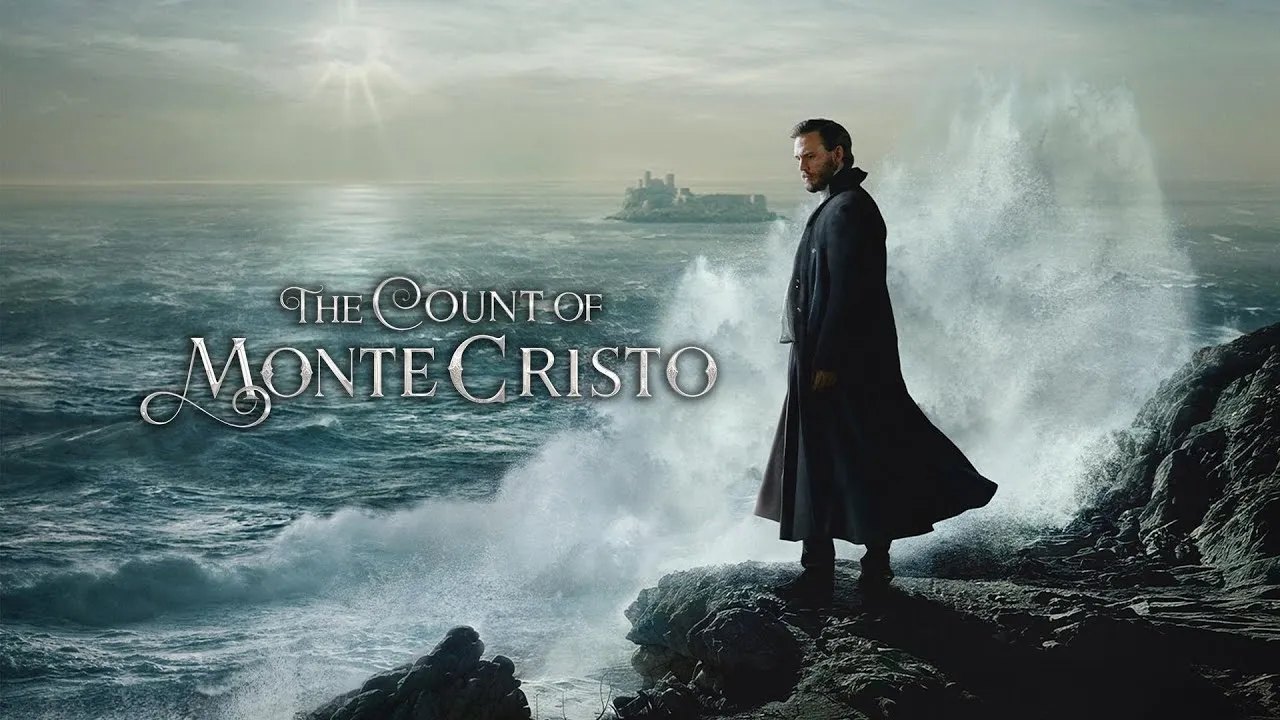

Alexandre Dumas’s novel is one of those foundational myths of Western literature, a story of betrayal and retribution so deeply embedded in our cultural consciousness that it feels permanently relevant. The 2024 French adaptation of The Count of Monte Cristo understands this. It leans into the story’s inherent power without apology.
We are reintroduced to Edmond Dantès, a young, successful sailor whose bright future—a captaincy and marriage to his love, Mercédès—is stolen by the bitter jealousy of his rivals, Danglars and Fernand Mondego. Their conspiracy, enabled by the corrupt ambition of prosecutor Gérard de Villefort, sends him not just to prison, but to a place outside of time: the island fortress of the Château d’If.
It is in this crucible of despair that Dantès is reforged. Stripped of his name, his love, and his future, he is reborn through rage and knowledge. When he emerges years later, he is no longer Edmond Dantès but the enigmatic and fabulously wealthy Count of Monte Cristo.
He arrives in Parisian high society as a specter of the past, a man with a singular, calculated purpose. In an era dominated by serialized, bite-sized streaming content, this film makes a bold declaration, presenting itself as a grand, visually spectacular adventure—a throwback to the lavish, old-school cinematic epics that demanded a viewer’s undivided attention.
Forging a Weapon from a Broken Man
At the center of this sprawling narrative is a performance of stunning duality by Pierre Niney, who navigates the character’s transformation with breathtaking precision. He first gives us Dantès as a young man alight with a naive, almost painful optimism. In the early scenes, Niney’s physicality is open and unguarded; he moves with a sailor’s easy confidence, his smiles are quick, and his love for Mercédès is expressed in gestures of unguarded affection.
This makes his betrayal all the more shattering. When he is dragged from the altar, his confusion and terror are visceral, the reactions of a man whose belief in a just world has been irrevocably broken. When Niney reemerges from the sea, reborn as the Count, the change is a total reconstruction of the self. He carries the immense weight of his lost years in his posture, which is now a study in coiled stillness and predatory grace.
The boyish enthusiasm is gone, replaced by the cold fury of a man who has stared into the abyss and found a purpose there. His intelligence, once a practical tool, is now a weapon of immense destructive power, and his deep-seated sorrow is the fuel for a meticulously planned conflagration that will consume everyone responsible for his fate. The performance is in the details: the unblinking gaze that assesses every room, the precise, economical movements, and a voice that, even in its most charming moments, carries an undercurrent of metallic coldness.
The film wisely spends a significant portion of its runtime on his transformation within the stone walls of the Château d’If, treating it not as a montage but as a crucial chapter of psychological development. His relationship with the Abbé Faria is not just a plot device to secure a fortune; it’s the period of his radicalization. Faria, played with weary brilliance, gives him a worldly education in history, science, languages, and politics, but most importantly, he gives his suffering a target and a methodology.
The Abbé analyzes the conspiracy against Dantès with the cold logic of a detective, naming the men responsible and explaining the corrupt systems of power that allowed them to succeed. This knowledge reshapes Dantès’s grief into a focused rage. The psychological shift from a desperate victim seeking escape to a self-appointed instrument of justice is profound and chilling.
In a key moment of choice, after Faria’s death, Dantès fully commits to a path of calculated hate, consciously forsaking the honorable, forgiving man he once was. He doesn’t just want to punish his enemies; he wants to become the architect of their complete and utter ruin, a decision that hollows him out from the inside long before he acquires his first franc of treasure.
The Slow Architecture of Ruin
In a streaming landscape that often prioritizes narrative velocity and plot turnover, The Count of Monte Cristo makes a defiant, almost archaic choice with its nearly three-hour runtime. This is not a film to be consumed passively between phone notifications; it demands engagement and rewards immersion.
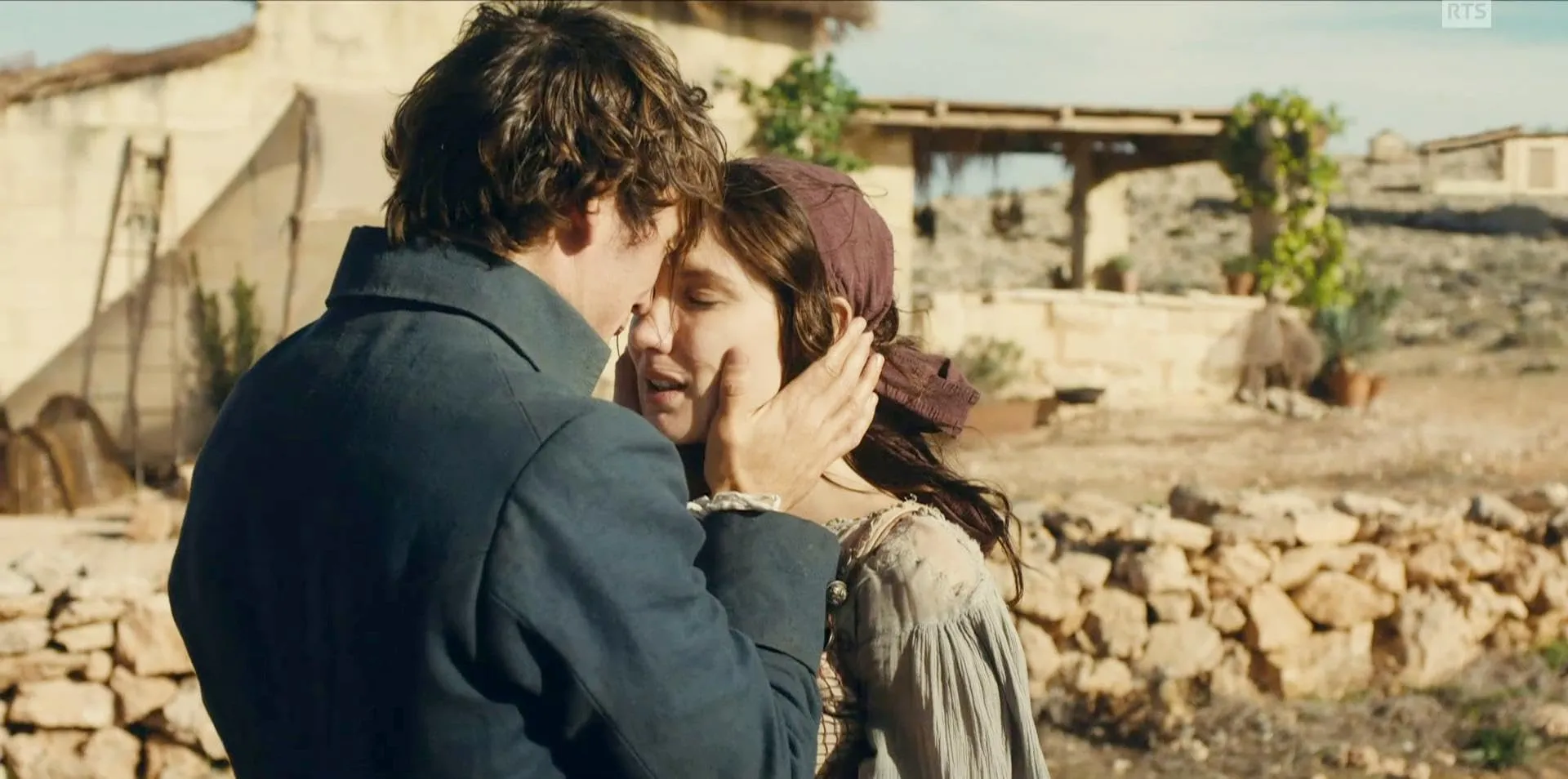
This expansive canvas is used to build its world meticulously, with a structure that mirrors the phases of its hero’s journey. The first act is a deliberate, almost agonizingly slow descent into hell, dedicating a full hour to Dantès’s betrayal, imprisonment, and dramatic escape before his reinvention is even complete.
The film’s rhythm then shifts, becoming a tense political and social thriller where every dinner party is a battlefield and every polite conversation is laced with poison. It is a gamble on the audience’s willingness to invest in a slow-burn narrative, a confident rejection of the modern demand for instant gratification. The pacing is a direct reflection of its protagonist’s strategy: it moves with patience and precision, understanding that true destruction requires time.
While the plot’s complexity, with its large cast of characters and interwoven schemes, occasionally verges on feeling overstuffed, it mostly succeeds in holding its many threads together in a satisfying tapestry of downfall. The takedown of the conspirators is a masterclass in narrative design and poetic justice.
For Fernand Mondego, who stole Dantès’s fiancée and built a career on a lie, the Count targets his public honor and military reputation. For the banker Danglars, the resentful sailor who instigated the plot out of professional jealousy, Dantès orchestrates a brilliant financial ruin that strips him of the wealth he values above all else.
For Gérard de Villefort, the prosecutor who buried him to protect his own career, the Count unearths buried family secrets that destroy his authority and his personal life. None are met with simple violence. Instead, Dantès orchestrates a meticulous dismantling of their lives, turning their own ambitions and weaknesses against them.
His plan is amplified by the presence of his associates, Haydée and Andréa, who are not mere pawns but complex individuals with their own deep-seated motivations. Haydée, sold into slavery by Mondego, seeks a justice that is far more personal and immediate than the Count’s cold calculations, adding a layer of volatile emotion that threatens to derail the master plan.
The Aesthetics of Power
This film puts every last euro on the screen, functioning as a powerful statement of intent from the French film industry. It’s a lavish, unapologetic blockbuster built to compete on a global scale, and its visual language is one of its greatest strengths. The production design creates a world of stark and meaningful contrasts. The grim, damp, stone-walled misery of the Château d’If is a tangible representation of Dantès’s despair.
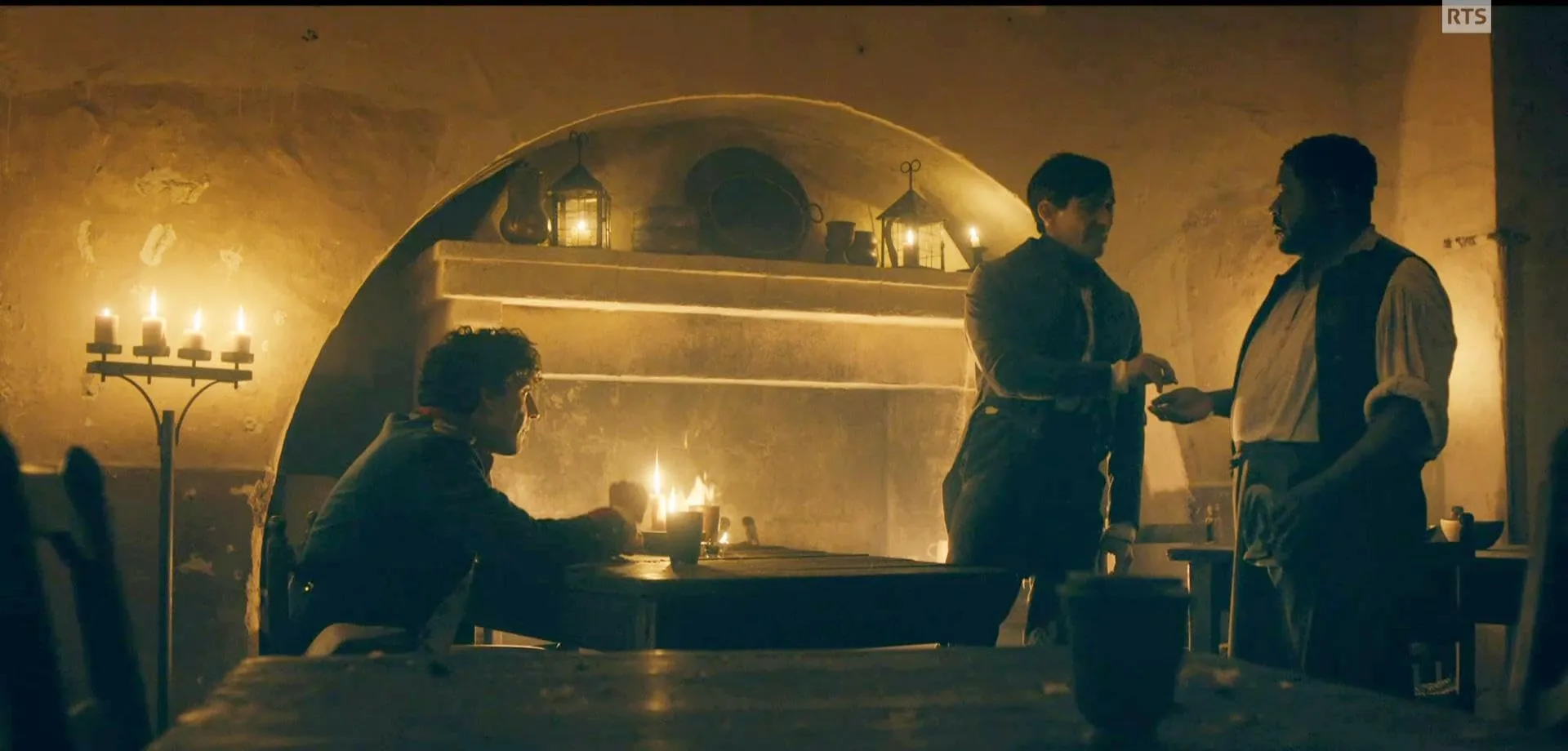
The cinematography in these scenes is oppressive and claustrophobic, using low light and tight framing to mirror his psychological state. This makes the later transition to the opulent grandeur of the Count’s Parisian mansion all the more striking. The residence is an ego trip rendered in architecture, with soaring domes, cavernous halls, cold marble surfaces, and exotic interior decor.
It’s a space designed to intimidate and overwhelm, a fortress of wealth that feels more like a museum or a mausoleum than a home. The period-authentic costumes are equally spectacular, functioning as a visual shorthand for the rigid social strata of 19th-century France. Atmospheric locations and sweeping cinematography capture both the intimate moments of quiet fury and the epic scale of the adventure, from a daring sea rescue in a storm to a tense duel in a misty forest.
Reinforcing this visual feast is Jérôme Rebotier’s magnificent orchestral score. In an age where many thrillers opt for minimalist, ambient electronic soundscapes, this film embraces a full-blooded, stirring score that feels lifted from the golden age of Hollywood epics. The music is a character in its own right, a constant companion to Dantès’s journey.
It gives him a somber, cello-driven theme that evolves throughout the film, from a lament of sorrow to a powerful declaration of intent. The score for his antagonists is often more bombastic and brassy, reflecting their arrogance and hubris.
The love theme for Mercédès is a fragile, recurring melody on the piano that is eventually drowned out by the darker, more complex orchestrations of the revenge plot. The music maintains a high level of energy and drama even in the film’s quieter moments, swelling during action sequences and providing a somber underpinning to the emotional scenes. It constantly reinforces the story’s high stakes, transforming a historical drama into a work of high opera.
The Ghost in the Mansion
Ultimately, the film is less interested in the triumph of revenge than in its corrosive, soul-destroying human cost. The narrative poses a difficult question: what is left of a man when his life’s singular purpose is achieved? Dantès’s quest for what he calls justice leaves a trail of collateral damage, destroying not just his enemies but also affecting the lives of their families and other innocents caught in his web.
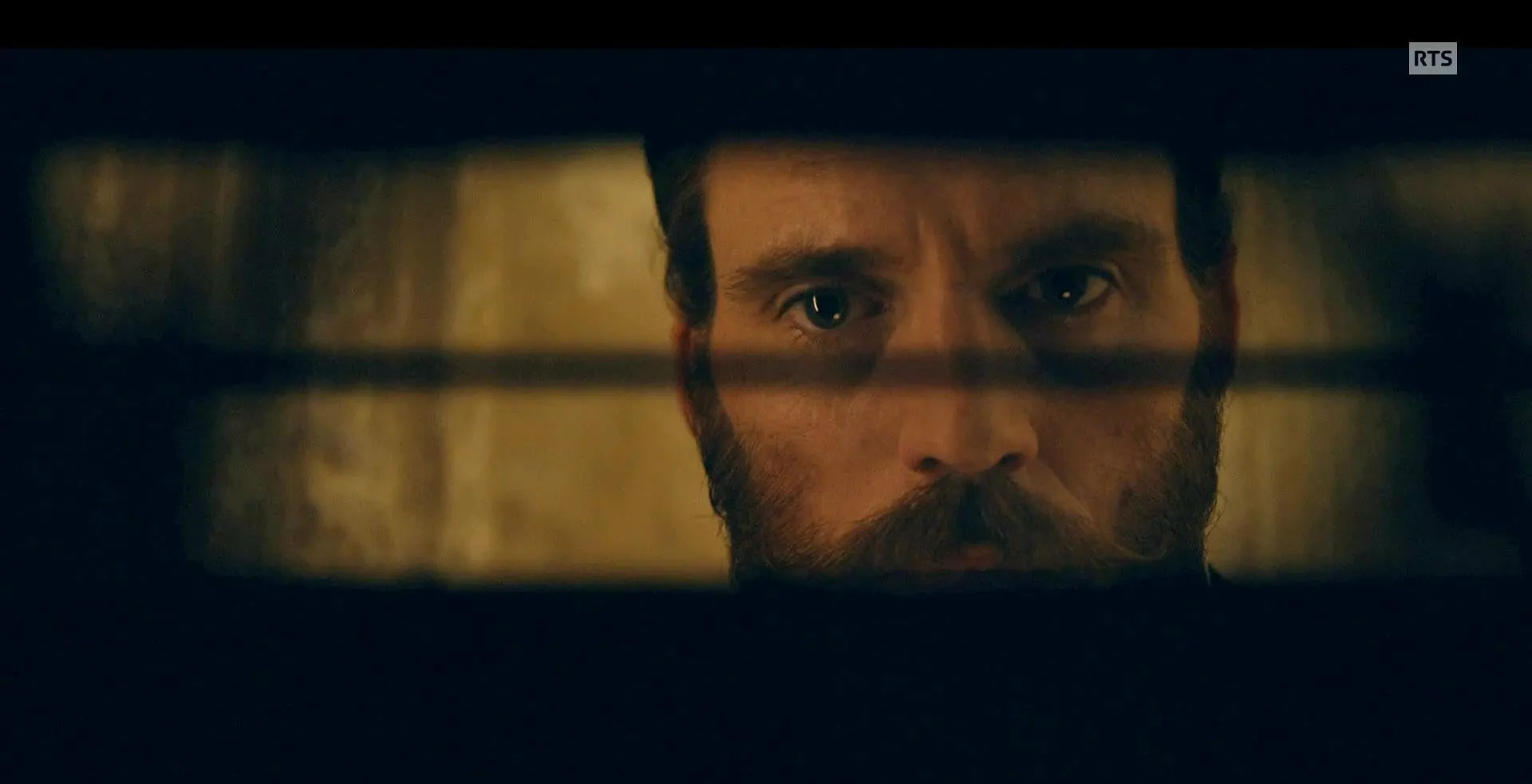
The satisfaction he seeks proves to be a phantom. In the end, his victory is a pyrrhic one. He may have escaped the physical prison of the Château d’If, but he has built a new, more ornate prison for himself—a fortress of wealth and solitude from which there is no escape. He is the ghost in his own mansion, haunted by the man he might have been. He achieves all of his goals, but the film leaves him utterly alone, a king ruling over an empire of ashes.
The emotional core of this tragedy lies in his fractured, poignant relationship with Mercédès. She is the living embodiment of the life he lost, the anchor to a past he can never reclaim. She is the only one who truly knew him, and therefore the only one capable of seeing the emptiness behind the Count’s carefully constructed facade. In their painful encounters, she peels back the layers of his performance, searching for the man she once loved.
Their shared, final realization is heartbreaking and serves as the film’s ultimate moral verdict. After decades of suffering and a diet of pure bitterness, Edmond Dantès no longer exists. The man standing before her is a stranger, a cold manipulator who has been irrevocably changed by his obsession.
A return to the love they once knew is impossible, not because her love has faded, but because the man she loved is gone forever. This somber reflection on the price of retribution is the film’s most powerful and resonant statement: you can avenge the past, but you can never, ever go back to it.
The Count of Monte Cristo is a 2024 French-Italian television mini-series based on the classic novel by Alexandre Dumas.
Full Credits
Director: Bille August
Writers: Alexandre Dumas, Greg Latter, Sandro Petraglia
Producers: Carlo Degli Esposti, Lou Gauthier, Engelbert Grech, Patrizia Massa, Sébastien Pavard, Nicola Serra, Cristina Tacchino
Cast: Sam Claflin, Jeremy Irons, Ana Girardot, Mikkel Boe Følsgaard, Michele Riondino, Nicolas Maupas, Lino Guanciale, Gabriella Pession, Blake Ritson
Director of Photography (Cinematographer): Nicolas Bolduc
Editors: Biel Andrés, Janus Billeskov Jansen, Nikoline Løgstrup, My Thordal
Composer: Volker Bertelmann
The Review
The Count of Monte Cristo
A stunning and unapologetically grand epic, this adaptation of The Count of Monte Cristo is a cinematic feast. Anchored by a towering, dual performance from Pierre Niney, the film masterfully balances spectacular action with a somber exploration of revenge's corrosive nature. While its deliberate pacing and immense scale demand patience, the reward is a powerful, visually breathtaking, and emotionally resonant tragedy that honors its classic source material while feeling urgently cinematic. It is a magnificent achievement in old-school storytelling.
PROS
- A powerful and transformative lead performance by Pierre Niney.
- Spectacular production design and cinematography that create a rich, immersive world.
- A stirring, full-bodied orchestral score that elevates the drama.
- An ambitious, epic scope that feels grand and cinematic.
- A thoughtful and emotionally resonant exploration of the psychological cost of revenge.
CONS
- The nearly three-hour runtime can be demanding and may feel slow for some viewers.
- The plot's complexity, with its many characters and schemes, can occasionally feel dense.