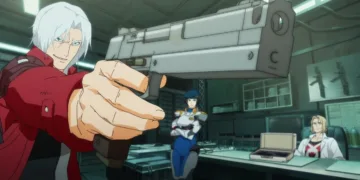































The second season of Devil May Cry opens with the kind of cold storage usually reserved for leftovers and government secrets. Dante sits trapped in cryogenic stasis, held by the militaristic organization DARKCOM, while the world drifts toward global disaster. The United States government has decided to export democracy to Hell, launching a full-scale invasion of Makai, the demon realm.
That campaign runs on the money and technology of the Ouroboros corporation. Its leader, Arius, searches for the Arcana, ancient relics capable of shifting the celestial balance of power. The familiar order shatters when the demon lord Mundus sends Vergil to Earth.
Vergil, the long-lost twin of the series protagonist, arrives as a lethal agent of the demonic throne. DARKCOM wakes Dante because the threat now shares his bloodline. The season pulls elements from the second and third video games into a story of interdimensional war, corporate appetite, and two brothers placed on opposite sides of a reality falling apart at the seams.
Dollars, Drones, and Demonic Doctrines
The political subtext here has the delicacy of a chainsaw revving beside your ear. The series presents the United States military and DARKCOM as occupying forces in Makai, selling the invasion with the language of liberation while chasing resources with both hands open. The season spends time inside the propaganda machine that keeps the war humming.
Every demon citizen gets flattened into a public enemy, which makes public support easier to manufacture. The echoes of early 2000s Iraq War rhetoric are clear, and the soundtrack from that era locks the parallel into place with all the subtlety of a nu metal drop during a slow-motion explosion.
Arius stands as the corporate face of the conflict. He is a billionaire sorcerer who uses high technology to replicate and control demonic energy. His pursuit of the Arcana turns ancient relics into trophies of extraction, mystical assets waiting to be seized, studied, and monetized. Mundus supplies the raw demonic cruelty. Arius brings the spreadsheet, the lab, and the smile of a man who has already named the weapons division.
The pacing hits rough air. The story often cuts away for childhood flashbacks that explain the origins of the twin brothers. These scenes give the season needed emotional weight, yet they can slow the military plot just as it begins building force. That push and pull between grounded soldiering and high fantasy magic defines much of the season’s rhythm. At its best, the structure gives the action a harsh dramatic pulse.
The opening sequence in Makai is the clearest example. It tracks a single squad through a terrifying deployment that ends in a needless, brutal death march. The scene frames the war’s human cost before the swords start singing. Beneath the stylish combat, the common soldiers are disposable pieces in a game designed by generals, executives, and demons with excellent branding departments.
Sibling Rivalry at the Edge of the Abyss
Vergil enters as Dante’s cold, disciplined shadow. His arrival immediately drains the room of Dante’s loud humor, which is quite a feat in a show built around guns, demons, and weaponized attitude. Raised as Mundus’ adopted son, Vergil carries the trauma of his mother’s death like a blade kept sharp through obsession. His quest for vengeance gives the season a tragic spine. Each order he follows forces him closer to a question he has avoided for years: what does justice look like when it serves a tyrant?

Dante changes sharply across the season. The reckless fighter chasing a paycheck gives way to a man forced to face the past he spent years outrunning. His time in stasis and his later “psych evaluation” open a window into a fractured mental state. The show uses quieter beats to strip away his carefree act. In those moments, his sarcasm starts to look less like swagger and closer to armor. Bosch gives those shifts real texture, letting Dante crack without turning him into a scowling misery machine. The jokes still land. They land differently now.
The brothers’ fighting styles make the emotional split visible. Dante fights with explosive improvisation, mixing firearms and sword strikes in a way that feels messy, alive, and dangerous. Vergil moves with precision and brutal economy. Every gesture has a purpose. Their encounters, especially the rain-soaked duel, use motion as character writing. The editing understands the assignment: cut too fast and the choreography turns to soup, linger too long and the impact fades. Here, the rhythm lets each clash register as both spectacle and argument.
Eva’s memory remains the emotional anchor for the series. The childhood flashbacks show the family before grief curdled into destiny. Those scenes reinforce the sense that the brothers draw their greatest strength from shared history. Their grief carries a force stronger than rivalry, which makes the tragedy sharper. The same memory that could bind them becomes another reason to raise a blade. Family therapy would have saved several cities here, but Makai seems short on licensed professionals.
Redemptions, Relics, and Rising Stakes
Lady serves as the season’s moral compass through a painful process of deprogramming. Once loyal to DARKCOM, she begins questioning a campaign built on slaughter. Her guilt over the massacre of Makaians in the previous season pushes her toward atonement. Her relationship with Dante grows through mutual respect and shared trauma. Both characters understand what it means to survive broken systems, and the series lets that recognition develop through action, silence, and bruised humor.
Mattie, an original character, gives that grief a necessary reflection. As an orphan, she mirrors Lady’s own history of loss. Their connection creates a full-circle moment in which Lady helps the girl face pain without feeding it into revenge. Professor Lucan fills a different role. He provides lore about Sparda, the father of the twins, and hints at a greater magical potential within Dante. He works as a catalyst for a future power shift, which gives the season one eye on its present war and another on the larger mythology creeping forward.
DARKCOM’s leadership keeps the tension sharp. Vice President Baines represents the administrative face of a crusade that values power above safety. The shift in government authority places civilians in greater danger. Boardroom decisions spill blood in the streets, which gives the political material its bite. The season fits into a long television tradition of war stories that expose the distance between command rooms and battlefields. Here, that distance stretches all the way from Earth to Hell.
The world building grows through Nell Goldstein’s appearance. Her presence brings technical detail to Dante’s weaponry, grounding the supernatural chaos in craftsmanship. The season also clarifies the history of the demon world. Makai’s hierarchy existed long before Mundus claimed the throne. These details give the universe age, texture, and a sense of political rot that predates the current villains. The battle between good and evil gains messier architecture, which suits a series where even the cleanest sword stroke leaves a nasty stain.
The Art of the Kinetic Needle Drop
Studio Mir has sharpened the show’s visual language. The integration of 3D computer-generated imagery with traditional hand-drawn animation feels much smoother this season. The action has weight. Every sword strike lands with intent and impact, and every collision seems to rattle the frame. Certain episodes shift art styles to express different emotional states, which keeps the visual palette from going stale during the longer story stretches. The direction understands the franchise’s basic promise: style matters, but impact pays the rent.
The audio identity remains proudly loud. Early 2000s nu metal tracks from Drowning Pool and Papa Roach create a specific nostalgic charge. These needle drops shape the soundscape and match the high-energy attitude of the source material. Some viewers may find the song frequency excessive, which is fair. The season sometimes treats the soundtrack like a friend who keeps grabbing the aux cord. Still, the music feeds the fight choreography and gives the series a period-specific swagger that feels deliberate.
Character design does plenty of storytelling on its own. Vergil’s blue aesthetic and Dante’s red coat create immediate visual clarity during chaotic fights. The environments carry meaning too. Ouroboros’ sterile, high-tech offices sit against the organic Gothic decay of Makai, creating a visual clash between corporate control and demonic history. The cinematography leans into that opposition through clean metallic spaces, rotting grandeur, and bursts of motion that keep the frame alive without losing the geography of the scene.
The voice cast balances the franchise’s camp roots with the heavier demands of tragedy. Johnny Yong Bosch and Robbie Daymond ground the supernatural spectacle in recognizable emotion. The sound design makes every bullet, blade, and demonic impact feel consequential. By the end, the season leaves the brothers suspended between reconciliation and repetition, trapped by old wounds, new wars, and the terrible possibility that the previous generation wrote a script they are still performing. How many times can a family tragedy reload before the gun finally jams?
Devil May Cry Season 2 officially premiered on Netflix today, May 12, 2026, releasing all eight episodes simultaneously for a worldwide audience. This new chapter follows the fallout of the first season’s betrayal, with Dante awakening from cryostasis to find the human world locked in a full-scale military invasion of the demon realm, Makai. The narrative leans heavily into the iconic rivalry between Dante and his twin brother, Vergil, as they clash over the fate of both worlds amidst a landscape of corporate greed and ancient magic. Fans can catch the entire series exclusively on Netflix, which continues to showcase the fluid, high-octane animation style of Studio Mir and a signature hard-rock soundtrack featuring early 2000s influences.
Where to Watch Devil May Cry Season 2 Online


- Title: Devil May Cry
- Distributor: Netflix
- Release date: May 12, 2026
- Rating: TV-MA
- Running time: 25–40 minutes
- Director: Han Seung Woo, Arthur Chaumay, Simon Duong van Huyen
- Writers: Adi Shankar, Alex Larsen
- Producers and Executive Producers: Adi Shankar, Hideaki Itsuno, Haruhiro Tsujimoto, Cheong-Il Han, Lee Seung Wook, Graham Hughes, Vikram Salgaocar
- Cast: Johnny Yong Bosch, Scout Taylor-Compton, Robbie Daymond, Graham McTavish, Hoon Lee, Ian James Corlett, Chris Coppola, Salli Saffioti
- Director of Photography (Cinematographer): Hae Jin Kim, Sang Kyu Lee
- Editors: Kim Gyung-chan, Kyung Min-ho, Kim Min-kyoung
- Composer: Power Glove, Jarome Harmsworth, Joel Harmsworth
The Review
Devil May Cry Season 2
The second season is a loud, jagged meditation on family guilt and state-sponsored violence. It replaces the simplicity of the first outing with a heavier narrative that rewards patient viewers. Vergil is the highlight, providing a necessary foil to Dante’s chaotic energy. While the pacing stutters during the heavy flashback sequences, the kinetic action and sharp political commentary keep the momentum alive. It is a confident step forward for the franchise. It balances video game roots with a darker, more mature perspective.
PROS
- A masterclass in disciplined, cold character writing.
- Seamless blending of hand-drawn art and digital assets.
- Sharp, timely parallels to real-world militarism.
- Every fight feels heavy and purposeful.
CONS
- Frequent flashbacks occasionally stall the primary conflict.
- Certain secondary figures receive less focus than they deserve.
- Constant needle drops can drown out quiet character moments.







