

























Every social contract is a fragile truce, a set of invisible lines we agree not to cross for the sake of order. The practical joke, in its purest form, is a controlled violation of this truce, a small act of chaos that reaffirms the stability of the whole. Constantine Paraskevopoulos’s film BFFs asks what happens when the violations are no longer controlled and the lines are erased entirely.
It positions the prank not as a form of humor but as a desperate language for men who have forgotten how to speak. We are presented with Henry Hartman (Adam Rifkin), a man so encased in the amber of corporate procedure and domestic expectation that his life has become a monument to beige predictability. His existence is one of perfect, soul-crushing order.
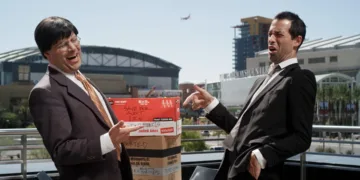
The film’s catalyst is the reintroduction of Jerry Klugman (Paraskevopoulos), a figure who appears less like an old friend and more like an elemental force of anarchy. Their reunion ignites a conflict between absolute order and absolute chaos, waged in a suburban battlefield of escalating sabotage.
A Two-Man Mutually Assured Destruction Pact
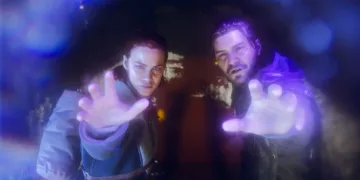
The film’s entire architecture rests on the volatile chemistry between its two leads, a dynamic I can only term “regressive camaraderie.” This is friendship as a flight from emotional maturity. With the film’s writer (Rifkin) and director (Paraskevopoulos) inhabiting these roles, their interplay feels dangerously authentic, a meta-exploration of a creative partnership pushed to its logical extremes.
Rifkin’s performance is a meticulous study in human erosion; he shows us a man worn down not by a single cataclysm but by a thousand tiny abrasions, his patience fraying thread by thread. In contrast, Paraskevopoulos portrays Jerry with a manic, almost predatory glee. His charm is a tool for psychological excavation, used to find and exploit every weakness. Their escalating war of pranks is a spectacle of inventive cruelty.
An early gag with car keys, a staple of juvenile power plays, metastasizes into schemes involving professional ruin, feigned infidelities, and the weaponization of Henry’s deepest anxieties. The film seems to suggest that for some men, intimacy is impossible without the mediating ritual of competition. They are not reconnecting; they are meticulously dismantling one another, searching for a foundation that might have never been there.
The Anarchic Chorus
Henry’s life becomes a pressurized container, squeezed from all sides by forces that seek to control or disrupt him. The supporting players are not passive observers; they are active agents in his psychic disintegration. Terrence Howard’s Mr. Coogan is a masterpiece of quiet corporate evil. He is the institutional tyrant to Jerry’s freelance anarchist.

His management style, a blend of condescension and veiled threats, is a socially sanctioned form of the same psychological manipulation Jerry practices. Both men view Henry as a resource to be exploited. The film’s female characters represent the futures Henry is caught between. Dóra (Jennifer Morrison), his pregnant wife, embodies a world of adult responsibility and emotional honesty that he seems fundamentally unequipped for.
Her groundedness makes the surrounding chaos feel even more acute. Aníta Briem’s character, Jerry’s stripper fiancée, offers a different kind of transactional existence, one that reflects the film’s cynical view of modern relationships. The narrative’s deliberate clutter, its introduction of peripheral cops and vengeful ex-employees, enhances the sensation of a life spiraling out of control. It is a portrait of a man drowning not in a single wave, but in the relentless chop of a dozen smaller ones.
An Aesthetics of Anxiety
The film is constructed to be an experience of sustained discomfort. Paraskevopoulos’s direction employs an aesthetic of anxiety, using frantic editing and claustrophobic framing to lock the audience inside Henry’s collapsing worldview. There are no moments of quiet reflection, no opportunities to catch one’s breath.

This relentless pacing mirrors the ambient panic of a digitally saturated age, where life is a constant stream of stimuli without respite. The tonal instability is the film’s sharpest tool. A scene of outrageous physical comedy will abruptly curdle into one of genuine menace, yanking the rug out from under the audience and refusing them the comfort of a single genre. This formal restlessness is tied directly to the film’s core thematic questions.
The story of a man from Homeland Security who brings nothing but domestic terror to his friend is a rich, bitter irony. The film is a harsh document of toxic nostalgia and a potent critique of a masculinity that equates destruction with affection. It leaves you pondering the ghosts in your own life, the old friends who might be waiting for the right moment to come back and burn it all down.
BFFs (2025) is a chaotic new comedy and crime film about two childhood best friends, Jerry Klugman and Henry Hartman, who reunite and whose escalating practical jokes take a potentially fatal turn. The movie had a limited theatrical release on Friday, September 26, 2025. You can also watch the film by buying or renting it on video-on-demand services like Prime Video and Apple TV. The film was produced by companies including Ammni Studios and RZA Productions.
Full Credits
Director: Constantine Paraskevopoulos
Writers: Adam Rifkin
Producers and Executive Producers: Clinton Kyle Hollister, Constantine Paraskevopoulos, RZA
Cast: Jennifer Morrison, Amaury Nolasco, Terrence Howard, Anita Briem, Nick Stahl, Taye Diggs, Kane Hodder, Michael Bacall, Christian Oliver, Adam Rifkin, Ele Keats, Ari Voukydis
Editors: Tyler Diamond, Clinton Kyle Hollister
Composer: DJ White Shadow
The Review
BFFs
BFFs is a brash and deliberately abrasive film that succeeds more as a thematic statement than a perfectly structured narrative. It weaponizes nostalgia, turning a buddy comedy into a relentless psychological siege. While its chaotic energy can feel unfocused, the committed performances and the sheer audacity of its premise make it a potent, if punishing, examination of friendship’s darkest capabilities. It is a messy, memorable, and deeply uncomfortable watch that lingers long after the sensory assault has ended.
PROS
- Strong and volatile chemistry between leads Adam Rifkin and Constantine Paraskevopoulos.
- A genuinely menacing and memorable supporting performance from Terrence Howard.
- A bold and unflinching exploration of toxic masculinity and the dangers of nostalgia.
- The aggressive, fast-paced directorial style effectively creates a palpable sense of anxiety.
CONS
- An overstuffed narrative that sidelines some supporting characters and subplots.
- The jarring tonal shifts between dark comedy and thriller can feel unbalanced.
- Its relentless pace can become exhausting, risking viewer fatigue over sustained tension.
- The film's chaotic nature sometimes undermines its deeper psychological insights.