



















Some films function as case studies in narrative entropy. French Lover is one such specimen, a romantic comedy that seems intent on proving the genre’s exhaustion through meticulous, glossy replication. It presents a world hermetically sealed against the messiness of genuine human connection, offering instead a sterile laboratory where two archetypes are observed.
The first is Abel Camara, a man who is not a person but an image, a globally recognized actor whose fame has become a kind of prison made of light. He yearns for the gravity of a serious role, something to anchor his floating existence. The counterweight is Marion, a woman defined by her earthbound struggles with divorce and debt.
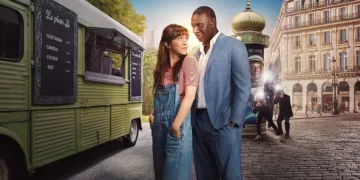
She is meant to be the anchor. Their collision is engineered by the script’s thinnest logic in a Parisian café, a setting so immaculately rendered it feels less like a real place and more like a set waiting for its actors. The city itself is a key performer, presented as a soft-focus dreamscape whose primary function is to distract from the emotional vacancy at its core.
The Vacant Idol and The Vanishing Woman
The film’s central male figure is a fascinating void. Abel’s character is not merely immature; he is a perfect product of an ecosystem that infantilizes its stars, leaving them unable to navigate basic human tasks. His tantrums are epic. His condescension is boundless, memorably demonstrated when he dismisses the staff of a public hospital as “bottom feeders.”
This is not the charming flaw of a lovable rogue; it is the ethical rot of a man detached from consequence. Omar Sy’s natural magnetism radiates from the screen, a physical energy that fights against the script’s inertia. Yet, even his considerable presence cannot animate this hollow man or make his redemption believable. Standing opposite him is Marion, a figure of supposed strength who ultimately reveals a startling lack of agency.
Sara Giraudeau imbues her with a quiet dignity, but the character’s internal life remains a closed book. Her own stated ambitions, such as owning a food truck, are introduced as character details and then promptly forgotten, spectral hints of a life she might have led in a different film. She exists to absorb Abel’s selfishness and reflect a better version of him back, a thankless, one-dimensional role. The supporting cast orbits this imbalance, their talent wasted on characters too thinly drawn to register.
A Blueprint for Affection
Examining the central romance is like performing an autopsy: all the requisite parts are present, but there are no signs of life. The film never builds a convincing case for their union, leaving the audience to ponder the fundamental question of Marion’s motivation. What psychological calculus leads her to invest in a partner so demonstrably narcissistic and helpless?

The script provides no answer, relying instead on the genre’s well-worn shorthand. We are shown lighthearted montages and forced banter, moments that follow the precise geometry of a romantic comedy blueprint without containing any of its spirit. Their chemistry is a matter of aesthetic arrangement, two attractive people sharing a frame. The power dynamic is stark and unexplored. Marion is cast in the role of emotional caretaker, the steady hand meant to guide a spoiled celebrity toward basic decency. This emotional labor is presented as the foundation of their love.
The film’s most significant failure is its superficial treatment of fame. The theme is invoked through paparazzi and tabloid headlines, but these are mere set dressing. The narrative never truly grapples with how a life lived under constant surveillance warps identity, distorts intimacy, or corrodes the soul. It is a potentially rich vein of inquiry that the film is content to leave untouched.
The Tyranny of the Pretty Picture
The film’s visual strategy is one of relentless, suffocating beauty. Director Nina Rives and cinematographer Renaud Chassaing employ consistently high-key lighting that bleaches the frame of all shadow, all ambiguity. Paris becomes a city without secrets or texture, a polished surface perfectly reflecting the narrative’s own lack of depth.

It is the antithesis of noir’s chiaroscuro, a world where moral complexity cannot exist because there are no dark corners for it to hide in. The camera moves with a languid, almost soporific grace, indulging in the city’s architectural splendor at the expense of narrative momentum. This contributes to the film’s punishingly slow pace. The two-hour runtime is not used to deepen character or explore nuance; it is used to luxuriate in its own aesthetic, creating a sense of inertia that weighs down the entire picture.
The inevitable “happily ever after” ending arrives not as an emotional culmination but as a contractual obligation. It is a neat, tidy bow on an empty box, a final confirmation that the film is more interested in fulfilling a formula than in telling a story with a human pulse. The experience is like looking at a postcard: lovely to behold for a moment, and just as easily forgotten.
French Lover is a French romantic comedy film released exclusively on Netflix worldwide on September 26, 2025. Directed by Lisa-Nina Rives, the movie tells the story of Abel Camara (Omar Sy), a charismatic and self-absorbed A-list movie star, whose life takes an unexpected turn when he crosses paths with Marion (Sara Giraudeau), a pragmatic, down-to-earth chef and divorcee. The film explores their unlikely connection and whether their love can survive the pressure of fame and the vast difference between their two worlds, offering a modern, heartfelt take on the classic opposites-attract romance formula.
Full Credits
Director: Lisa-Nina Rives
Writers: Lisa-Nina Rives, Hugo Gélin, Noémie Saglio
Producers and Executive Producers: Hugo Gélin, ZAZI Films, Federation Studio France, Korokoro Productions
Cast: Omar Sy, Sara Giraudeau, Pascale Arbillot, Alban Ivanov, Cindy Bruna, Benoît Crou, Xavier Lacaille, Claudia Bacos
Director of Photography (Cinematographer): Renaud Chassaing
Editors: Valérie Deseine
Composer: Guillaume Ferran
The Review
French Lover
French Lover is a triumph of aesthetics over authenticity. Its polished visuals and the inherent charisma of its leads cannot compensate for a hollow script and a central romance built on a foundation of narrative convenience. The film is a beautiful, empty vessel, a two-hour journey to a destination you saw coming from the first frame. It is a cinematic confection that looks exquisite but offers no nutritional value, dissolving on contact and leaving no lasting impression.
PROS
- Visually polished with beautiful cinematography showcasing a romanticized Paris.
- Strong, charismatic screen presence from lead actors Omar Sy and Sara Giraudeau.
- High-gloss production design creates an appealing, escapist atmosphere.
CONS
- The script is formulaic, predictable, and emotionally inert.
- The lead characters are underdeveloped, particularly the unlikably immature Abel and the passive Marion.
- The central romance lacks a believable foundation and feels unearned.
- An overlong runtime contributes to a plodding, uneven pace.
- Its exploration of fame and relationships remains superficial.