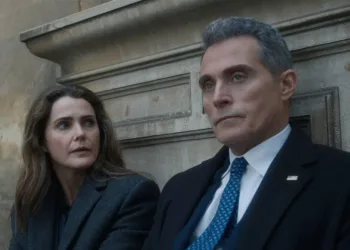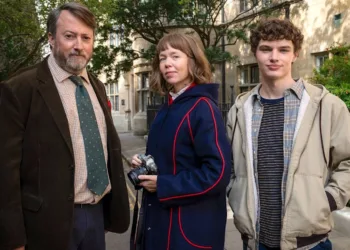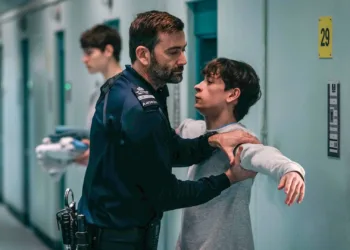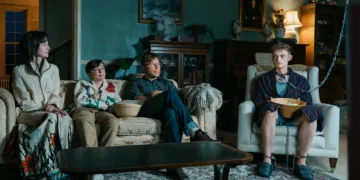



















The life of Tommy is a blur of cheap stimulants and petty vandalism, a nocturnal existence rendered in the frantic language of social media clips. He is a caricature of disaffected youth, crashing cars and tormenting strangers until one night’s drunken stupor ends abruptly. He awakens not to a hangover but to the cold reality of a basement.
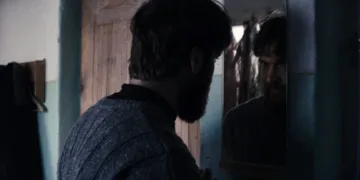
A metal collar is fitted around his neck. He is chained to a wall. His captor is Chris, a man whose soft-spoken demeanor and suburban attire are a thin veil for an unnerving project. Chris intends to save Tommy from himself, to forcibly rehabilitate him. The stage is set for a disquieting inquiry into the nature of control, where the line between salvation and damnation is a very thin one.
The Architecture of a Family
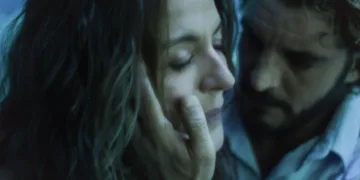
Tommy’s prison is a sprawling country home, an exercise in gothic tension where every shadow seems purposeful and the sound design amplifies the dread. The family unit operating within its walls is a study in quiet aberration. Chris’s wife, Kathryn, drifts through rooms like a phantom, a pale figure whose dormant maternal instincts are grotesquely reawakened by the presence of their captive.
Expressionistic framing often isolates her in doorways, a ghost haunting her own life, her silence a heavier presence than any dialogue. Their son, Jonathan, offers a counterpoint of relentless, unnerving cheerfulness; his every bright word lands with the dissonance of a major chord in a minor key. Chris’s methods are a blend of new-age therapy and medieval discipline.
The use of Tommy’s own social media videos as a re-education tool is a particularly modern cruelty, forcing him to confront a curated image of his own monstrosity. The dynamic between captor and captive shifts with geological slowness. Tommy’s raw defiance begins to erode, replaced by a complex dependency on the very man who stole his freedom.
This is not simple Stockholm syndrome; it is a twisted search for paternal structure within a moral vacuum. The family’s motives remain shrouded, hinting at a past trauma that this ritual is meant to appease. Even the housekeeper, Rina, who functions as the audience’s frightened surrogate, is ultimately absorbed into the house’s oppressive gravity, her storyline’s abrupt cessation a final denial of any simple escape.
A Treatise on Taming
The film presents its central procedure as “rehabilitation,” a term that frays at the edges the longer we observe its brutal mechanics. Chris’s project raises a fundamental question: is this a misguided act of altruism or simply sadism cloaked in therapeutic language?
The narrative probes the philosophical space between freedom and security, echoing a Hobbesian bargain where absolute liberty is surrendered for the promise of safety. Tommy’s former life was one of anarchic freedom, yet it was also a prison of impulse. In captivity, he discovers a perverse form of care, a rigid structure his own life lacked.
The film finds its sharpest satirical edge in Chris’s worldview, particularly his dismissal of Tommy’s protests with a lecture on his generation’s tendency toward “victimhood.” The commentary is dry, acidic, and uncomfortably familiar, complicating audience allegiance by making its villain the mouthpiece for a recognizable cultural critique. The film’s title is the key to its entire thesis. The constant visual and verbal reinforcement of Tommy as a stray dog—collared, leashed, and trained—is a sustained metaphor for a process of dehumanization.
The camera often adopts a high angle, looking down on Tommy, while the sound mix keeps the metallic clink of his chain ever-present. The film methodically strips its subject of his autonomy to ask what remains, forcing a deep reflection on how much control a person will accept for a sense of purpose, even one delivered at the end of a chain.
The Polished Cage
The film is anchored by its formidable cast, who give flesh to these allegorical figures. Stephen Graham’s Chris is a masterclass in contained threat, his mild exterior and calculated placidity barely concealing a core of absolute rigidity.

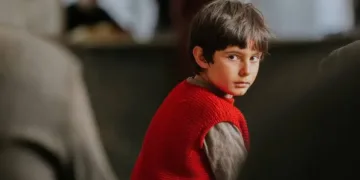
Anson Boon charts Tommy’s descent from belligerent youth to vulnerable dependent with a raw physicality, his very posture changing from an aggressive swagger to a defeated slump. Andrea Riseborough, as Kathryn, commands the screen with an enigmatic stillness, using the negative space around her to convey entire histories of grief. Director Jan Komasa builds a suffocating, hermetic world, aided by Michel Dymek’s precise cinematography.
The basement is rendered in deep chiaroscuro, a classic noir technique that makes the space both a physical and moral abyss. This darkness is contrasted with the flat, sterile, almost overexposed lighting of the upstairs living areas, making the supposed normality of the home feel deeply sinister. Occasional wide shots of the desolate moors that surround the house amplify Tommy’s complete isolation, turning nature itself into another wall of his prison.
The screenplay, however, cannot maintain this high level of precision. By leaving motivations deliberately obscure, the characters risk becoming mere ciphers for ideas, preventing genuine emotional investment. The narrative loses its tautness in the final act as the psychological chess game reaches a stalemate instead of a checkmate. The film’s potent concept is not always matched by its execution.
The film “Good Boy” had its world premiere at the 50th Toronto International Film Festival on September 5, 2025. Information about a wider theatrical release or streaming availability has not yet been announced.
Full Credits
Director: Jan Komasa
Writers: Bartek Bartosik, Naqqash Khalid
Producers: Jeremy Thomas, Ewa Piaskowska, Jerzy Skolimowski
Cast: Stephen Graham, Andrea Riseborough, Anson Boon, Kit Rakusen, Monika Frajczyk
Director of Photography: Michal Dymek
Editor: Agnieszka Glinska
Composer: Abel Korzeniowski
The Review
Good Boy
Good Boy is a visually sharp and superbly acted psychological thriller, carried by its unsettling premise and meticulous craft. Its exploration of control and freedom is intellectually stimulating, creating a potent atmosphere of dread. The film's power is diminished by a screenplay that prioritizes symbolic weight over character depth, causing the narrative to falter in its final stages. It remains a fascinating, if flawed, piece of cinema that leaves a cold, memorable impression.
PROS
- Exceptional performances from Stephen Graham, Anson Boon, and Andrea Riseborough.
- Atmospheric direction and precise, meaningful cinematography.
- A potent and thought-provoking central concept.
- Sharp, darkly humorous social commentary.
CONS
- Characters often feel like abstract symbols rather than developed individuals.
- The narrative loses momentum and tension toward the end.
- An ambiguous script that avoids providing satisfying motivations.
- The final act pushes the premise into absurdity.