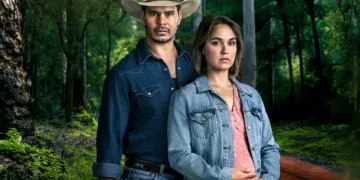























Australian television has found in the crime procedural a potent tool for national interrogation. Few series demonstrate this better than Mystery Road: Origin, which uses the familiar beats of a detective story to excavate the country’s deepest wounds. The second season moves Detective Jay Swan (Mark Coles Smith) to the perpetually damp timber town of Loch Iris, a place that feels physically and spiritually distant from the sun-baked landscapes the franchise is known for.
It sets its story in the year 2000, a moment of national optimism defined by the Sydney Olympics and talk of reconciliation. The series leverages this historical irony to great effect. While the nation looked ahead, Loch Iris remained caught in its history, a town of whispered secrets and unresolved sins.
Jay and his partner Mary Allen (Tuuli Narkle), pregnant and serving as guardians to their niece Anya, arrive seeking peace on Mary’s ancestral Country. What they find instead is a community where the past refuses to be buried and fresh starts are a dangerous illusion.
The Locked Room of History
The town’s simmering hostility boils over with a series of seemingly disconnected events. A terrified Aboriginal boy, Swayze (Aswan Reid), is found fleeing in a stolen car. A child disappears from the local caravan park. A man is found murdered. These are the standard starting points for any crime drama, but here they serve as triggers that threaten to expose a foundational rot.
The narrative lines all converge on St Joseph’s, a former church-run home whose history of abuse is literally locked away in a records room at the town hospital. This location is more than a plot device; it stands as a monument to the institutional horrors of the Stolen Generations and the state-sanctioned destruction of families. The show astutely uses the audience’s familiarity with genre storytelling to make this difficult history immediate and absorbing.
Mary’s personal quest to find her own birth records becomes the key to unlocking this collective trauma. Her search transforms her from a supporting character into a parallel investigator whose work is just as vital as Jay’s. The atmosphere of Loch Iris is thick with this unspoken history, a place haunted not by ghosts but by the living weight of its own secrets.
Walking the Tightrope of Authority
Jay Swan operates within a system that was not built for him. His description of his work as “walking a tightrope” is a concise summary of the impossible balance he must maintain as an Aboriginal man representing colonial law. His quiet professionalism is a form of resistance in a town that expects him to fail.
This dynamic is sharpened through his interactions with Sergeant Paula “Simmo” Simmons, played with magnificent grit by Robyn Malcolm. Simmo is the embodiment of white indifference, a once-idealistic cop now content to manage the town’s decline from a barstool. She is less a character than a condition, representing a community’s deep-seated refusal to look at itself honestly. Their relationship is a slow-burning fire of professional friction and grudging respect.
The arrival of Jay’s brother, Sputty (Clarence Ryan), adds another layer of complexity. Sputty’s more confrontational response to the town’s racism provides a sharp contrast to Jay’s methodical approach, showing there is no single correct way to survive in such a hostile environment. The central investigation becomes deeply personal for Jay as Mary’s search for her origins puts their entire family in the path of those who would kill to keep the past hidden.
Crafting a Colder West
The season’s artistic success is a direct result of its production. The decision to employ an all-First Nations writing team is a powerful statement, fundamentally shifting the perspective from which this story is told. This behind-the-scenes representation is a key factor in the show’s authenticity and points to a progressive trend in global television, where storytelling authority is rightfully being placed in the hands of the communities being depicted.

Visually, directors Wayne Blair and Jub Clerc create a distinct aesthetic. They replace the warm, dusty tones of a Western with a palette of cold blues and damp greens. This is a different kind of frontier, one defined by emotional repression and buried secrets. The performances are superb.
Mark Coles Smith carries the weight of Jay’s internal struggles with a powerful stillness, while Robyn Malcolm’s Simmo is a memorable addition to the canon of difficult, compelling characters. Even when the plot follows a recognizable path, the series is elevated by its commitment to character, its thick atmosphere, and its politically sharp point of view, confirming its status as a vital piece of television.
“Mystery Road: Origin” season two premiered on Sunday, September 21, 2025, on ABC TV, with all episodes available to stream on ABC iview. The series is a prequel to the “Mystery Road” franchise, following a young Detective Jay Swan and his partner Mary as they attempt to forge a new life together. The new season is set six months after the first, in a fading timber town where they uncover a crime and a shadowy past that threatens to tear them apart.
Full Credits
Director: Wayne Blair, Jub Clerc
Writers: Steven McGregor, Jada Alberts, Erica Glynn, Samuel Paynter, Gary Hamaguchi
Producers and Executive Producers: Greer Simpkin, David Jowsey, Ivan Sen, Brett Sleigh, Rachel Okine
Cast: Mark Coles Smith, Tuuli Narkle, Robyn Malcolm, Clarence Ryan, Geoff Morrell, Nicholas Bell, Luke Carroll, Helen Morse
Director of Photography (Cinematographer): Sky Davies
Editors: Nick Holmes
Composer: Vin Goodyer
The Review
Mystery Road: Origin Season 2
While its central mystery follows a familiar path, this season of Mystery Road: Origin is essential television. Its true strength is its atmospheric execution and its sharp examination of Australia’s historical wounds. With powerhouse performances from Mark Coles Smith and Robyn Malcolm and the authentic voice of a First Nations writing team, the series uses the crime genre to ask vital questions about justice and memory. It is a moody, intelligent, and deeply significant production that proves how potent genre storytelling can be.
PROS
- Mark Coles Smith and Robyn Malcolm deliver powerful, layered performances.
- The chilly, damp setting of Loch Iris is masterfully realized, creating a distinct and unsettling mood.
- The series intelligently uses its crime plot to explore the historical trauma of the Stolen Generations and systemic racism.
- The all-First Nations writing team brings a crucial and authentic perspective to the narrative.
CONS
- The central murder mystery can feel conventional compared to the show's thematic depth.
- The slow-burn, character-focused pace might not appeal to all viewers seeking a faster thriller.