




























Anthony D’Ambrosio’s “Triumph of the Heart” confronts us with a question that has haunted human consciousness since we first contemplated mortality: what remains when everything is stripped away? Set within the suffocating confines of Auschwitz’s starvation bunker during August 1941, this biographical drama excavates the final two weeks of St. Maximilian Kolbe’s life, the Polish Franciscan priest who volunteered to die in place of a fellow prisoner.
The film refuses easy sanctification. Shot on location in Poland with a predominantly Polish cast led by Marcin Kwaśny as Kolbe, D’Ambrosio constructs his narrative around an ensemble of condemned men who represent the fractured soul of wartime Poland: the patriot, the laborer, the communist, the Jew, the atheist. Each becomes a mirror reflecting different aspects of human response to absolute desolation.
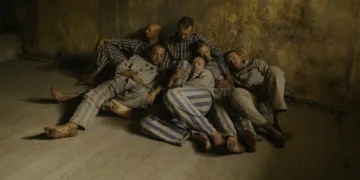
This is cinema that demands confrontation with darkness. The bunker becomes both literal prison and metaphysical crucible, where ten men face the systematic erasure of their humanity. Yet within this descent into the abyss, D’Ambrosio discovers something that resists destruction. The film explores how dignity persists when dignity should be impossible, how hope can emerge from hopelessness without betraying the reality of suffering.
Flesh Made Spirit, Spirit Made Flesh
Kwaśny’s Kolbe emerges as a figure caught between transcendence and flesh, sainthood and humanity. The performance avoids the trap of beatific abstraction, instead presenting a man who carries both profound faith and profound uncertainty. His leadership manifests through presence rather than proclamation, through the simple act of asking his fellow prisoners to share their names, their memories, their favorite meals.

The ensemble work creates a complex tapestry of masculine vulnerability. Rowan Polonski’s Albert brings particular depth to the role of the soldier questioning God’s existence in the face of incomprehensible evil. These men do not transform into angels; they remain stubbornly, heartbreakingly human. Through flashbacks that reveal their former lives, we witness not just what they have lost, but who they were before history crushed them.
Christopher Sherwood’s SS Commandant Karl Fritzsch provides the necessary counterpoint of calculated cruelty. His portrayal reveals the banality of evil, the way systematic destruction can become routine. Yet the performance suggests something deeper: the recognition that breaking these men’s spirits has become his obsession, his own form of spiritual imprisonment.
The actors convey the physical ravages of starvation with unflinching honesty. Bodies diminish, minds fragment, hallucinations blur the boundaries between memory and madness. Yet their performances maintain an essential dignity that speaks to something indestructible within human nature.
Shadows and Illumination
D’Ambrosio’s visual language operates through stark dialectics of light and shadow, creating a chiaroscuro that mirrors the philosophical tensions at the film’s heart. Darkness dominates the frame, yet light persistently intrudes, cutting through the bunker’s gloom with surgical precision. This interplay becomes the film’s primary metaphor: how illumination can exist within absolute darkness without negating that darkness.
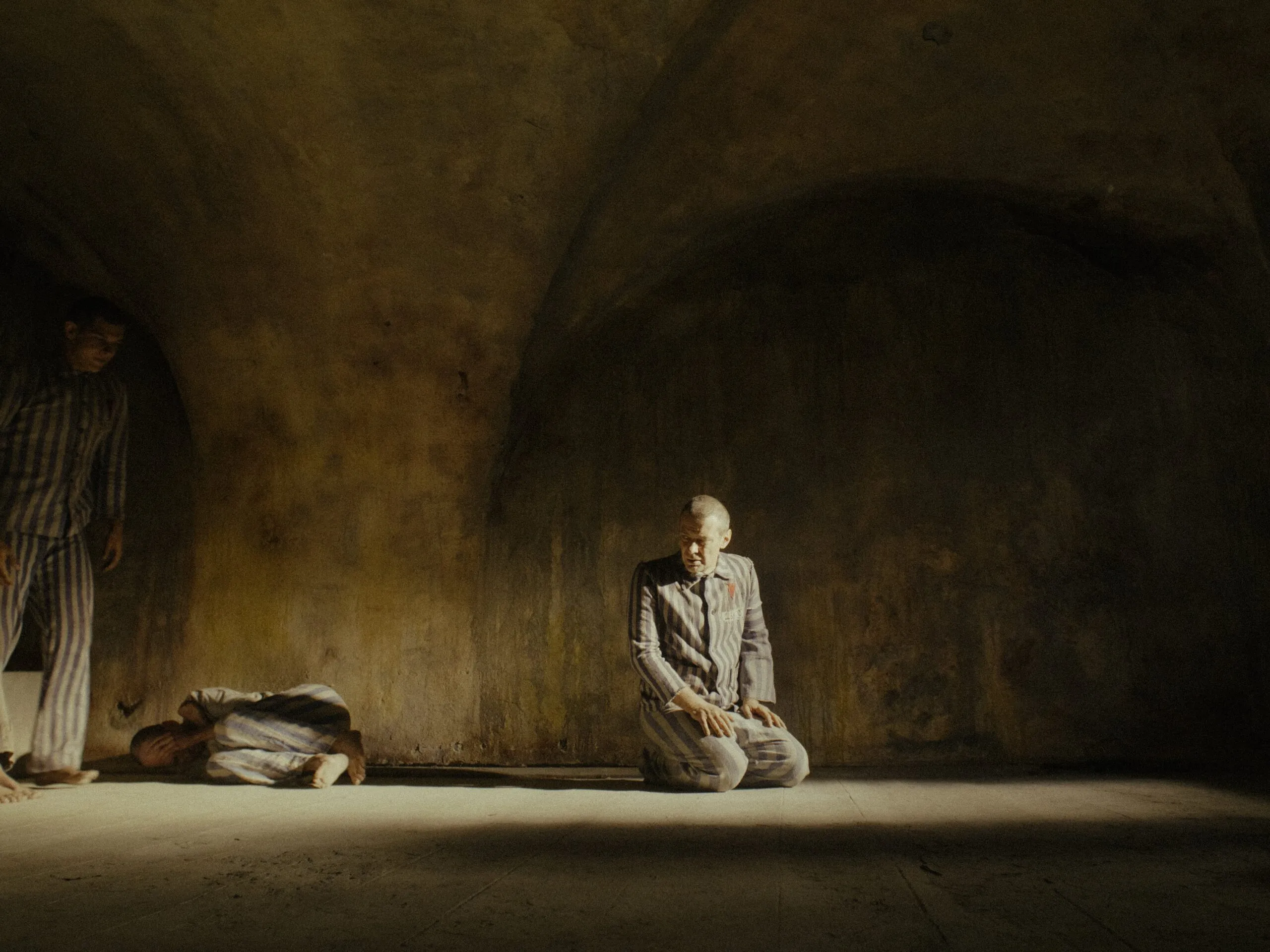
The confined setting could easily become claustrophobic theater, yet D’Ambrosio’s direction maintains spatial intimacy without suffocation. His camera work finds movement within stillness, discovering new angles and perspectives within the bunker’s brutal geometry. The editing maintains psychological rhythm rather than conventional pacing, allowing moments of silence to expand and contract like breathing.
Sound design becomes crucial to the film’s emotional architecture. Strategic silences give way to singing, hymns, and fragments of Polish songs that transform into acts of spiritual resistance. These moments of music pierce the oppressive quiet, creating ripples that extend beyond the bunker walls to inspire other prisoners. The acoustic landscape suggests that some forms of expression cannot be silenced, even in places designed to eliminate all human voice.
Flashbacks expand the narrative scope without diminishing the bunker’s centrality. These glimpses of former lives arrive like fragments of dreams, sometimes unclear whether they represent memory or hallucination. The production design maintains authentic period atmosphere while serving the film’s deeper metaphysical concerns about memory, identity, and the persistence of love across time.
The Persistence of the Sacred
“Triumph of the Heart” grapples with fundamental questions about the nature of victory and defeat. Traditional definitions collapse within the bunker’s walls; conventional measures of success become meaningless. The film suggests that true triumph might exist in maintaining one’s humanity when humanity itself is under assault.

Kolbe’s transformation of his fellow prisoners operates through mysterious alchemy. He does not preach or proselytize; instead, he creates space for others to discover their own capacity for transcendence. The community that forms among these dying men represents something precious and fragile, a brief flowering of brotherhood in conditions designed to destroy all human connection.
The film handles its religious content with sophisticated restraint. Faith becomes lived experience rather than doctrine, expressed through actions rather than words. This approach allows the story to speak across religious boundaries while maintaining its spiritual core. The sacred emerges from the profane, the divine from the human, without requiring viewers to accept any particular theological framework.
D’Ambrosio achieves remarkable balance between honoring his subject and acknowledging complexity. The film neither sanitizes the horror nor exploits the suffering, instead finding a middle path that respects both the historical reality and the spiritual dimensions of this story. “Triumph of the Heart” stands as mature filmmaking that trusts its audience to engage with difficult material and find their own meaning within it.
This is essential viewing for those willing to confront cinema’s capacity to illuminate the darkest corners of human experience while discovering light that cannot be extinguished.
“Triumph of the Heart” is a drama and historical film directed by Anthony D’Ambrosio. It had its Polish premiere on August 13, 2025, and is scheduled for a limited theatrical release in the United States on September 12, 2025, through Outsider Pictures. While it will be shown in select movie theaters, it may also become available to buy or rent on video-on-demand services like Prime Video and Apple TV at a later date.
Full Credits
Director: Anthony D’Ambrosio
Writers: Anthony D’Ambrosio
Producers: Cecilia Stevenson
Cast: Marcin Kwaśny, Christopher Sherwood, Rowan Polonski, Armand Procacci, Sharon Oliphant, Oleg Karpenko, Peggy Schott, Lech Dyblik
Director of Photography: Andrew Holzschuh
Editors: Anthony D’Ambrosio, James K. Crouch
Composer: Thomas Farnon
The Review
Triumph of the Heart
D'Ambrosio has crafted a profound meditation on human dignity that transcends typical religious cinema. "Triumph of the Heart" succeeds as both historical drama and spiritual inquiry, finding authentic grace within authentic suffering. The film's restraint and respect for its subject matter create powerful emotional resonance without exploitation. While demanding mature engagement, it rewards viewers with genuine insight into the nature of hope and sacrifice.
PROS
- Exceptional lead performance by Marcin Kwaśny
- Sophisticated handling of religious themes
- Strong ensemble work and character development
- Masterful use of confined setting
- Authentic Polish production values
- Profound thematic depth without preaching
CONS
- Emotionally demanding subject matter limits audience
- Some dialogue occasionally feels polished for the setting
- Claustrophobic bunker setting may challenge some viewers
- Limited action sequences
- Requires significant emotional investment