
























Yuichiro Sakashita’s Blonde moves at the clip of contemporary life, opening in freefall and staying there. The story follows Kenta Ichikawa, played with verve by Takanori Iwata, a 30-year-old middle school teacher whose personal and professional lives collide. Misaki, his girlfriend, raises the question of marriage, which rattles him.
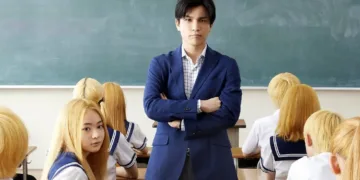
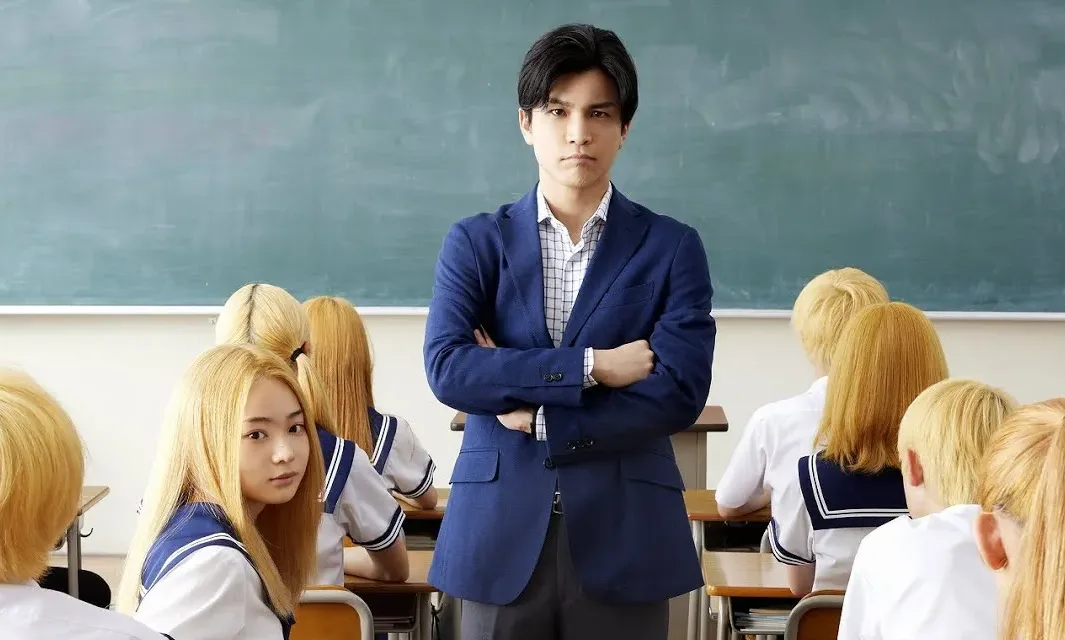
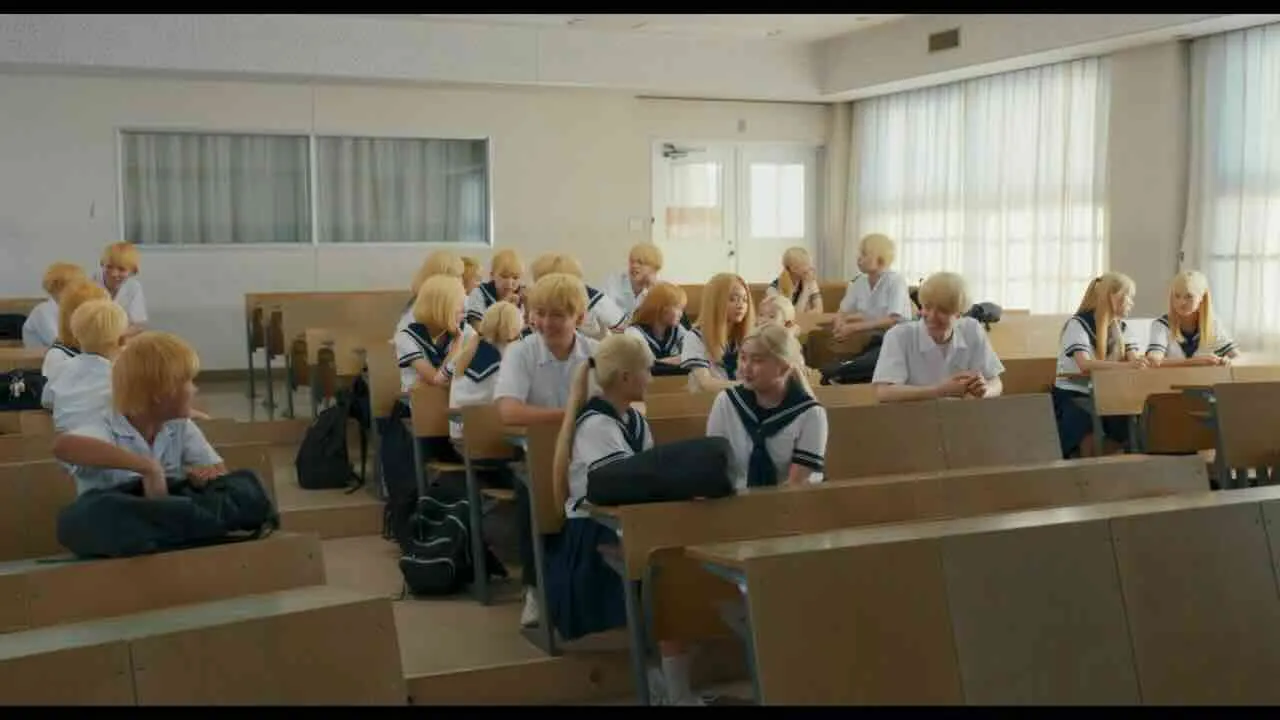
A school incident then erupts and pulls the ground from under him. About twenty students arrive with bleached hair, organized by Itaroku, played by Tamaki Shiratori, as a direct challenge to strict appearance rules. Sakashita, known for comedies with a social angle, builds a sharp critique of school culture from this lively setup, letting a nimble comedy frame bigger questions about conformity and control.
The Teacher’s Inner Child and the Student’s Inner Adult
The engine of the film is a psychological portrait of Kenta, which shapes Blonde as a hesitant coming-of-age tale for a teacher. He is prickly, self-involved, and wary of turning 30, clinging to avoidance as a coping strategy. That evasion powers the humor.
Sakashita leans on voiceover and direct address, opening Kenta’s head to us in a stream of dry, self-flagellating commentary about his life, the test-heavy school culture, and the insecurity that keeps him spinning his wheels.
Kenta’s interplay with Itaroku flips the usual classroom hierarchy. She takes responsibility, argues for structural change, and asks questions that puncture his rule-bound rationalizations. I read their pairing as a playful dismantling of authority myths, with the student modeling the steadiness the teacher lacks. Their cooperation becomes the film’s narrative hinge. Migi Kadowaki, as Misaki, gives the personal stakes a steady pulse and frames Kenta’s stasis with clear-eyed patience.
Rules, Rebellion, and Narrative Threads
Blonde lands its critique of social rigidity with clarity. The students’ protest exposes an institution that keeps outdated regulations because altering them is deemed inconvenient, a portrait of inertia shaped by habit rather than malice.
The bleached hair quickly becomes a national talking point, pulling cameras to the school and drawing a comment from the Prime Minister. The speed of that swell captures how youth-led defiance can seize the public gaze.
The film carries two threads at once: Kenta’s stunted growth and the students’ campaign against the rulebook. The link between them slackens at points, since Kenta’s inner stalemate does not always lock into the external fight over policy.
The pace stays brisk and the dialogue snappy, which keeps attention trained on the screen. The midsection loosens its grip as the satire spreads its focus, and the ending lands with a softer beat than the initial promise sets up.
Unvarnished Style and Striking Imagery
Sakashita’s direction keeps a clean, frank surface that fits a topical comedy. The laughs come from Kenta’s interior monologue and the small collisions of ego and embarrassment, rather than big comic business.
Yuta Tsukinaga’s cinematography favors clarity and brightness, and the sea of golden hair cuts through the school’s neutral halls with a simple, rebellious charge. That image sticks. As someone who gravitates to dry comic rhythms, I found the steady camera and unfussy staging a good match for the script’s barbed asides and quick pivots.
The cast lifts the material. Takanori Iwata gives Kenta a showy, self-pitying edge and keeps him watchable through stubbornness and panic. Tamaki Shiratori brings poise and spark to Itaroku’s resolve. The film runs with its premise and keeps the energy lively, shaping a sharp critique inside a light, easy watch. It sticks to crisp humor and a clear idea, and even when the last stretch settles, the piece still plays as a confident, engaging satire.
The 2025 Japanese film Blonde (Kinpatsu), which is a topical comedy-drama. It is not the 2022 American film about Marilyn Monroe. The film had its World Premiere at the 38th Tokyo International Film Festival on October 28, 2025, and is scheduled for a wider release in Japanese theatres on November 21, 2025. It centers on a 30-year-old middle school teacher struggling with his own immaturity whose life is upended when a mass student protest breaks out, with dozens of students dying their hair blonde in defiance of strict school rules. You can expect to watch this movie in Japanese theatres via the distributor, The Klockworx, starting in late 2025.
Credits
Title: Blonde (金髪)
Distributor: The Klockworx
Release date: October 28, 2025 (World Premiere at TIFF), November 21, 2025 (Japanese Theatres)
Running time: 103 minutes
Director: Sakashita Yuichiro
Writers: Sakashita Yuichiro
Producers and Executive Producers: Yusuke Wakabayashi, Kazumi Fukase
Cast: Takanori Iwata, Tamaki Shiratori, Mugi Kadowaki, Maho Yamada, Kentaro Tamura, Chika Uchida
Director of Photography (Cinematographer): Yuta Tsukinaga
Editors: Ryuichi Takita
Composer: Yuko Sebu
The Review
Blonde
Yuichiro Sakashita's latest is a clever and highly entertaining satirical comedy. The use of Kenta's internal monologue makes for dry, character-driven humor, anchored by Takanori Iwata's perfectly insufferable performance. While the film offers sharp critique of rigid social rules, its dual plots—the social rebellion and Kenta's personal immaturity—never fully merge, causing the narrative to sputter towards a soft finish. It is a fun, topical watch that does not quite fulfill its explosive potential.
PROS
- Sharp, dry comedy rooted in the protagonist's internal monologue and insecurity.
- Effective critique of Japan's rigid school system and social inertia.
- Strong, charismatic central performances by Takanori Iwata and Tamaki Shiratori.
- Entertaining and digestible style, with savvy use of voiceover and fourth wall breaks.
CONS
- The two primary narrative strands (Kenta’s psychology and the student protest) remain disconnected.
- The story loses momentum toward the final act, leading to an underwhelming finish.
- Kenta's personal life storyline, particularly with his girlfriend Misaki, is underdeveloped.
- The film is not always as funny as it intends to be, relying heavily on Kenta's self-pity.