



























Todd Rohal’s “F*ck My Son!” announces itself with a title that functions as both warning label and litmus test. Adapted from Johnny Ryan’s graphic novel, the film occupies that peculiar territory where exploitation cinema meets body horror, where midnight movie sensibilities collide with deliberate cultural antagonism.
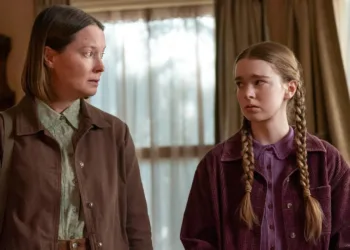
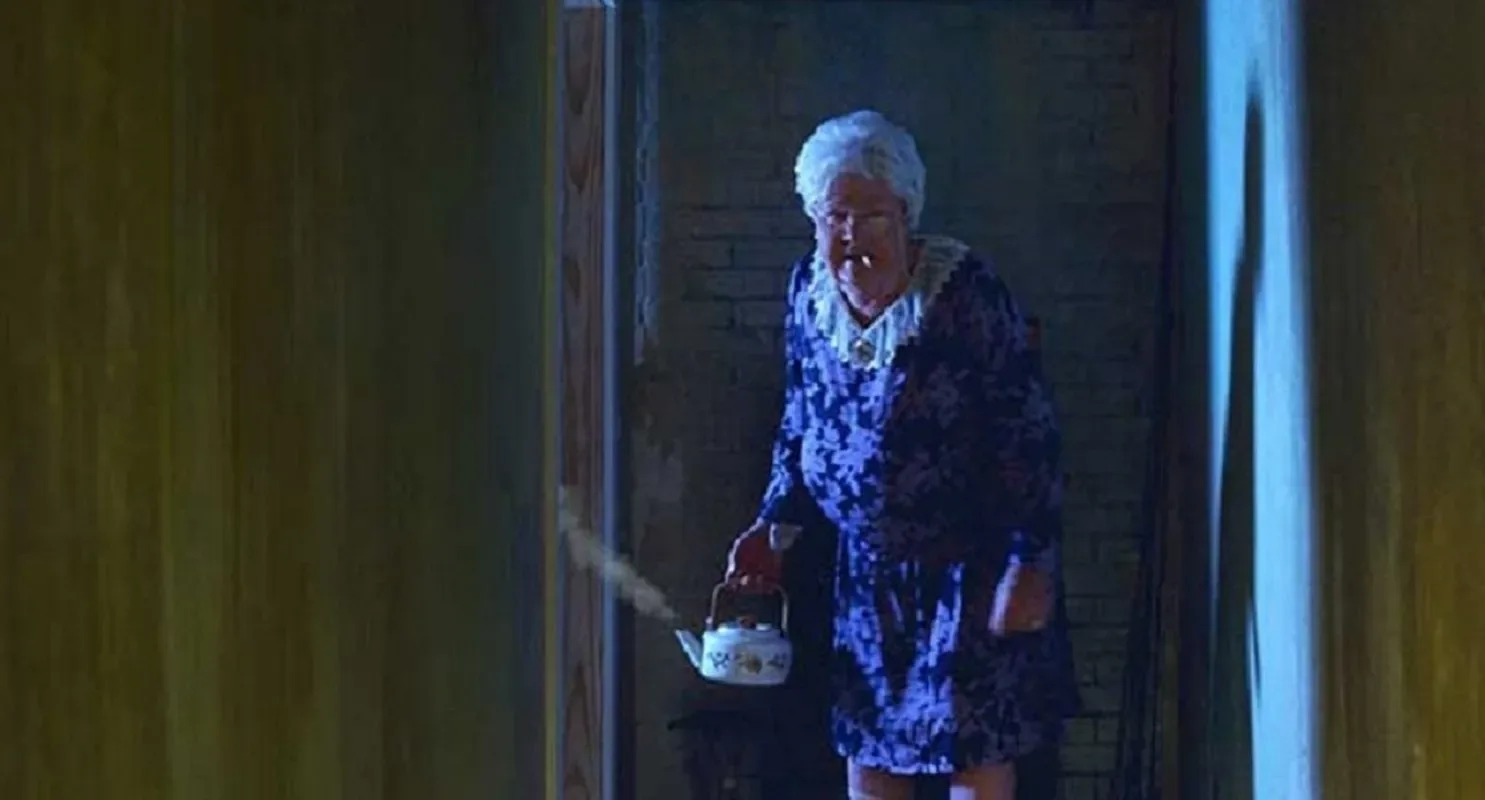
The premise is admirably direct: Vermina (Robert Longstreet, performing in drag with manic commitment) kidnaps single mother Sandi (Tipper Newton) and her young daughter Bernice (Kynzie Colmery), then issues an ultimatum that mirrors the film’s title. Sandi must satisfy Vermina’s grotesquely deformed son Fabian (Steve Little), or Bernice suffers the consequences.
This is X-rated cinema that wears its rating like armor. Rohal has designed an experience intended exclusively for theatrical consumption, complete with “Perv-O-Vision” glasses that promise to enhance (or obscure) the film’s considerable grotesquerie. The question isn’t whether the film will offend. The question is whether offense alone constitutes artistic achievement. It doesn’t.
When Transgression Becomes Tedium
The film’s opening sequence represents its creative zenith. A fake theater pre-show hosted by one Dagney Milstead walks audiences through proper conduct: no defecating in seats, no masturbation during screenings. The Perv-O-Vision gimmick gets introduced with knowing winks and calculated absurdity. For perhaps ten minutes, “F*ck My Son!” achieves what it promises: a gleeful dismantling of contemporary moviegoing decorum. Then the actual narrative begins, and the descent is precipitous.

Rohal’s fundamental miscalculation lies in his relationship with repetition. A joke that might land once gets stretched across five or six iterations. Fabian burps in Sandi’s face. Then does it again. And again. The “Three Blind Tenors” gag (a strained conflation of the operatic trio and Andrea Bocelli) appears multiple times, never achieving lift-off. The film mistakes audience endurance for engagement, confuses duration with impact.
The tonal schizophrenia proves fatal. X-rated exploitation demands grimy authenticity, yet Rohal intersperses this with cartoonish zaniness (the “Meatie Mates” animated sequences, featuring anthropomorphic meat products) and obligatory horror homages. The film can’t decide if it’s genuinely disturbed or merely performing disturbance.
The AI-generated imagery controversy (approximately 90 seconds scattered throughout) deserves contextual understanding. Rohal deploys the technology for pre-show crowds and the “Meatie Mates” segments, deliberately highlighting the artificial quality. This reads as commentary on algorithmic slop fed to contemporary children, the soulless content that passes for entertainment in our streaming-saturated present. The intent is sound. The execution remains distracting.
What truly undermines the film is its desperate quality. Transgressive cinema works best when it feels effortless, when boundary-crossing emerges organically rather than through calculated provocation. This film announces each taboo violation with a megaphone. The self-satisfaction becomes oppressive.
At 94 minutes, the film has no business feeling this padded. Then comes the two-part ending, announced via pompous title cards (“The Ending: Part I”), a joke about substance-free narratives requiring elaborate epilogues. The joke would work if the film hadn’t already exhausted its audience’s patience.
Commitment in Service of Nothing
Tipper Newton deserves better than this material. Her performance as Sandi provides the film’s only genuine emotional anchor, a baseline of recognizable human response against which the surrounding madness can register. She plays maternal desperation with exasperated sincerity, grounding scenes that would otherwise float away into pure abstraction. There’s legitimate scream queen potential here, wasted on a script that treats her primarily as a receptacle for gross-out gags.
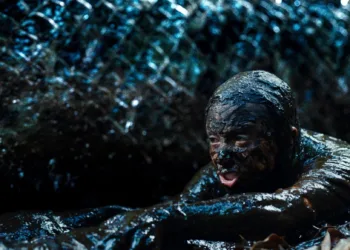
Longstreet attacks Vermina with full-throated excess, chewing scenery at eleven throughout. The performance suits the material’s demands if not its durability. Steve Little disappears beneath Robert Kurtzman’s prosthetic work, which delivers genuinely disturbing practical effects. Fabian’s wart-covered body, his bloated features, the infamous “missing penis” sequence (where Sandi must fish through his interior cavity, encountering hot dogs and insects before finding the horrific appendage) all demonstrate real craft. The body horror elements succeed on their own terms, viscerally unpleasant and technically accomplished, yet completely in service of a narrative that has nowhere to go with them.
The cinematography apes ’80s Z-grade aesthetics, all harsh lighting and flat compositions. This intentional cheapness may enhance the throwback ambitions or simply make the experience cheaper, depending on your tolerance.
The Garbage Defense
“F*ck My Son!” arrives bearing an alibi. Rohal has described it as “garbage made by trashmen for trashmen,” a pre-emptive deflection of criticism. If you don’t like it, you weren’t the intended audience. This defense mechanism has precedent in exploitation cinema’s tradition of audience self-selection. Yet the best transgressive films managed to be provocative AND artistically coherent, earning their shock value through craft rather than announcement.
The film gestures toward deeper themes. Maternal devotion perverted into monstrosity, with both Vermina’s obsession with her son’s sexuality and Sandi’s protection of Bernice representing opposite poles of parental fixation. There’s something here about the grotesque demands we place on bodies, about the violence inherent in sexual coercion. These themes remain gestural. The film is too busy congratulating itself on its own daring to develop any sustained framework.
The theatrical-only release strategy carries meaning. In an age of algorithmic content delivery and infinite streaming libraries, “F*ck My Son!” insists on collective viewing. It positions itself as an event, something to be witnessed communally. This anti-streaming stance has merit. The question is whether the film itself justifies the mandate.
Rohal seems convinced he’s created necessary art for a moment of cultural repression. The Project 2025 references, the hand-wringing about what will still be permissible to make, these elements suggest a film positioning itself as defiance. Transgression as political act, bad taste as resistance.
Perhaps. Or perhaps we’re simply watching a juvenile gross-out comedy that mistakes its own offensiveness for profundity.
The disconnect between title and execution proves telling. A film called “F*ck My Son!” should deliver something genuinely disturbing, something that earns its linguistic aggression. Instead, we get repetitive body humor, fart jokes extended past any reasonable breaking point, and shock beats that feel focus-grouped for maximum taboo violation.
Some moments do land. When the film commits to a joke and moves on, brief sparks of the intended experience emerge. These moments are outnumbered by tedious repetition. The film’s greatest failure is temporal. It’s boring when it should be shocking, repetitive when it should be inventive, self-satisfied when it should be self-aware.
Appreciating that it exists, acknowledging that it refuses to compromise its vision, recognizing the genuine craft in certain technical elements, none of this obligates us to pretend the viewing experience is anything other than exhausting. A failed provocation that confuses offensiveness with entertainment, admirable in concept but exhausting in reality.
F*ck My Son! is a 2025 American comedy horror film written and directed by Todd Rohal, based on the comic book Fuck My Son: A Tale of Terror, Issue One by Johnny Ryan. The film premiered on September 11, 2025, at the Toronto International Film Festival (TIFF) as part of its Midnight Madness program, and was slated for a limited theatrical release on October 17, 2025. The plot revolves around an elderly woman who kidnaps a young woman and her daughter for her mutant son to fornicate with. The movie is noted for its X-rated, boundary-pushing content, drawing inspiration from the works of John Waters, Troma films, and The Texas Chainsaw Massacre.
Full Credits
Director: Todd Rohal
Writers: Todd Rohal, Johnny Ryan (comic book author)
Producers and Executive Producers: Professional Motion Picture, Little Titan, TUbb, Robert Kurtzman MUFX (Production Companies)
Cast: Tipper Newton, Steve Little, Robert Longstreet, Kynzie Colmery, Macon Blair, Gevin Booth, Katie Graham, Tommy Lucente
Director of Photography (Cinematographer): Benjamin Kasulke
Composer: Aaron M. Fernandez Olson
The Review
F*ck My Son!
"F*ck My Son!" mistakes endurance for entertainment, stretching thin provocations across an interminable runtime. While Newton's grounded performance and Kurtzman's grotesque effects demonstrate real craft, the film's desperate pursuit of transgression yields mostly tedium. Rohal's theatrical-only gambit positions garbage as cultural defiance, yet fails to make that garbage interesting enough to justify the collective viewing experience it demands. A provocation that forgot to be provocative.
PROS
- Tipper Newton's committed, grounded performance
- Robert Kurtzman's genuinely disturbing practical effects
- Opening pre-show sequence displays clever satirical edge
- Theatrical-only strategy has conceptual merit
CONS
- Repetitive jokes stretched far beyond their effectiveness
- Desperately tries to shock rather than earning transgression organically
- Tonal inconsistency undermines any coherent vision
- Padded runtime with unnecessary two-part ending
- Self-satisfied quality overwhelms potential insights