











![Kingdom Hearts Collection [I-III] Review](https://gazettely.com/wp-content/uploads/2026/10/Kingdom-Hearts-Collection-I-III-1-360x180.webp "Kingdom Hearts Collection [I-III] Review: KHII Holds Steady as Newer Entries Fluctuate 34")




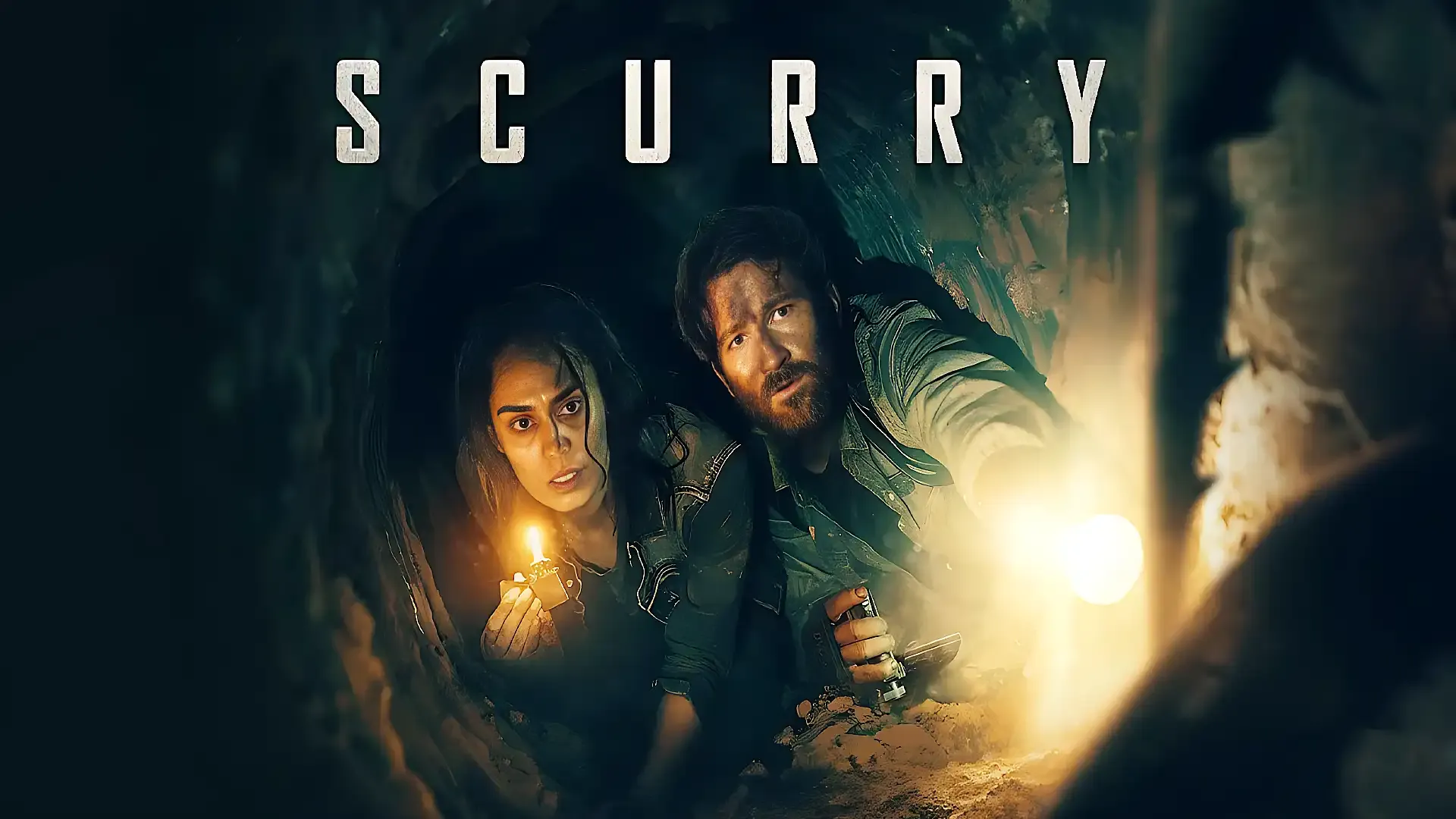

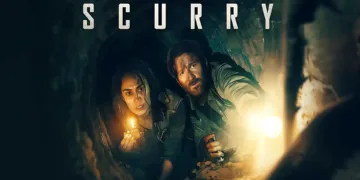
The function of the apocalyptic film is often to chart the societal fissure, to watch the grand machine of civilization grind to a halt. Scurry has little interest in such macro-level concerns. Its opening shot pushes past a burning cityscape to find the true subject: a single man, Mark, at the bottom of a hole. The world has already ended; the story begins in its tomb. For him, the only direction is down, into a geomorphic underworld of tunnels where light is a finite resource and sound is a predator.
The film immediately establishes itself as an exercise in sustained, subterranean dread. This personal hell is soon populated by another soul, Kate, a wounded and distrustful survivor who carries the violence of the surface world in her eyes. The narrative is thus set not on a stage, but in a coffin, a tense duet performed in a space where the suffocating dark and the things that scuttle within it are the primary audience.
The Unblinking Eye
The film’s central technical conceit is its presentation as a single, continuous shot, a formal choice that transforms the act of watching into a participatory ordeal. This is not merely a gimmick but a weaponization of perspective, locking the audience into the characters’ panicked sensorium with no editorial escape. The camera becomes a third survivor, its unblinking gaze tracking every desperate crawl through a narrow passage, every terrified glance back into the absolute black.
This method creates a potent verisimilitude, forcing a physical response of tightness in the chest. In one moment of directorial flair, the frame pulls back to reveal a cutaway of the earth, a god’s-eye view that shows Mark and Kate’s vulnerable position as a creature burrows through the soil just above them. This expressionistic framing underscores their cosmic insignificance. The environment itself, a claustrophobic maze of dirt and rock, is rendered as a primary antagonist.
The illusion of a single take is an ambitious one. While the artifice occasionally reveals itself in a clumsy digital stitch, these minor fumbles do little to break the sustained atmosphere. The lighting, drawn entirely from diegetic sources like failing phones and a Zippo, produces a stark chiaroscuro that feels lifted from classic noir. Light carves faces from the void, making shadows writhe with imagined threats.
Two People in a Room
With the world reduced to a collapsing tunnel, the philosophical weight settles on the two survivors. Their relationship becomes a tense examination of trust in a situation that rewards self-preservation, a compressed morality play staged at the end of the world. Mark is an everyman, an open wound of fear and regret, still clinging to the hope of reaching his family as if it were a religion. Kate is a creature of the new world: pragmatic, suspicious, and ready to use her weapon.
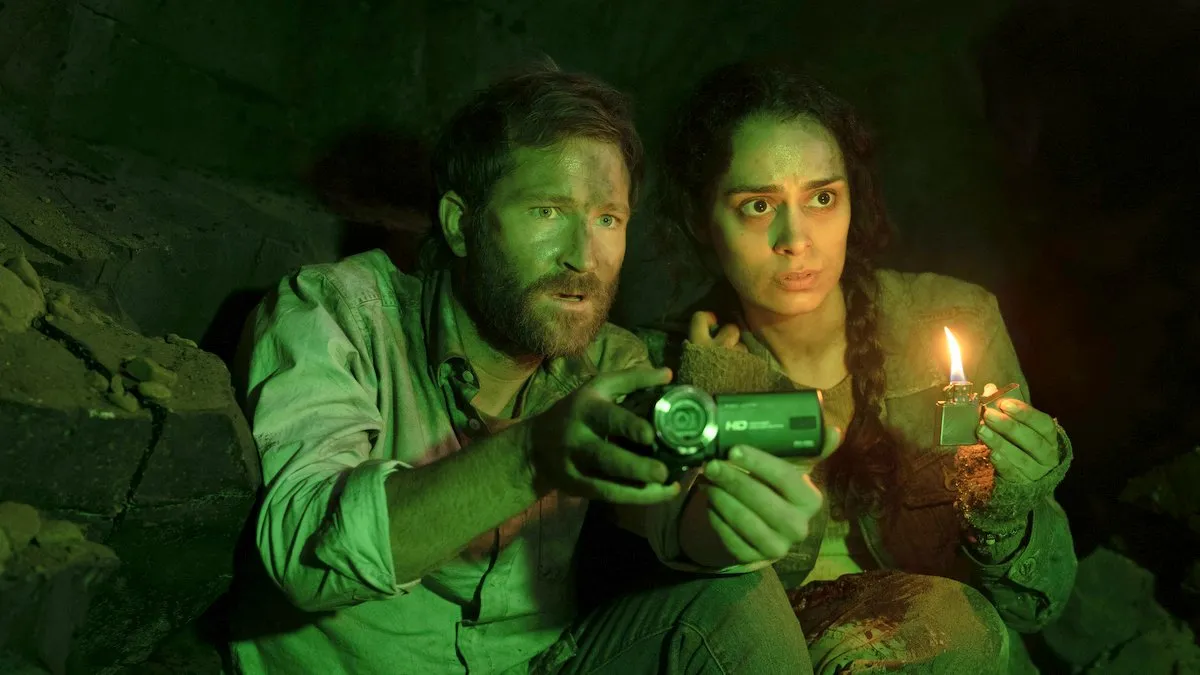
Her aggression feels less like a character trait and more like a symptom of severe shock. Jamie Costa gives Mark a believable fragility, a man ill-equipped for this reality. Emalia portrays Kate with a high-strung energy that registers as authentic panic, a body flooded with adrenaline that leaves no room for sentiment. The film forces them into a desperate alliance, exploring the ethical gray zone between cooperation and exploitation.
The script’s attempts to deepen these characters through shared anecdotes about their pasts are its weakest point. The screenplay mistakes confession for connection, offering moments of backstory that feel less like organic bonding and more like perfunctory exposition. One gets the sense these backstories were invented on the spot, obligatory beats in a survival-story formula. The true character work happens in the silence between the chittering noises, in the shared glances lit by a dying phone screen.
The Shape of Fear
As a creature feature, Scurry understands the power of suggestion and the economy of shadow. For much of its runtime, the antagonists are a sonic presence, their growls and clicks echoing through the tunnels to manipulate audience perception. The sound design does the heavy lifting, building a palpable sense of dread long before the creatures are revealed in their chitinous, spider-like glory. The film’s pacing is mostly relentless, a constant forward momentum driven by primal fear.
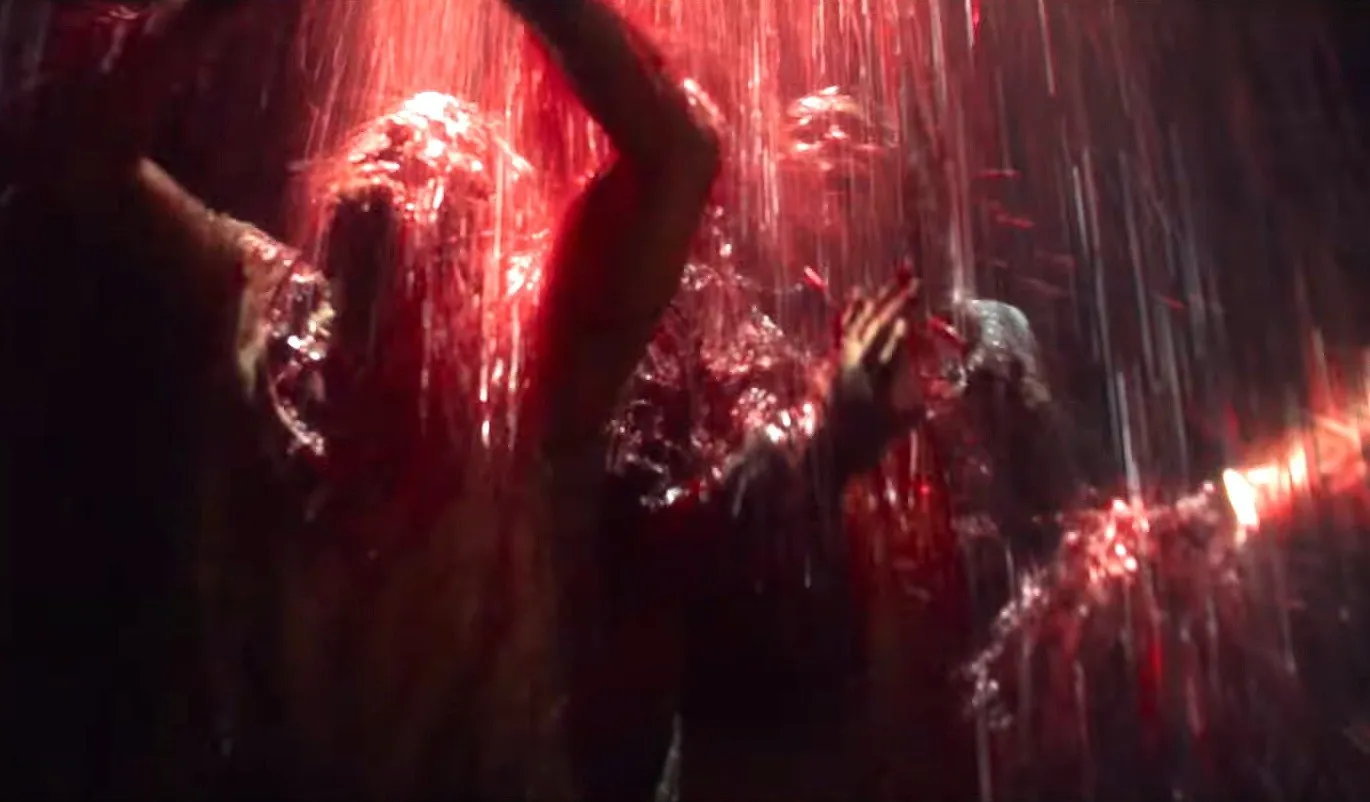
This makes the noticeable lull in the final act feel like a sudden drop in pressure, a narrative misstep that momentarily slackens the carefully built tension. The ambitious, wide-angle destruction of the opening shot stands in sharp contrast to the intimate, contained horror that defines the main story.
This bait-and-switch is effective, promising a disaster epic before delivering a personal nightmare. The film’s final, hopeless image offers no catharsis or comfort. It is a bleak, fitting end to the harrowing descent, a final word that confirms the universe’s indifference and reinforces the idea that some tunnels simply have no exit.
Scurry is a 2024 Australian horror-thriller film directed by Luke Sparke. The movie is shot in a single, continuous take and centers on two strangers—a family man and a criminal—who find themselves trapped underground after a monstrous attack devastates their city. They must navigate a treacherous, narrowing tunnel while injured and pursued by a relentless threat lurking in the darkness. The film had its premiere at the Sydney Science Fiction Film Festival and is slated for a limited theatrical and digital release on platforms like Apple TV, Prime Video, and Fandango at Home, beginning around October 3, 2025.
Full Credits
Director: Luke Sparke
Writers: Tom Evans
Producers and Executive Producers: Carly Sparke, Carmel Imrie, Luke Sparke, Geoff Imrie
Cast: Jamie Costa, Emalia, Peter O’Hanlon
Director of Photography (Cinematographer): Wade Muller
Editors: Luke Sparke
Composer: Frederik Wiedmann
The Review
Scurry
An exercise in sustained dread, Scurry leverages its ambitious single-take cinematography to create a brutally effective and claustrophobic nightmare. While the screenplay's attempts at character depth falter, the relentless tension, visceral direction, and primal atmosphere make for a potent survival horror experience. It is a technically audacious film that succeeds as a raw sensory ordeal, even if its human story remains underdeveloped. A harrowing descent worth taking for fans of the genre.
PROS
- Ambitious and immersive single-take cinematography creates relentless tension.
- Masterfully builds a claustrophobic and genuinely terrifying atmosphere.
- Strong directorial vision with moments of brilliant, expressive camerawork.
- Effective sound design that amplifies the sense of unseen threats.
- Lead performances authentically convey states of extreme panic and fear.
CONS
- The screenplay is underdeveloped, with character backstories that feel contrived.
- A noticeable drop in pacing during the final act lessens the narrative's momentum.
- Dialogue often serves as functional exposition rather than organic character development.
- The illusion of the single take is occasionally broken by noticeable technical flaws.