
























![Kingdom Hearts Collection [I-III] Review](https://gazettely.com/wp-content/uploads/2026/10/Kingdom-Hearts-Collection-I-III-1-360x180.webp "Kingdom Hearts Collection [I-III] Review: KHII Holds Steady as Newer Entries Fluctuate 37")




H.P. Lovecraft’s work has always presented a peculiar challenge for game developers. His stories thrive on the unknowable, on horrors that exist just beyond human comprehension. Yet games demand interaction, agency, and some measure of understanding.
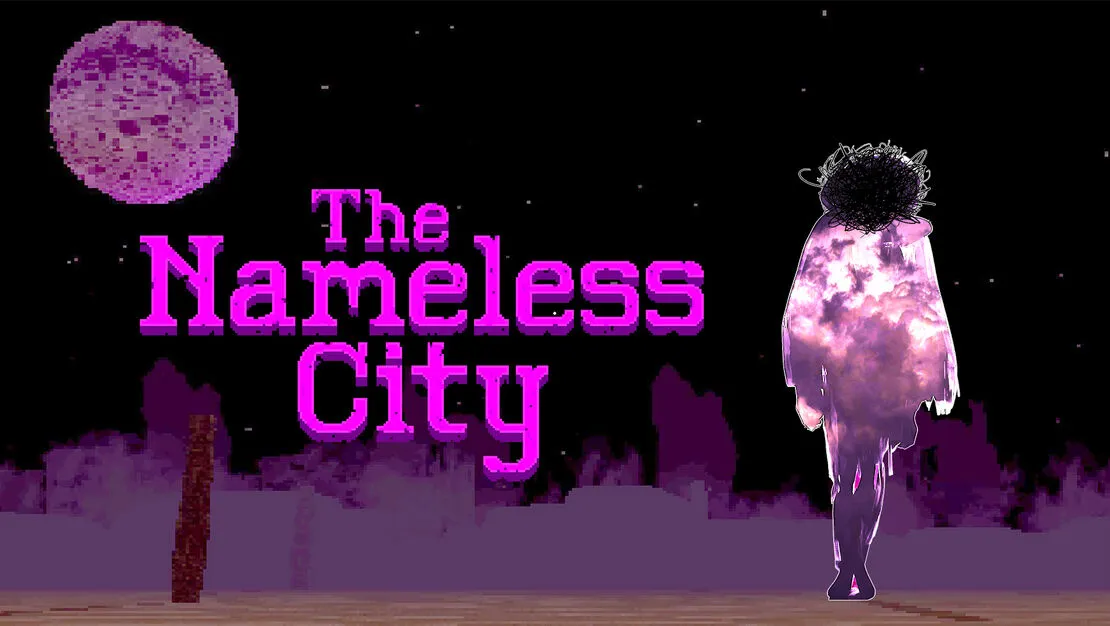
The Nameless City, developed by Paradnight Studio, tackles this challenge by adapting Lovecraft’s 1921 short story of the same name. This marks a significant piece of literary history, as it was the first tale Lovecraft wrote within what would become the Cthulhu Mythos. The game casts you as an unnamed explorer who ventures into the Arabian Peninsula, drawn to ruins of an ancient city lost to time and memory.
This is a first-person horror-adventure built around exploration and atmosphere. Paradnight Studio has crafted something intentionally compact, clocking in at 60 to 90 minutes depending on how thoroughly you explore and how quickly you solve its puzzles. The brevity feels deliberate rather than restrictive. This is a focused experience that understands its source material and the limitations of translating cosmic dread into interactive form.
Words From the Abyss
The most striking choice Paradnight Studio makes is lifting dialogue directly from Lovecraft’s original text. Your protagonist narrates the experience using the author’s own words, observations delivered in measured, melancholic tones as you descend deeper into structures that should not exist. This creates an interesting dynamic where the story feels authentically Lovecraftian while the game must find ways to extend what was originally a brief tale into something interactive.
The narrative unfolds through environmental storytelling as much as through spoken word. You encounter ancient glyphs etched into stone, murals depicting a reptilian civilization, and architectural impossibilities that suggest a people who existed long before humanity claimed dominion over Earth. The story captures that essential Lovecraftian tension between curiosity and survival, where the protagonist’s need to understand propels them forward even as every discovery suggests they should flee.
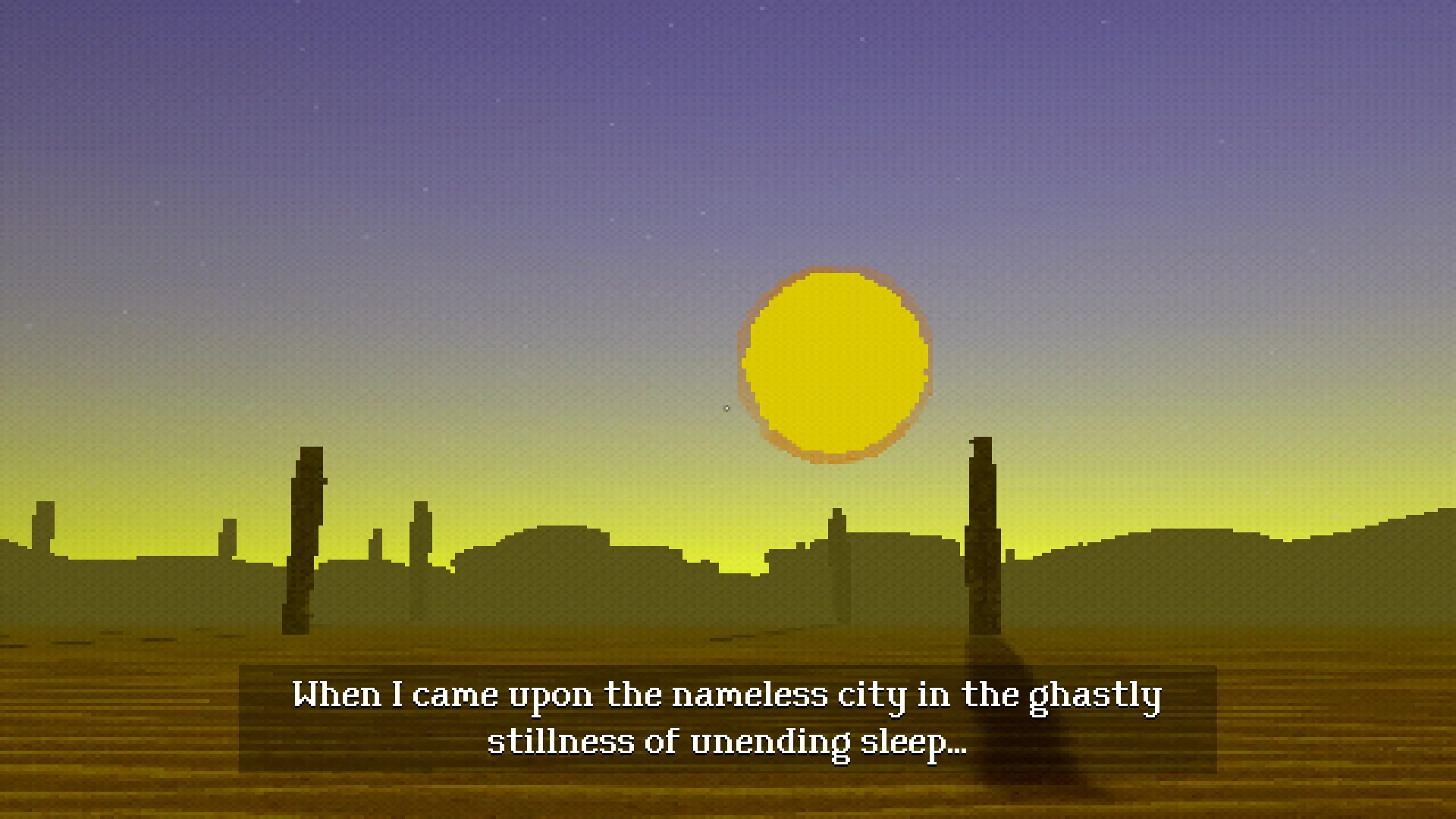
The atmosphere builds through accumulation rather than shock. You begin in blazing desert sunlight, but each corridor you crawl through takes you further from that warmth and safety. The game literalizes the metaphorical descent into madness through its level design. Staircases spiral down endlessly. Passages narrow until you must crouch to continue. The architecture itself becomes oppressive, reminding you that you’re abandoning the surface world for something older and more terrible. This physical descent mirrors your psychological state, tracked through a sanity meter that depletes in darkness and when you use forbidden knowledge.
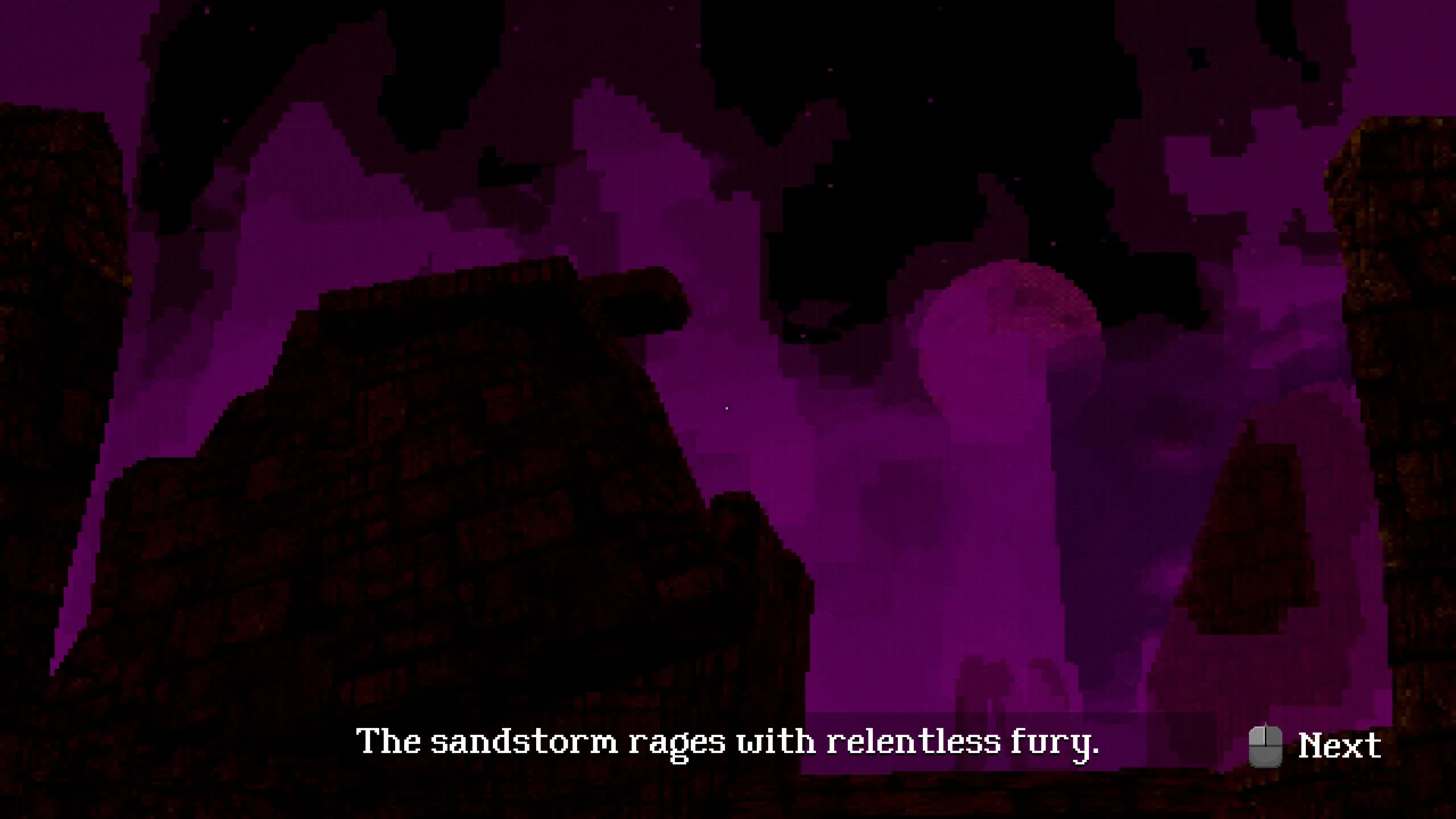
Paradnight Studio chose PSX-era visuals for this project, and the low-poly aesthetic serves the material well. There’s something unsettling about simplified geometry when it’s used to depict cyclopean architecture. The art direction relies on strong silhouettes and color choices rather than detailed textures, which actually helps the imagination fill in the gaps. When you can’t quite make out what you’re seeing, your mind does the work of making it horrifying. The frame rate stays solid throughout, and the developers use lighting cleverly to guide you when the environment becomes disorienting.
The audio design deserves particular praise. The narrator’s voice carries the right weight, somber without being melodramatic. There’s an electronic soundtrack layered underneath that pulses and drones, creating tension through sustained notes rather than sudden stings. The sound design understands that silence can be as powerful as noise, letting certain moments breathe while others feel suffocating.
The game incorporates AI-generated imagery for specific moments: the visions that assault you when your sanity wavers, the screens that appear when you die, and some of the murals depicting the city’s former inhabitants. These images lean into the distorted, wrong quality that AI sometimes produces, using that uncanny valley effect to represent things beyond human understanding.
Forbidden Knowledge, Mechanical Cost
The Nameless City could have been purely a walking simulator, but Paradnight Studio adds a layer of mechanical interaction through the glyph system. As you explore, you discover ancient symbols that get recorded in your spellbook. These glyphs can be combined to produce effects: dispelling barriers that block your path, creating barriers to shield yourself from wind that would otherwise blow you off ledges, or summoning light in areas where your torch has guttered out.
What makes this system interesting is how it connects mechanically to the horror themes. Each time you cast a spell, your sanity meter drops significantly. You’re wielding power that humans were never meant to touch, and the game makes you feel that cost. There are moments late in the experience where you must repeatedly cast light-generating spells just to see and stay sane, creating a desperate rhythm where you’re fighting against your own mind’s deterioration. The forbidden knowledge you’ve acquired becomes both salvation and curse.
The puzzle design stays relatively straightforward. Most challenges involve recognizing which glyph combination applies to the obstacle in front of you. There’s one extended section that takes place on a strange dimensional plane where you must activate switches in a specific sequence. This puzzle can consume a significant portion of your playtime, potentially up to 45 minutes if the solution doesn’t click immediately. It relies on understanding the spatial logic of a space that repeats infinitely, using that repetition to access different areas.
There are also endurance challenges where speed matters. You might need to dash toward light sources before darkness drains your sanity completely, or navigate hazardous terrain while your mental state deteriorates. These moments add welcome variety to what is primarily a contemplative experience.
The game isn’t particularly punishing. Death means a quick respawn at a recent checkpoint, and you’re unlikely to die more than a handful of times during your playthrough. The challenge comes less from mechanical difficulty and more from solving environmental puzzles and managing your sanity resource. When you do get stuck, the game uses visual cues like lighting effects to subtly point you toward the next area, which helps maintain momentum without breaking immersion.
The Price of Curiosity
The Nameless City can be completed in 60 to 90 minutes, with some players finishing in under an hour if they move quickly and solve puzzles efficiently. This brevity will disappoint anyone expecting a lengthy adventure, but the short runtime feels appropriate for adapting a short story. The game doesn’t pad its content or artificially extend sequences beyond what the narrative demands. There are moments where crawling through yet another narrow passage feels repetitive, but these never quite cross the line into tedium.
Pricing sits at $5.99 on Steam and $9.99 on console platforms. The value proposition depends heavily on how you weight runtime against experience quality. An hour of focused, atmospheric horror might satisfy some players while others will balk at the cost per minute of gameplay.
What Paradnight Studio accomplishes here is a faithful adaptation that respects Lovecraft’s original vision. The game captures cosmic horror effectively, using its limited resources to create genuine unease. The spell system transforms what could have been a passive experience into something with meaningful player choice and resource management. The ending delivers the kind of haunting imagery and narration that Lovecraft fans expect, leaving you with disturbing implications rather than tidy resolution.
The limitations are equally clear. You only work with three main glyphs throughout the game, which means spell variety stays minimal. The gameplay loop consists almost entirely of exploration and basic puzzle-solving, with no combat or complex systems to master. Significant stretches involve crawling through corridors that start to blend together visually. If you’re seeking mechanical depth or extensive content, this won’t satisfy those needs.
The Nameless City succeeds as a mood piece, a brief plunge into cosmic dread that understands what makes Lovecraft’s work unsettling. It’s best suited for horror enthusiasts curious about a faithful adaptation, Lovecraft fans who want to experience the story that started the Cthulhu Mythos in interactive form, or players who appreciate compact narrative experiences.
There’s genuine craft here in how Paradnight Studio translates prose into environmental design, how they make the spell system feel both mechanically relevant and thematically appropriate. The game demonstrates that short-form horror adaptations can work when developers understand the source material and build around it rather than trying to stretch it thin. For those seeking something different from the endless parade of lengthy open-world titles, an hour spent exploring these cursed ruins might be exactly the right kind of unsettling.
The Review
The Nameless City
The Nameless City delivers atmospheric Lovecraftian horror in a compact package. Paradnight Studio's faithful adaptation captures cosmic dread through thoughtful environmental design and a sanity-draining spell system that makes forbidden knowledge feel genuinely dangerous. The PSX aesthetic and unsettling audio create genuine unease. However, the 60-90 minute runtime, limited mechanical depth, and repetitive corridor crawling constrain its ambitions. This works best as a focused mood piece for horror fans and Lovecraft enthusiasts rather than those seeking extensive gameplay systems.
PROS
- Captures Lovecraftian atmosphere and cosmic horror effectively
- Spell system ties mechanics to narrative themes
- Strong audio design and evocative PSX visuals
- Faithful adaptation of source material
- Well-paced for its short runtime
CONS
- Very brief experience (60-90 minutes)
- Limited spell variety (only three glyphs)
- Repetitive corridor navigation
- Minimal mechanical depth
- One puzzle can consume excessive time







