

























![Kingdom Hearts Collection [I-III] Review](https://gazettely.com/wp-content/uploads/2026/10/Kingdom-Hearts-Collection-I-III-1-360x180.webp "Kingdom Hearts Collection [I-III] Review: KHII Holds Steady as Newer Entries Fluctuate 37")





A documentary camera is an instrument of intent. It arrives with a thesis, a story to be extracted from the raw material of life. Sometimes, however, life offers a different story altogether. The intended narrative is supplanted by an unforeseen truth, and the camera, a passive witness, captures not the planned event but its profound, unscripted alternative.
Such is the case with Sharon & Ozzy Osbourne: Coming Home. What began as a procedural account of a transatlantic relocation—the logistical untangling of a life in Los Angeles for a return to a Buckinghamshire estate—was transformed by circumstance. The project’s initial focus on Ozzy Osbourne’s homecoming becomes an examination of his final days.
The footage, originally shot to document a new beginning, is re-contextualized by a sudden end. The result is a film that functions as an accidental requiem, a work whose ultimate meaning was found not in its production but in its editing, after the final scene of its subject’s life had already been shot.
An Architecture of Irony
The viewer watches this film through a filter of foreknowledge, a condition that imbues the entire work with a chilling resonance. Every composition is haunted by a ghost in the frame. The narrative structure, perhaps unintentionally, becomes a masterclass in dramatic irony, where the audience is granted an omniscience the subjects lack.
Casual remarks about the future land like carefully placed explosives. When Sharon refers to their new life in England as “our last chapter,” the line is suspended in the air, its intended meaning of quiet retirement overwritten by the finality of death. The film’s editing lingers in these moments, allowing the weight of what is unsaid to fill the space. Ozzy’s own pronouncements on his mortality are sharp and darkly funny.
His stated refusal to be interred in an American, “McDonald’s version of a cemetery” is both a piece of wry commentary and a successful final plea to fate. The filmmakers construct a psychological tension by juxtaposing scenes of optimistic planning—the digging of a new lake, the renovation of rooms—with stark, quiet shots of Ozzy’s physical fragility. We are made privileged, mournful voyeurs, watching a man unknowingly walk toward a predetermined end.
Domesticity’s Absurd Theater
To counter the looming existential dread, the film frequently retreats into the familiar, chaotic embrace of the Osbourne household. Here, the tone pivots into an absurd theater of the mundane, a high-volume performance of domestic life that has been honed over two decades of public exposure. This environment provides a strange, almost frantic counter-melody to the quiet narrative of decline.

The camera captures the enduring disorder with a documentarian’s patience: dogs foul suitcases, expletives are exchanged with the casual rhythm of pleasantries, and the business of being The Osbournes continues unabated. Kelly’s exasperated cries about living in an “insane asylum” feel both genuine and perfectly timed for an audience expecting such antics. The visual disparity between Sharon and Ozzy becomes a compelling subtext.
She is a study in controlled preservation, her posture erect and her expression a mask of maternal command. He is a study in physical surrender, his body slumping at awkward angles, his discomfort palpable. This juxtaposition reveals their shared coping mechanism: a performance of normalcy in the face of an unavoidable reality, a loud, chaotic dance to drown out the silence.
Coda for an Iron Man
The film’s final act narrows its focus to the essential duality of its subject: the frail man and the immortal performer. His struggle to prepare for a final show with Black Sabbath is not about rock glory; it is presented as a biological imperative. The stage, the audience, the noise—these are depicted as a life-force, something he needs with the same elemental urgency as oxygen.
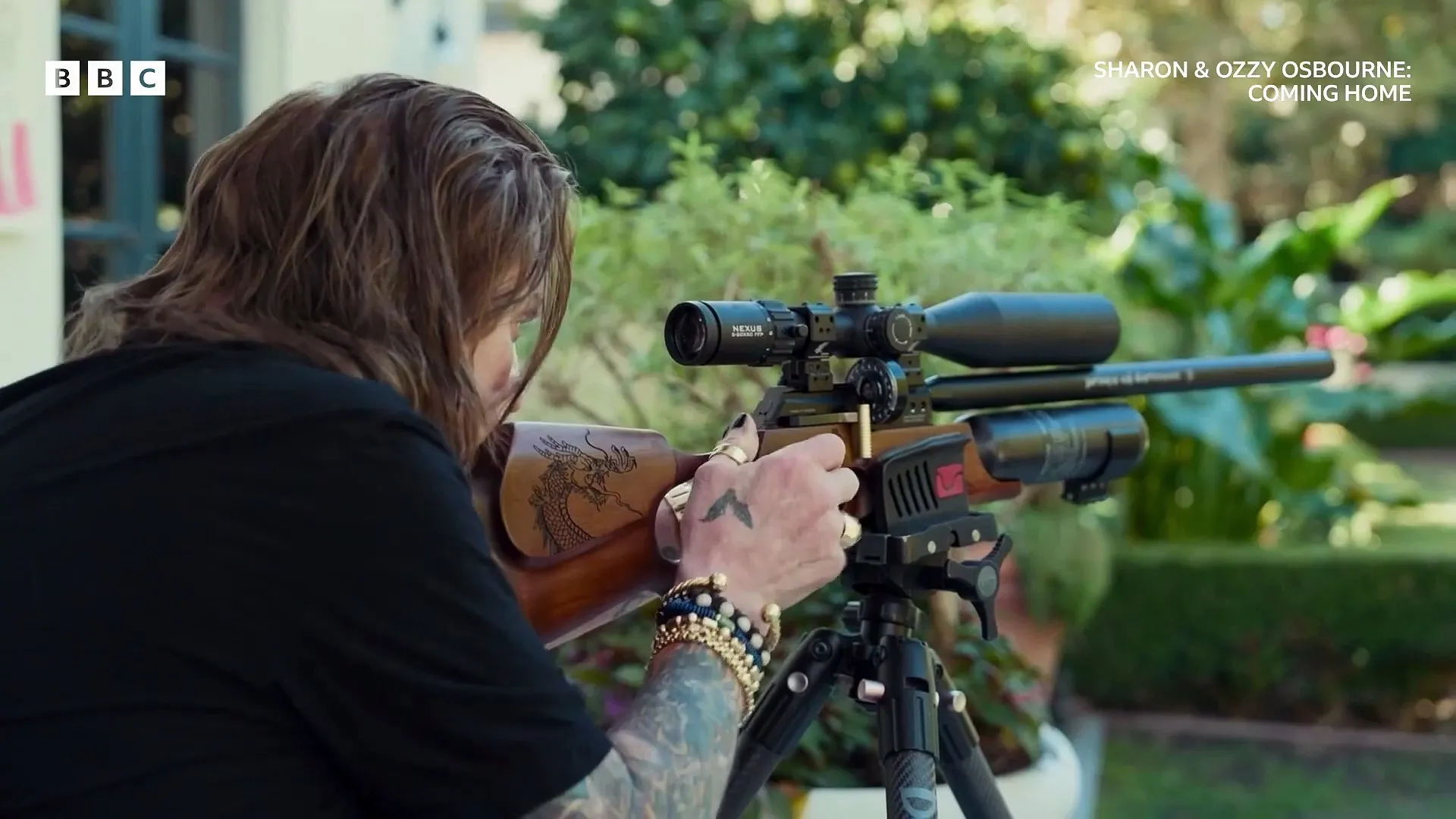
Wisely, the film withholds the spectacle of the concert itself. By denying the viewer the catharsis of the performance, the director forces a confrontation with the quiet, human aftermath. The actual climax is more potent. In its closing moments, the film overlays Ozzy’s own voice, in his distinctive Brummie accent, upon the silent, somber footage of his funeral procession.
He speaks of a life well lived, with no regrets. This editing choice collapses the distance between the subject and his own memorial. It is a direct, self-authored farewell, a final piece of raw communication that elevates the film from a simple document of a life into a moving, articulate testament.
The documentary film Sharon & Ozzy Osbourne: Coming Home is an intimate portrait that follows the legendary rock star Ozzy Osbourne and his wife Sharon during his final years, focusing on their move back to the United Kingdom after two decades in Los Angeles. The one-hour special offers a bittersweet look at the couple’s return to their English country estate and reflects on their life and enduring relationship. The film premiered on BBC One on October 2, 2025, and is available to stream on BBC iPlayer.
Full Credits
The Review
Sharon & Ozzy Osbourne: Coming Home
The film transcends its simple premise to become a profound meditation on mortality. What could have been a shallow reality series is elevated by circumstance into a work of startling poignancy. It avoids becoming a schmaltzy tribute by presenting an unfiltered, often uncomfortable, yet deeply human portrait of a man’s final chapter. Its power lies not in polished filmmaking but in its unscripted authenticity, capturing a farewell that is both accidental and beautifully fitting. It is a raw, emotional, and unforgettable final document.
PROS
- An intensely intimate and unfiltered portrayal of Ozzy Osbourne's final months.
- The powerful dramatic irony throughout the film creates a deeply moving viewing experience.
- Offers an authentic look at the enduring, chaotic, and affectionate Osbourne family dynamic.
- Functions as a poignant, accidental meditation on homecoming and mortality.
CONS
- The narrative can feel disjointed, a clear result of being repurposed from a longer series.
- A complete absence of final concert footage may disappoint viewers expecting a musical tribute.
- Its unpolished, fly-on-the-wall style might feel aimless to some.