





























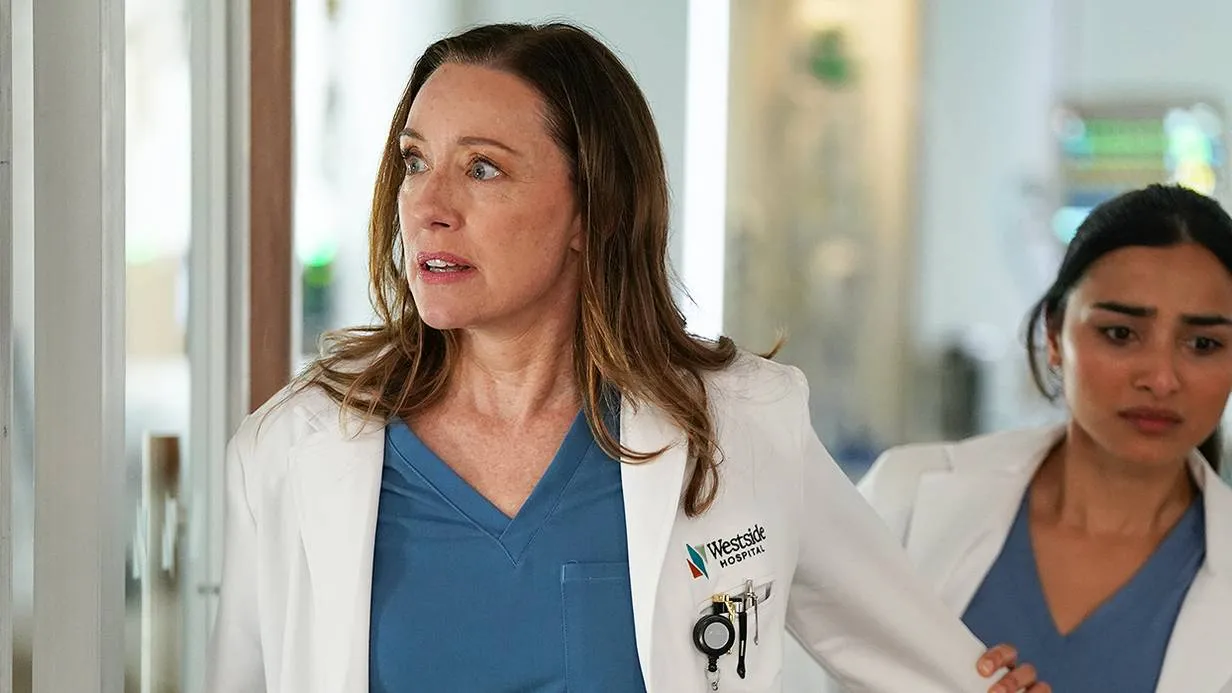

Doc Season 2 brings viewers back to Westside Hospital and to the disorienting crisis shaping Dr. Amy Larsen (Molly Parker). Adapted from the Italian series Doc – Nelle tue mani, the show builds on a premise tied to lived trauma: Amy’s car accident erased eight years of her memory. She remembers herself as a married, compassionate doctor from before her son’s death.
She wakes into a life she does not recognize. She is divorced from Dr. Michael Hamda (Omar Metwally), once Chief of Internal Medicine and now working as an intern, and she is trying to form a future with Dr. Jake Heller (Jon-Michael Ecker). The season lifts the temperature right away.
It starts with the aftermath of Amy’s impulsive kiss with Michael, seen by Jake, then swings into a shooting and hostage crisis that throws the hospital into survival mode. By tying a classic medical emergency to Amy’s private struggle, the premiere frames her search for lost memory as a fight for identity, with her present self forced to live alongside the ghost of the person she used to be.
Identity Crisis and Modern Romance
Parker plays Amy with steady clinical authority that can crack into sudden vulnerability. The push and pull of the season comes from two versions of Amy rubbing against each other: the warm doctor she recalls and the colder, career-obsessed figure described by people who lived through the missing years. The show uses that split to point at a familiar social script in high-achievement cultures, where professional excellence can become a performance that drains tenderness out of daily life.
Amy’s amnesia leaves her without the safety net of experience, so she leans hard on empathy. The series treats that reliance as a professional obstacle and a personal correction, giving her a bedside manner that feels earned through pain. Her choice to use a sensory deprivation tank to chase memories brings the theme into a modern mental-health register: wholeness is framed as something a person can pursue through technique, and the pursuit carries real risk in an era that prizes self-optimization.
The love triangle tracks a very current problem for adult romance on television: rebuilding a life looks simple on paper and tangled in the body. Jake’s frustration comes from watching Michael remain a constant presence, a living archive of the past Amy still carries inside her.
Amy and Michael share a connection rooted in familiarity, and that familiarity forces them to draw fragile limits while Michael juggles his job and the crisis of his wife, Nora, going into premature labor. Nora’s perspective matters. She turns a soap-style setup into a story about collateral damage, showing how a marriage can be worn down by the psychic weight of a former relationship that never fully leaves the room.
The supporting cast strengthens this cultural angle. Dr. TJ Coleman’s heroic shooting and recovery arc gives the season a grounding thread about bodies that fail and identities that fracture. He is an Army Ranger accustomed to action and control, now facing a year of difficult rehabilitation, a long stretch that captures the quiet terror of losing both physical ability and professional purpose.
During the hostage situation, the shift between Nurse Julie and Amy from resentment to shared respect opens a window on workplace solidarity. Their dynamic suggests a more attentive approach to female relationships under pressure, rejecting easy rivalry in favor of a bond forged through crisis.
The Weight of Clinical Compassion
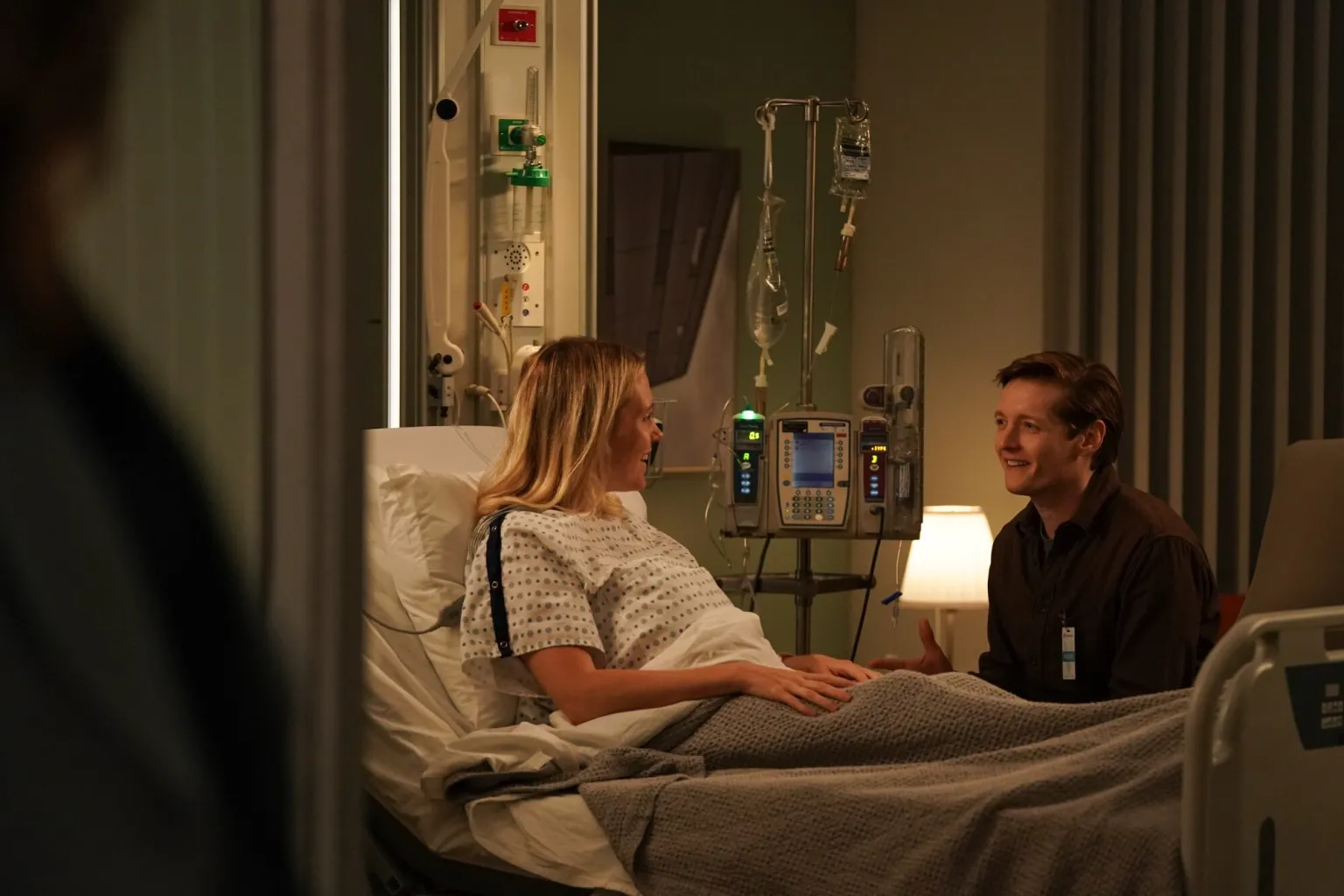
The premiere pins its chaos to a patient story with heavy moral stakes. Rosie, a young woman needing a heart transplant, and her desperate father, Alex, pull the hospital into a case where life hinges on judgment. Amy and TJ find a spot on Rosie’s lung that threatens to derail the transplant. That discovery drags Amy toward a decision she cannot remember making.
Flashbacks show the truth: six years earlier, Amy concealed Rosie’s terminal condition and advised Alex against the transplant. She acted from a grieving parent’s heart, trying to protect Alex’s hope and preserve time with his daughter. The series presents this as a choice where emotional truth overrode clinical transparency, and it refuses to make that choice tidy.
The conflict between honesty and hope points to a broader tension in contemporary medicine, where the system demands objectivity while patients seek care shaped by humanity. The episode asks how much moral weight a doctor can carry while working inside rules designed for efficiency and liability. Amy’s past decision, born from tragedy, produces dangerous consequences that help ignite the present violence.
Michael’s ethical breach deepens the institutional critique. Under duress, he lies to the transplant network (UNOS) to secure the heart, showing how crisis can push even principled leaders into ethically unstable ground. The show’s gaze stays fixed on the pressures that create these moments, with the hospital portrayed as a machine that can corner its staff into moral compromise.
The high-stakes scenario ends with Rosie’s tragic death, set against the sound of Michael’s baby being born upstairs. The parallel lands with force. It captures the relentless rhythm of a large medical center, where death and birth sit side by side and where clinicians absorb both without pause. The confrontation with Alex becomes the catalyst for Amy’s first recovered memory. Her healing arrives through shock, underlining the psychological cost of living without a past and the way trauma can function as its own trigger for repair.
Disrupting the Hierarchy
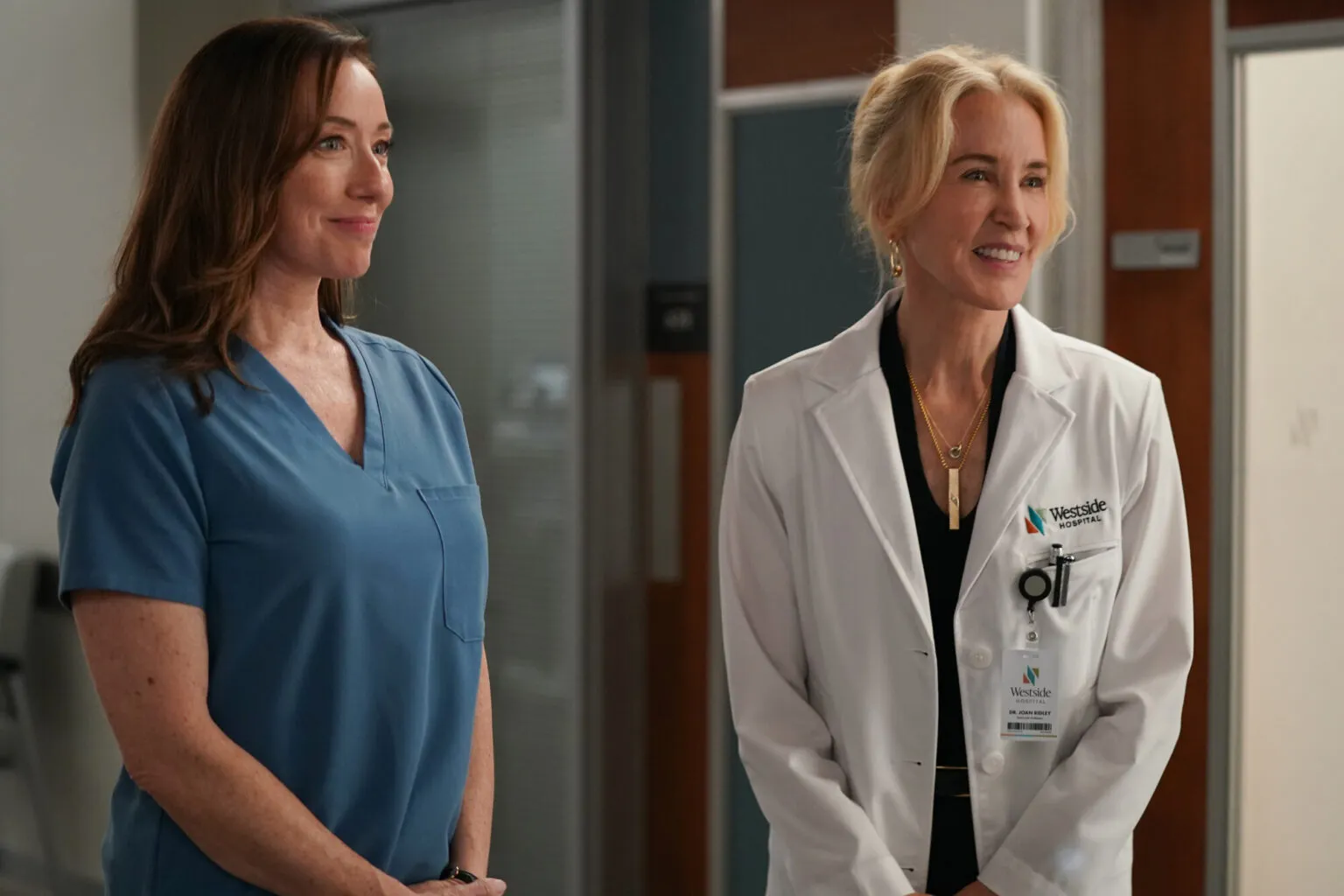
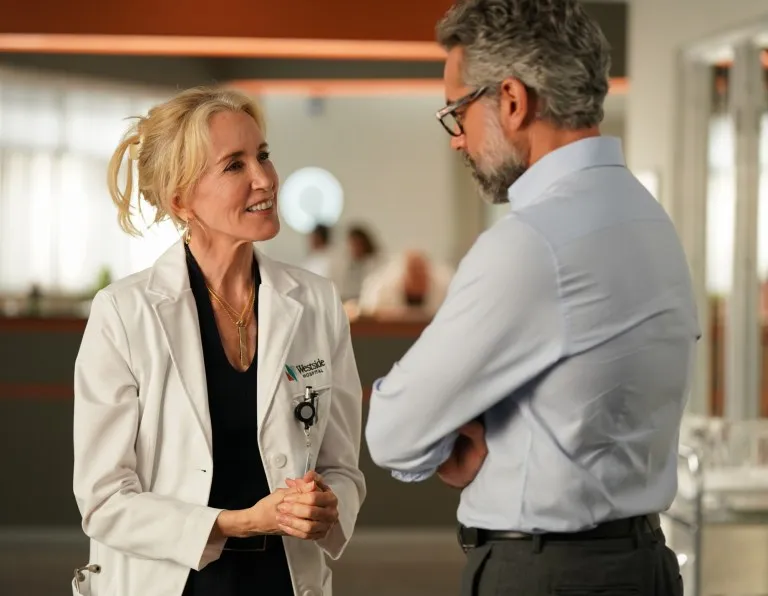
Dr. Joan Ridley (Felicity Huffman) enters as the new Chief of Internal Medicine and brings a cutting corporate energy into Westside’s culture. Joan is portrayed as highly intelligent and openly manipulative, a figure who reads institutional need and uses Michael’s weakness to seize control.
The revelation that she previously influenced Amy to leave Michael reframes the missing years as a time shaped by internal trauma and by external, self-serving actors. Joan embodies a professional archetype that treats hospitals as arenas for status and leverage, and her presence sharpens the season’s view of power inside healthcare.
The case of a woman with a phantom pregnancy (pseudocyesis) shifts the pace after the premiere’s violence. It gives the series room to focus on the overlap of medical knowledge and mental health, mirroring a growing streaming-era habit of granting psychological conditions the same narrative seriousness as physical ones. The episode also highlights Amy’s renewed empathy and her effective working rhythm with Dr. Gina Walker, showing how her present approach to diagnosis gains strength through human connection.
Michael’s professional arc keeps the administration critique in focus. He hires Joan quickly, then the board searches for a scapegoat after the hostage crisis and forces him into paternity leave. Michael repeatedly ends up absorbing blame while higher leadership protects itself. The season paints a portrait of institutional hypocrisy in plain terms: results are demanded from the people on the floor, and responsibility drains upward only when it is convenient. That pattern mirrors a wider cultural suspicion of large institutions that prize optics over accountability, especially in moments of public emergency.
Pacing, Structure, and Cultural Commentary
Season 2 uses Amy’s amnesia to press on present-day anxieties about identity and accountability. Eight lost years raise a hard question: who defines the person who lived through them? Amy’s need to apologize for an earlier self she cannot access aligns with contemporary conversations about remorse, growth, and the difficulty of making amends without a clear memory of the harm. The show keeps probing the role of memory in personal change, especially for someone rebuilding her life inside a profession that records every mistake.
The narrative form mirrors this theme. The premiere uses a non-linear structure that shifts between crisis and backstory, echoing the fragmented state of Amy’s mind. Trauma becomes part of the storytelling method, turning a clinical condition into a dramatic tool. The way the Rosie and Alex case triggers a memory breakthrough ties procedural stakes to character rupture and recovery, keeping the medical plot and Amy’s inner life locked in the same engine.
The pacing stays heightened throughout, pairing the hostage crisis with the fallout of the kiss, Michael’s baby being born, and Jake’s heartbreak. This rapid escalation fits a streaming climate that favors emotional momentum and constant turning points. Doc points toward a future for medical dramas where personal trauma drives suspense and where ethical and social questions ride alongside each emergency, shaping character development through the pressures of a system in perpetual crisis.
The American medical drama series Doc premiered its first season on January 7, 2025, on Fox, and was later renewed for a 22-episode second season. Season 2 premiered on September 14, 2025. The series is an adaptation of the Italian show Doc – Nelle tue mani, which itself is inspired by the true story of a doctor who lost 12 years of his memory after an accident. The series is developed by Barbie Kligman and is available to watch on Fox, with episodes streaming the following day on Hulu.
Full Credits
Title: Doc
Distributor: Fox, Hulu (streaming)
Release date: September 14, 2025 (Season 2 Premiere)
Rating: TV-14
Running time: 44 minutes (per episode)
Director: Adam Davidson, David Greene, Russell Lee Fine, Michael Weaver, Mary Lou Belli (These directors worked on various episodes across the series, but a single overall director is not listed for the season.)
Writers: Barbie Kligman, Hank Steinberg, Francesco Arlanch, Viola Rispoli, Katie Varney, Jake Gillman, Andre Jackson, Judi McCreary, Mark Bianculli, Carol Barbee, David Renaud, Laura Valdivia
Producers and Executive Producers: Barbie Kligman, Hank Steinberg, Erwin Stoff, Russell Lee Fine, John Weber, Frank Siracusa, Rebecca Thomas, Judith McCreary, Luca Bernabei, Nick Iannelli, Katie Varney, Victoria Woods, Molly Parker, Oren Gottfried, Austin Titley, David Renaud, Laura Valdivia
Cast: Molly Parker, Omar Metwally, Jon Ecker, Amirah Vann, Anya Banerjee, Patrick Walker, Charlotte Fountain-Jardim, Felicity Huffman, Scott Wolf, Sarah Allen, Emma Pfitzer Price
Director of Photography (Cinematographer): David Greene, Fraser Brown
Editors: D. Gillian Truster, Jonathan Eagan, Lauren Brandon, Duncan Christie, Joel Griffen, David Rogers
Composer: James S. Levine
The Review
Doc Season 2
Doc Season 2 successfully uses the complex psychological core of Amy’s amnesia as a powerful vehicle for exploring personal trauma, identity, and professional ethics. Molly Parker grounds the series with a nuanced performance, giving weight to the struggle of reconciling two versions of one’s self. While the show sometimes succumbs to extreme melodrama, particularly in its high-stakes opening, it remains a thoughtful, intense examination of how trauma reshapes character and the high emotional cost of a second chance in life and medicine.
PROS
- Deep, analytical exploration of identity and recovery from trauma.
- Molly Parker's performance captures both clinical competency and acute vulnerability.
- Innovative use of amnesia as a narrative device that directly fuels both medical and personal storylines.
- Willingness to engage with complex ethical dilemmas (truth versus hope in treatment).
- Effective juxtaposition of life and death themes, particularly the parallel hospital crises.
CONS
- Over-reliance on extreme melodrama (simultaneous shooting, hostage situation, and premature labor).
- The constant professional scrutiny and scapegoating of Michael strains believability.
- Introduction of certain supporting character arcs (like Joan’s calculating nature) can feel overly manipulative for plot purposes.