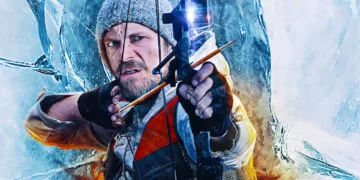










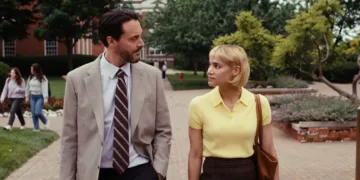

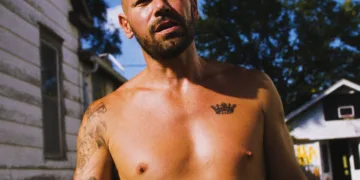









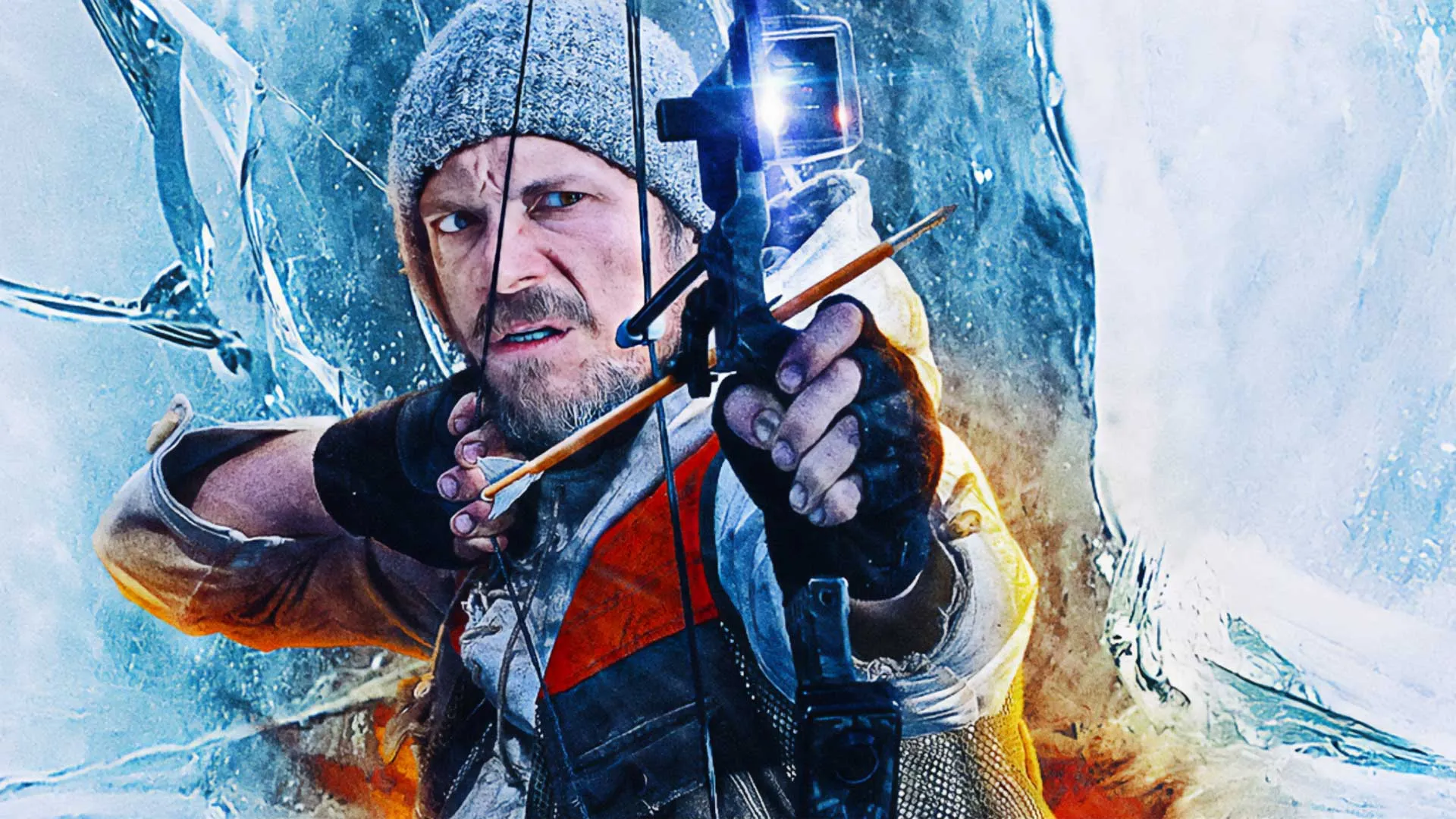

Stefan Ruzowitzky, who led The Counterfeiters to an Oscar, returns to action-thriller terrain with Ice Fall. The premise sets clear stakes: a plane loaded with stolen cash crashes into a frozen lake within a remote stretch of Montana Blackfoot territory, and the search for the lost money begins. Harlan (Joel Kinnaman), a grieving veteran and hardened local angler, hauls up one of the cases from the ice.
That find draws the suspicion of Ani Bayawaa (Cara Jade Myers), an Indigenous game warden who first encounters him as a poaching suspect. Their standoff ends when Rhodes (Danny Huston), the calculating head of the criminal crew, homes in on the money’s location. Harlan and Ani flee together through harsh, wide-open country, turning a routine arrest into a pursuit where every step on the ice matters. The opening half hour lays out a straightforward path for a winter survival thriller built on pressure and proximity.
Muted Characters and Distracting Subplots
The film frames Harlan and Ani as partners of necessity whose survival requires trust, yet the bond never gathers the emotional weight the story demands. Harlan’s history as a veteran and his grief receive mention without meaningful shaping, which leaves Joel Kinnaman playing motivation in outline rather than in detail. Cara Jade Myers gives Ani steady authority, though the portrayal of a seasoned warden rarely delivers the charge that would amplify the tension between duty, suspicion, and survival.
Focus slides away from this pair toward Rhodes and his crew, and that redistribution of attention flattens momentum. Moments that attempt to humanize the criminals arrive on the heels of shocking brutality, including the killing of an innocent bystander, which undercuts the tonal footing of the chase. Pen (Martin Sensmeier), an Indigenous ex-gang member who has embraced Christianity, brings a striking, brooding presence.
His philosophical sparring with Rhodes and his conversion arc play like a second film stitched to the main pursuit. These detours split the line of action that should keep tightening, and they leave Graham Greene’s appearance as Oz, a tribal leader, brief and fragile when the story could use his gravity.
Atmosphere, Pacing, and Technical Missteps
Cold-weather survival stories thrive when the landscape bears the same narrative weight as the antagonists on screen. Ice Fall suggests a lethal environment, yet the presentation rarely turns the setting into a felt threat. Outdoor sequences lean on a digital, manufactured look that keeps the Montana wilderness at arm’s length. The images soften the bite of cold and drain the sense of exposure that should haunt every decision, from crossing thin ice to choosing a hiding place.

Action beats arrive in short pulses. Animal traps and makeshift tools like a bow and arrow provide flashes of resourcefulness that could lock the audience into the characters’ problem-solving loop. The staging seldom builds on those ideas. Without sustained escalation, each sequence peaks quickly and releases pressure just as quickly.
Technical choices compound that problem. Editing cuts with jagged leaps and stitched takes call attention to the assembly, especially in fights and chases, which breaks the spell that a survival thriller needs. The camera frequently jumps between tight close-ups and wide frames during quiet exchanges.
That swing interrupts the rhythm of conversation and weakens the intimacy that might deepen our investment in Harlan and Ani. After the setup lands cleanly, pacing slackens. Long passages pass without fresh danger or a sharpened objective, and the story loses the forward drive that defines this genre.
A Thriller Lost in the Woods
Ice Fall threads in material about Indigenous life, land issues, and the work of a reservation game warden. The film approaches these topics with care, yet the treatment remains partial. The result feels like two separate projects sharing one timeline: a lean chase for stolen cash and a drama about local concerns and responsibility. Neither thread gains the time or focus needed to transform theme into propulsion.
The hook promises a cat-and-mouse pursuit across treacherous ice with money as the lure and death in the water below. Survival thrillers often live or die on clarity of objectives, the stress of limited resources, and the tempo of setbacks. Ice Fall sketches those elements and introduces capable performers, then struggles to convert them into sustained tension.
Atmosphere never fully chills the frame, character chemistry stays cool, and pacing loosens its grip. Set beside other survival stories and compared with Ruzowitzky’s better received work, this film reads as a middling entry that leaves a strong premise underused. The experience lands as an even slide rather than a buildup, with too little emotional impact and too few passages of lasting excitement to earn a firm recommendation.
Ice Fall is an action thriller that premiered on November 4, 2024, and was released by Aura Entertainment. The film follows a remote and deadly chase after a plane carrying millions in stolen cash crashes into a frozen lake in Montana. An unlikely pair—a local hunter and a game warden—find themselves targeted by the ruthless criminals who want their money back. The movie is available on digital and on-demand platforms.
Credits
Title: Ice Fall
Distributor: Aura Entertainment
Release Date: November 4, 2024
Rating: R
Running Time: 1 hour 30 minutes
Director: Stefan Ruzowitzky
Writers: George Mahaffey, Steve Isles
Producers and Executive Producers: Robert Ogden Barnum, Alastair Burlingham, Steven R. Doerck, Charlie Dombeck, Robert S. Gold, David Gendron, Christopher Lemole, Tim O’Hair, Steven Paul, Alex Proyas, Stefan Ruzowitzky, Luke Taylor, William V. Ward, John Wells, Michael W. Young
Cast: Joel Kinnaman, Cara Jade Myers, Danny Huston, Martin Sensmeier, DeVaughn Nixon, Graham Greene, Frida Gustavsson, Michael Greyeyes, Michael Irby
Director of Photography (Cinematographer): Benedict Neuenfels
Editors: Evi Belzner, Stefan Ruzowitzky
Composer: Martin Todsharow
The Review
Ice Fall
Ice Fall takes a gripping premise—a fight for survival and stolen cash in the freezing wilderness—and struggles in its execution. The film is hindered by muted character chemistry, distracting subplots, and inconsistent technical direction. While its attempts at weaving in thematic depth are appreciated, the cinematic structure often feels disjointed. The potential for a sharp, intense thriller is lost to a lack of sustained momentum and an unconvincing atmosphere. It is a largely unremarkable entry into the cold-weather action genre.
PROS
- The core setup involving a plane crash, stolen money, and a chase across frozen terrain is inherently high-stakes.
- The portrayal of the conflicted antagonist Pen stands out, bringing a needed layer of intensity to his subplot.
- The opening thirty minutes successfully establish the conflict and the potential for a gripping thriller.
CONS
- The main protagonists, Harlan and Ani, lack defined motivations and chemistry, making their partnership feel merely functional.
- The attempts to humanize the villains and explore Pen's philosophical conflicts severely distract from the central cat-and-mouse tension.
- The use of digital effects for the outdoor setting often makes the Montana wilderness look manufactured, diminishing the sense of cold-weather peril.
- Inconsistent editing and awkward cinematography disrupt the flow of both action and intimate scenes.
- The film struggles to maintain momentum, suffering from slow stretches after a promising start.