
















Trespasses, a four-part drama adapted from Louise Kennedy’s novel, plants the viewer in a small town outside Belfast in 1975. The air carries grievance and fear. This is The Troubles at full pressure, where politics functions like weather: pervasive, cold, and changeable in an instant.
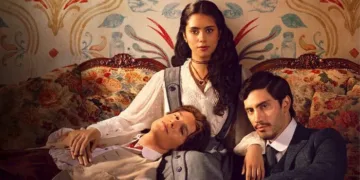
The story centers on Cushla Lavery, played by Lola Petticrew, a Catholic primary school teacher whose life splits into three daily obligations. She submits to the strict sectarian order that frames her movements, she manages the care of her widowed and gin-steeped mother, Gina, played by Gillian Anderson, and she tries to construct a private self while helping at her brother’s pub.
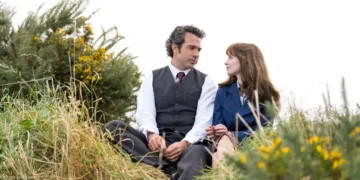
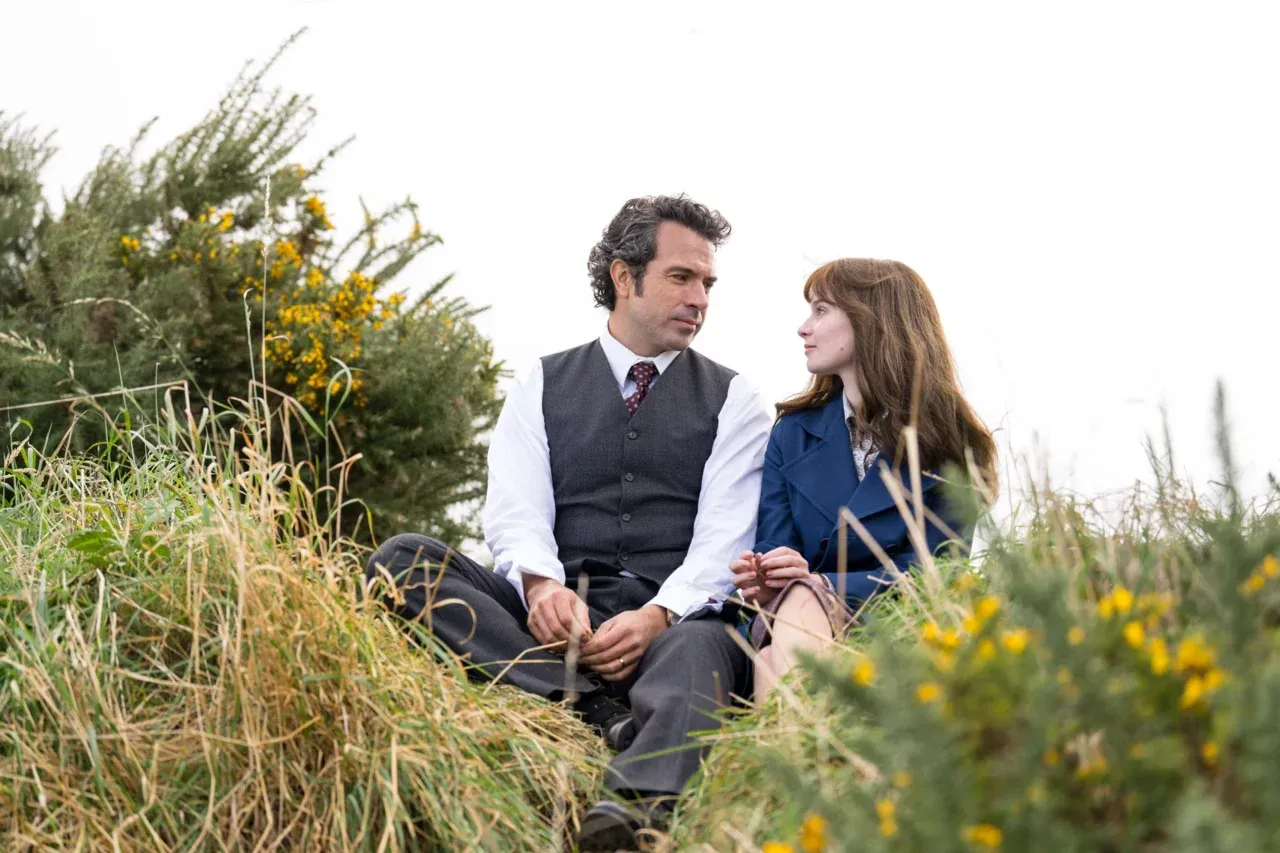
Equilibrium lasts until Michael Agnew appears. Tom Cullen plays him as an older, married Protestant barrister whose courtroom defenses of young Catholic men mark him as a target. The series states its thesis early: forbidden desire creates blast radius when it meets entrenched division and routine terror.
The Architecture of Transgression
Trespasses arranges Cushla’s path as a dual-track tragedy. Her rebellion moves along two routes that converge with precision, an elegant system of social physics that converts motion into damage.
The first route is the affair. Her connection with Michael counts as adultery and as a crossing of sectarian lines. Their distance in class and age contributes further friction. Cushla’s working life in the pub and Michael’s city circle give the romance a public awkwardness that never quite disappears. Cushla’s own dry aside about a possible “Fenian fetish” assigns him a taste for symbolic rebellion, an impulse that flatters and unsettles in the same breath.
The second route is political risk, born from compassion. Cushla intervenes in the life of the McGeown family. Their situation revolves around exogamy, a Catholic mother married to a Protestant father. Cushla’s urge to protect the child, Davy, expresses a human ethic that refuses sectarian arithmetic. The result is swift harm to people who did not prepare for harm. The show studies how an act of care becomes raw material for communal suspicion.
The title provides a schema for the whole. Trespasses refers to religious petitions, to private transgressions such as adultery and deceit, and to political crossings of loyalty and line. Across four episodes, the narrative moves like careful clockwork. Minimal scenes matter. Marginal figures retain weight. The gears tighten until history’s machine captures what remains of individual hope.
Performing the “Lavery Complex”
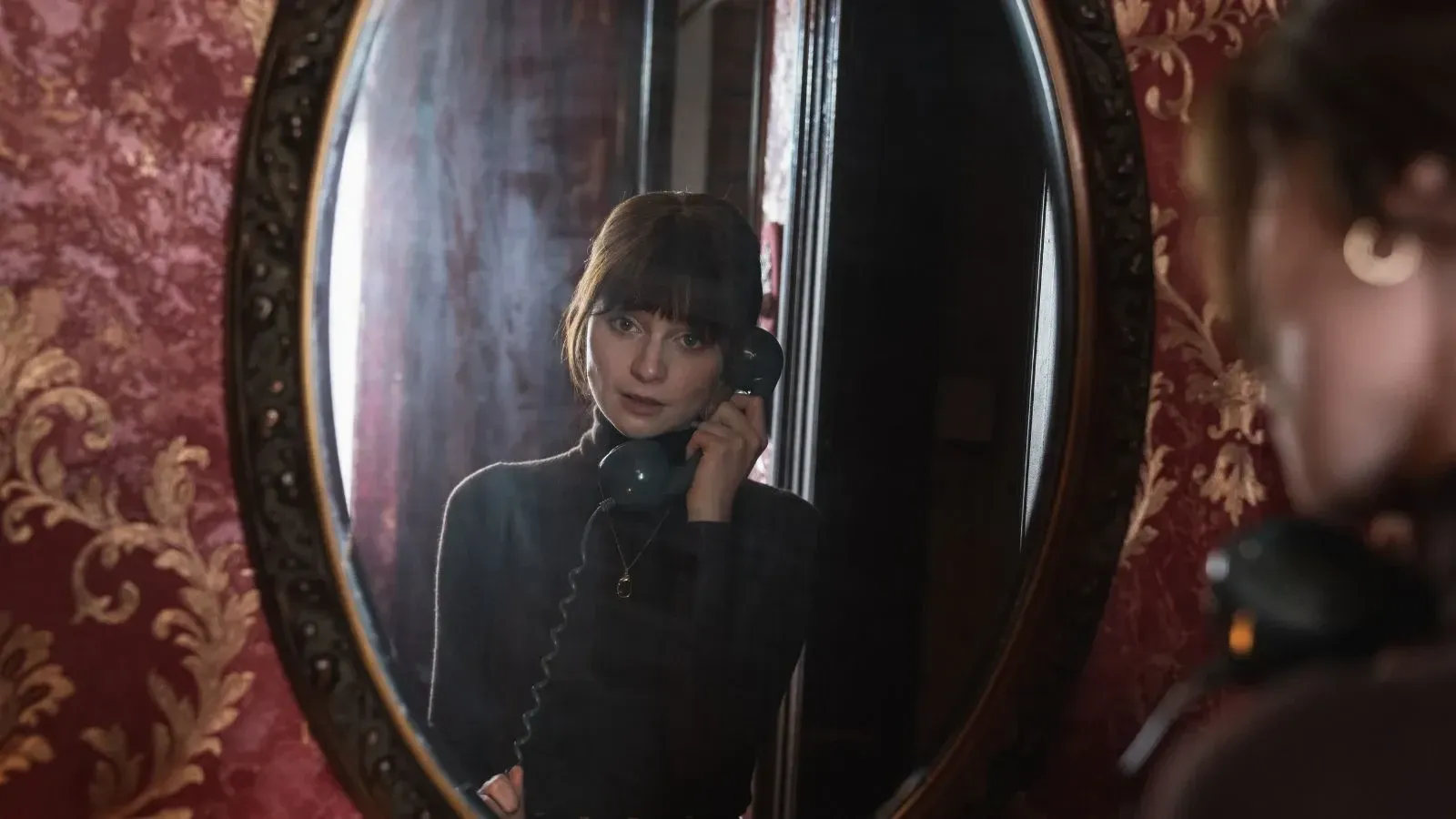
The series leans on Lola Petticrew, who must hold multiple identities at once: idealistic teacher, pragmatic barmaid, exhausted caregiver, and newly awakened lover. Petticrew keeps these strands visible without reducing Cushla to a composite sketch. Her energy and innocence share space with the realism of a community that polices every look. The performance refracts the entire project. Cushla’s descent into grief and trauma lands with physical force.
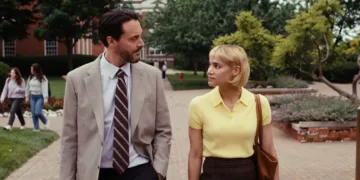
Tom Cullen’s Michael Agnew arrives with charisma and contradiction. He presents as a Romantic figure, all tousled hair and waistcoat, and he speaks a philosophy that prizes freedom over fear. That idealism seduces. He also conceals, equivocates, and benefits from an age gap that sits in the room like a piece of heavy furniture. The show treats him as a flawed man with an attractive theory of life. The attraction remains legible. The flaws remain documented.
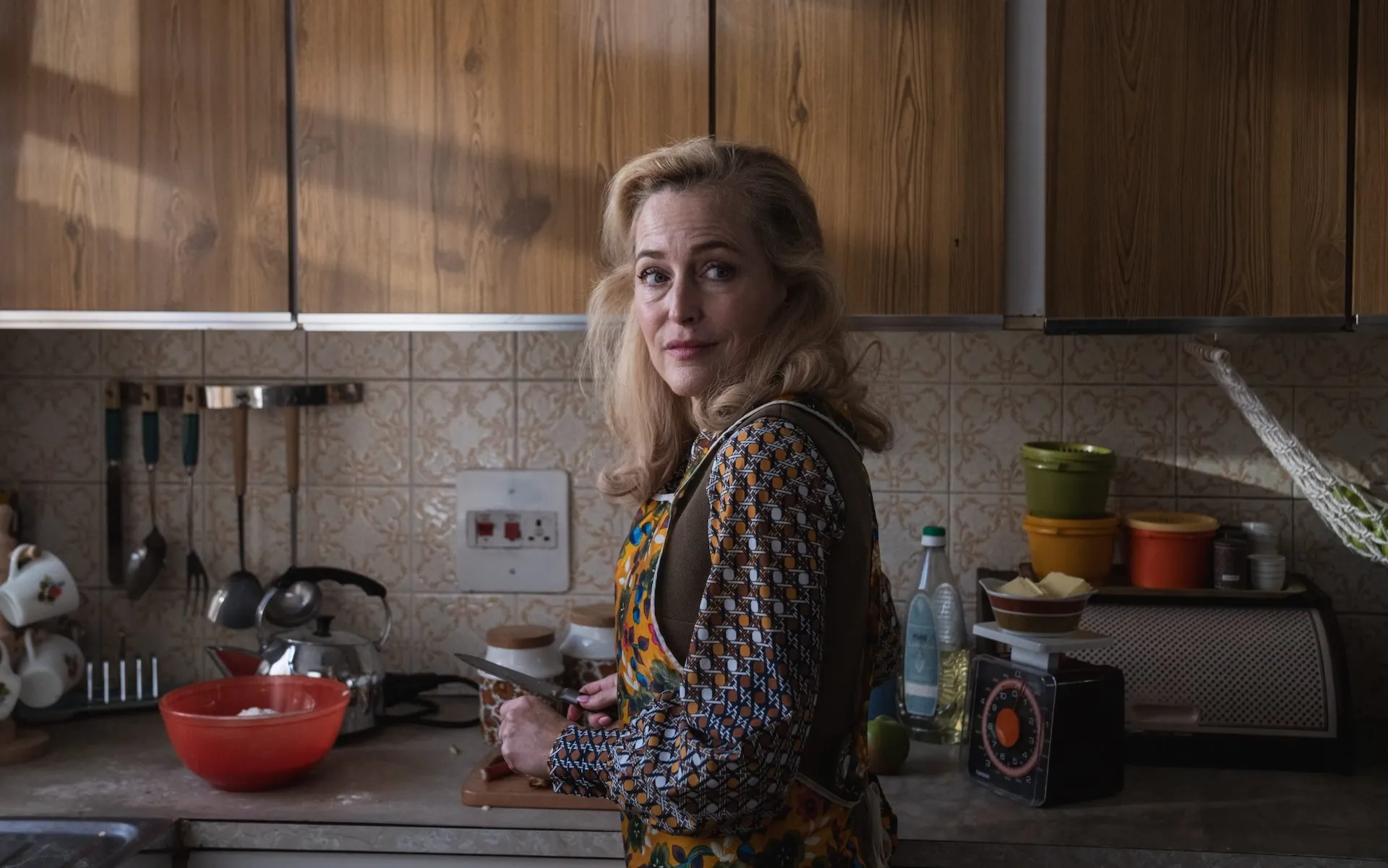
Gillian Anderson shapes Gina as a study in theatrical ruin. The “Glorious Wreck” archetype appears, complete with a bottle that behaves like a second partner. Gina functions as the gravity field that Cushla must cross. Anderson grants her sudden pulses of maternal feeling that break through bitterness before retreating again. The surrounding ensemble builds a credible micro-society: Wee Gerry’s quiet presence, Victor’s stinging cynicism, a neighborhood chorus of watchfulness that feels routed through habit and fear.
The Sensory Politics of 1975
Trespasses excels at atmosphere. The year 1975 functions as a character, a silent antagonist that shares no lines and changes every decision. Distant news bulletins create a constant hum. Sirens and explosions bleed into conversations and meals.
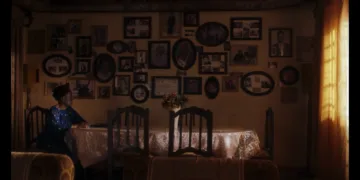
Allegiance appears in images: flags, murals, posters that announce loyalties before anyone speaks. Production design prefers brown interiors and rooms painted with cigarette smoke. Armed checkpoints staffed by “bully boy British troops” break the town’s map into zones of permission and denial.
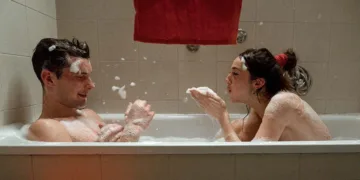
Director Dawn Shadforth favors intimacy that feels historically grounded. The camera often holds close to Cushla, which produces a tight radius of vision and the sensation of surveillance. Secrecy defines the affair. Their pied-à-terre functions as temporary shelter, a brief zone of amnesty that never convinces as permanent.
Ailbhe Keogan’s writing raises the intellectual charge. Characters discuss art and books, which frames interior life as a counter-measure to violence. The literate tone coexists with Ulster understatement, a social instrument that files the edges off catastrophe. A chronic drinker becomes “fond of a drink.” Terror becomes “an awful carry-on.” The idiom reads as accurate, sometimes sub-titled, and always rooted in place. Cultural veracity comes from speech patterns that refuse decoration.
A Female Gaze on Historical Cruelty
The series employs familiar material, a forbidden romance inside The Troubles, and finds modern resonance through a female-centered lens. Cushla’s sexual and emotional awakening sits at the hinge of the story. Domestic space and political space occupy the same coordinates. The result reads like microhistory: daily rituals recorded alongside public harm, each shaping the other.
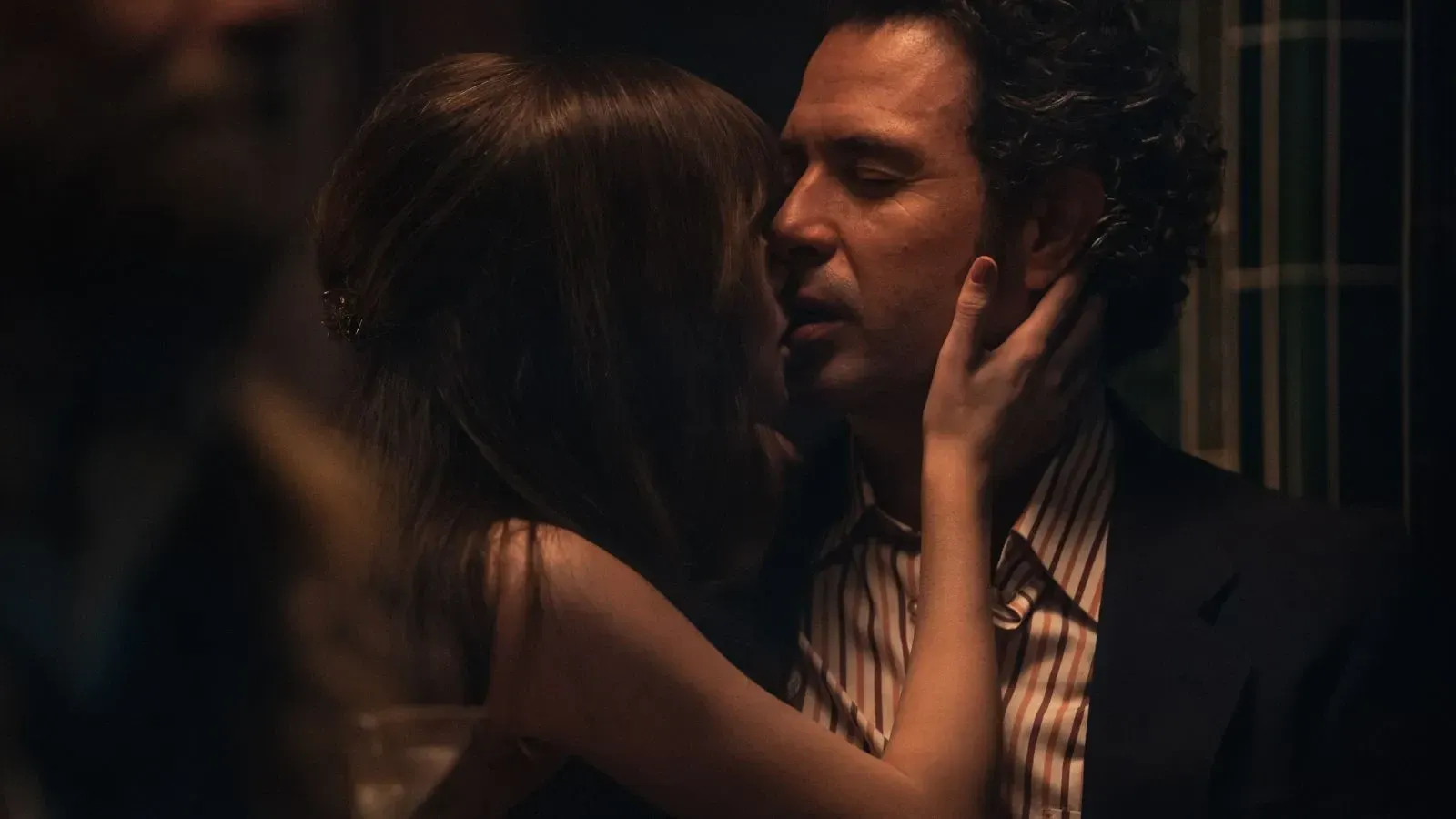
Emotional tone ranges across heat and cold. The passion between Cushla and Michael glows against rain and shadow. The story reaches devastation where trauma lands without warning. The tone keeps faith with ordinary humanity rather than misery for its own sake.
A final coda arrives with a charge that suggests a narrow seam of hope refuses extinction. Trespasses reimagines the star-crossed template within a twentieth-century conflict and measures the cost in small lives. The work argues for the persistence of the desire for freedom inside systems designed to punish desire.
Trespasses is a four-part British drama series based on the novel by Louise Kennedy, set in 1975 Northern Ireland during The Troubles. The story follows Cushla Lavery, a young Catholic schoolteacher, and her forbidden affair with Michael Agnew, an older, married Protestant barrister. The series premiered on Channel 4 in the UK on Sunday, November 9, 2025, with all episodes made available for streaming immediately on the Channel 4 platform.
Credits
Title: Trespasses
Distributor: Channel 4, All3Media International
Release Date: November 9, 2025
Rating: TV-MA
Running Time: 4 episodes (approximately 60 minutes each)
Director: Dawn Shadforth
Writers: Ailbhe Keogan (screenplay), Louise Kennedy (novel)
Producers and Executive Producers: Maria Mulhall (Producer), Amanda Posey, Gillian Anderson, Finola Dwyer, Dawn Shadforth, Louise Kennedy (Executive Producers)
Cast: Lola Petticrew, Tom Cullen, Gillian Anderson, Martin McCann, Oisín Thompson, Emily Taaffe, Barry Ward, Lisa Dwyer Hogg, Lorcan Cranitch, Frank Blake, Gary Lydon, Lalor Roddy
Editors: Dave Davis, Dominic Leung
The Review
Trespasses
Verdict Trespasses is a sophisticated, emotionally potent historical drama that uses a forbidden romance as a surgical tool to examine the crushing weight of sectarian violence on personal life. Led by Lola Petticrew's luminous, multifaceted performance, the series succeeds as both a meticulously detailed period piece and a devastating exploration of passion, duty, and the limits of individual compassion within a rigid, political system.
PROS
- Lola Petticrew offers a deeply nuanced and magnetic portrayal of Cushla, effectively anchoring the series' emotional and political complexity.
- The production design and direction meticulously recreate 1975 Belfast, using constant background tension to create a suffocating sense of dread.
- The four-part structure is tight and compelling, skillfully weaving Cushla's two major narrative threads (the affair and the McGeown family) toward an inevitable, high-stakes climax.
- The series uses the "forbidden love" trope to explore broader themes of sectarianism, hypocrisy, and the clash between personal desire and societal duty.
- The story provides a vital female-centered view of The Troubles, moving beyond traditionally male-dominated conflict narratives.
CONS
- The significant age gap and Michael's immediate, smooth charm may make the central romantic dynamic feel somewhat imbalanced or contrived for some viewers.
- The highly authentic local accent and dialogue may require subtitles for non-native viewers, potentially disrupting immersion.
- Michael Agnew, despite his charisma, functions primarily as a catalyst, and his personal dishonesty could be seen as inhibiting the viewer's full emotional investment in the couple.