






















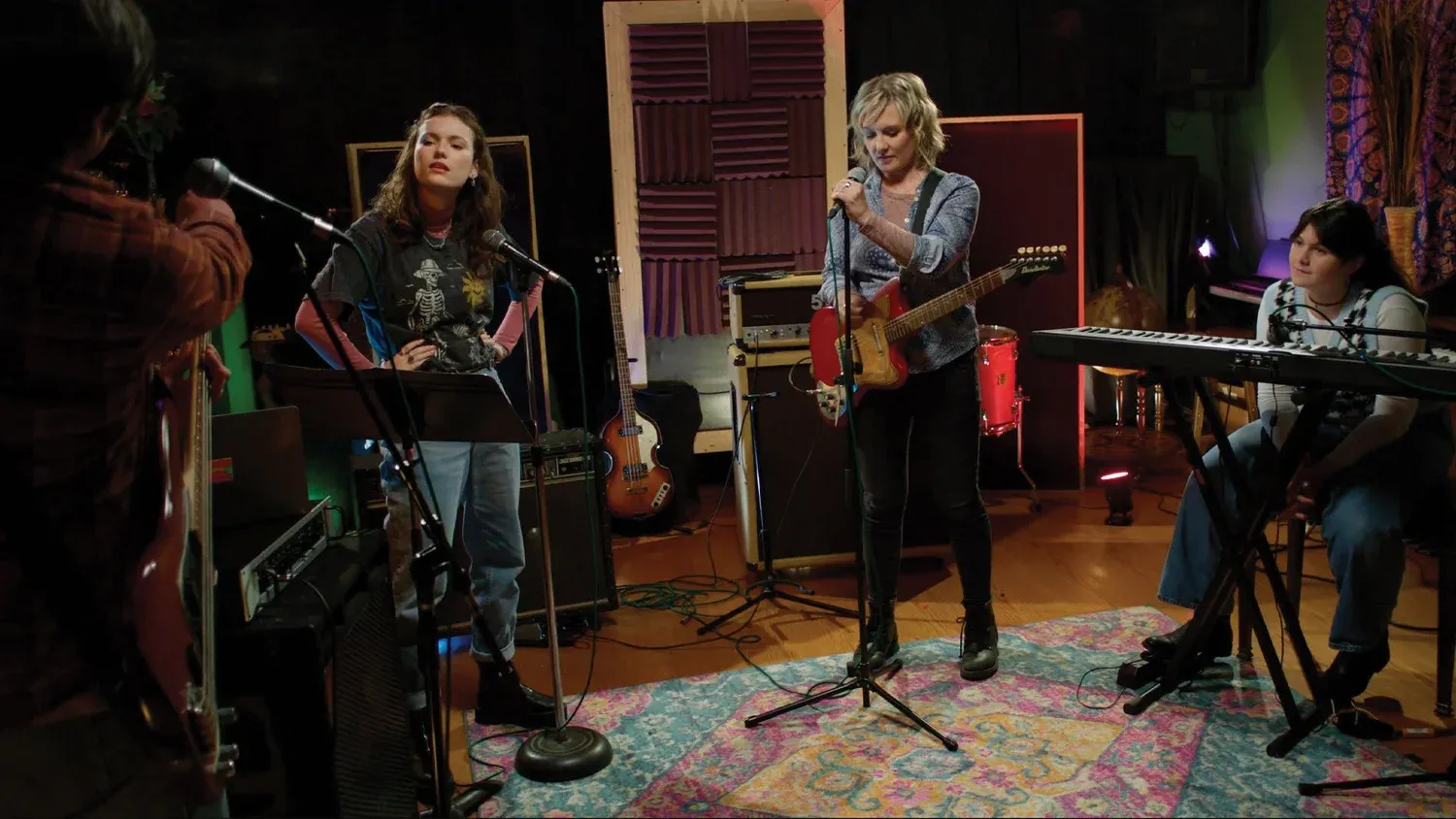

Lavender light spills from a faulty star projector, and a bedroom turns uncanny. Sixteen-year-old Joey Wethersby (Kirrilee Berger), daughter of City Kids’ faded fame, grows up in a cramped New York routine. Her parents, Laurie (Amy Carlson) and Gordon (Jordan Bridges), linger at the edges of a past life. Gordon teaches, a muted echo of his earlier persona.
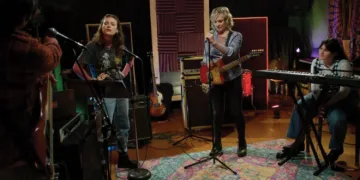
Laurie clings to the industry’s margins and receives online ridicule while trying to keep art alive inside a house that runs on memory. Joey absorbs the residue of unrealized dreams and proposes a fresh start through a family band. The plan fractures almost immediately. Gordon breaks the children’s night light, the star machine opens, and a lavender doorway invites Joey into a second life.
The portal delivers her to a fixed, glossy set built like a Disney-era musical sitcom. Color floods every surface. Performers repeat a single phrase, “Peas and Carrots,” the old background-actor murmur reshaped into law. Night after night, Joey crosses into this hyper-saturated stage world, and the premise locks into a stark hinge: the scraped-down texture of her days versus the neon lure of a frictionless script where routine masquerades as destiny. Stardom gleams on cue cards and canned applause. Background work wears its anonymity like a mask.
The Tenuous Threads of Reality
The film builds a dual track and then searches for a binding rhythm. The domestic strand aims for ballast and lands in airless repetition. Joey shoulders adult burdens with practiced efficiency, smoothing over the moods and misfires of parents who keep reaching for a bygone noise. Gordon dispenses pat guidance and drifts through scenes with a shrug that curdles into irritation. The household material contains a workable portrait of disappointment and obligation, yet the narrative keeps moving away from it.
The alternate realm offers a rigorous visual conceit and a puzzling narrative drift. Joey begins as an extra and soon stands at the center of the sitcom, performing skits that change tone and purpose from scene to scene. Ms. Washington (Kelly McAndrew), Joey’s physics teacher, finds a way into the set’s strange geometry, a sign that someone within the story seeks structure.
The link between dimensions rarely clarifies. The tonal slide from family drama to high surrealism loosens the story’s grip. The camera lingers on the dream machine of the studio and loses contact with the stakes outside it. By the close, a familiar message arrives: scale ambition, embrace authenticity, choose the smaller footprint over the glittering stage. The moral lands with a thud, underscoring a sour instruction to a sixteen-year-old who keeps looking for voice and volume.
Miscast Charms and Stilted Acting
Performances assemble like mismatched parts pulled from different shelves. Kirrilee Berger’s Joey holds the screen with quiet focus and a steady emotional register reminiscent of actors known for clear, calm truth-telling. She tracks the disorientation of living in two frames at once and rarely blinks. Even so, the film assigns teenage roles that do not sit cleanly on Berger or Talia Oppenheimer, and scenes gain a faint quality of costume play.
The parents spark in brief arcs. Amy Carlson brings warmth and solidity, yet Laurie recedes to the periphery, her usefulness to the plot clipped short. Jordan Bridges crafts a Gordon who grates on contact, a portrait of passive fatherhood that dispenses sitcom-ready counsel and leaves its aftertaste in scene after scene. Interest concentrates in the supporting orbit.
Kelly McAndrew’s Ms. Washington sharpens every exchange and gives the story a reliable line reading of authority. Angel Desai and Faith Gitchell act as lucid escorts through the purple haze, their guidance in the alternate dimension supplying energy whenever the script loses shape. Collective charm from the ensemble keeps attention alive while the plot loosens its screws.
Nonsense and Technical Amateurism
Form announces itself through contrast. The studio world glows with neon purples that signal a search for self under the stage lights. The art direction quotes the look of a melodramatic musical series and turns it into a bright, looping gag. Home scenes retreat to a plain palette that reads as safety and stasis. The divide is clear and legible, and the eye always understands where it stands.
Tempo undercuts that clarity. The runtime clocks in modestly; the experience stretches. Long, untrimmed skits seize the frame, and editorial patience curdles into torpor. The project reads like a pilot that keeps setting up its rules instead of a feature that tightens screws and pays off. Production texture carries a homemade grain. Peripheral performances fall stiff, and plotting choices scramble intent. Music arrives with solid pedigree and plays at an acceptable hum, yet the City Kids anthem never locks into the kind of sticky hook that could hold a family’s mythology in place.
“Peas and Carrots” enters as a visual-metaphorical joke about filler talk. It morphs into a mirror for the film, a cue for empty syllables that move mouths while meaning thins out. Peas And Carrots assembles clever ingredients and then loses the recipe, collecting charm in clusters while language and structure collapse into glossy babble. The idea promises a meditation on background life and spotlight hunger. What remains is a watchable surface, a chorus of pleasing faces, and a purple stage that keeps repeating its line.
Peas and Carrots is an independent film that follows the story of sixteen-year-old Joey Wethersby, the daughter of former rock stars. After suggesting her family form a new band, Joey finds herself nightly transported to a bizarre alternate reality where everyone only speaks the phrase “Peas and Carrots.” The film explores themes of ambition, identity, and the choice between the spotlight and the background. It premiered at the Dances With Films festival in December 2024 and had a limited theatrical release starting on October 3, 2025, distributed by Blue Harbor Entertainment. It is rated PG and has a running time of 96 minutes.
Credits
Title: Peas and Carrots
Distributor: Blue Harbor Entertainment
Release date: October 3, 2025 (Limited)
Rating: PG
Running time: 96 minutes
Director: Evan Oppenheimer
Writers: Evan Oppenheimer
Producers and Executive Producers: Edward Schmidt, Jay Zellman, Brian O’Carroll
Cast: Kirrilee Berger, Amy Carlson, Jordan Bridges, Andrew Polk, Kelly McAndrew, Talia Oppenheimer, Callum Vinson, Laurissa Romain, Dan Thompson, Faith Gitchell, Krishna Doodnauth, Angel Desai, Gabriel Rush, Ajay Naidu
Director of Photography (Cinematographer): Leland Krane, George Lyon, Brian O’Carroll
Editors: Evan B. Wood
The Review
Peas And Carrots
Peas And Carrots is a surreal, sometimes captivating coming-of-age film that ultimately buckles under the weight of its own bizarre dual structure. It possesses intriguing visual ambition and sincere performances, particularly from its younger cast, but its confounding narrative lacks the discipline to connect its high-concept sci-fi elements with its grounded family drama. The film attempts to question the nature of ambition but delivers a muddled, unsatisfying message. It’s a compelling experiment that needed a more focused vision.
PROS
- Intriguing visual concepts and use of neon purple hues in the alternate reality.
- Strong, emotionally grounded performances from the lead, Kirrilee Berger, and scene-stealer Kelly McAndrew.
- Unique premise blending mundane family life with surreal, meta-cinematic elements.
- The cast's charm motivates the audience to stay engaged despite plot confusion.
CONS
- The dual narrative is confusing and fails to connect the two worlds effectively.
- Pacing is slow, making the 90-minute runtime feel like a slog due to unnecessary alternate reality skits.
- The central coming-of-age lesson feels abrupt and poorly integrated into the story.
- The casting of younger actors is unconvincing, contributing to a sense of amateurism.
- The father character, Gordon, is poorly written and irritating, dragging down the family dynamic.