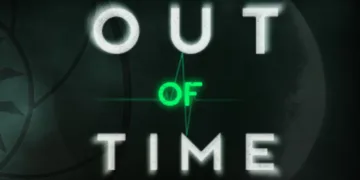


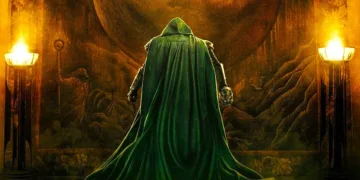

















Out of Time arrives as a cooperative roguelite action game built on the “Survivors-like” loop of dense bullet-hell combat paired with persistent character growth. Manticore Games steps away from its user-generated Core platform with a self-contained release that frames everything around The Shattering, a disaster that folds past, present, and future into a single broken timeline.
Humanity fights The Tangle, a creeping purple force that swallows reality. The tone is gleefully absurd: futuristic robots, medieval knights, and modern animals share the battlefield. Players depart from the hub city of Infinitopia and drop into time-warped stages while a strict 15-minute clock advances toward a boss encounter. Every run asks for clear choices between survival and mission progress from the first minute.
The Gear of Consequence
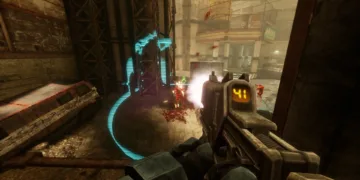
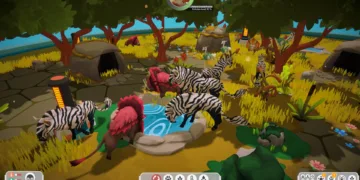
Moment-to-moment play centers on a frantic auto-shooter against enormous enemy swarms that can reach the thousands. Out of Time uses a full 3D space and a movable camera that supports close third-person or a pulled-back isometric view. Verticality matters. Jumping, gaining high ground, and reading angles provide tactical control beyond simple circular kiting.
The game’s signature system replaces fixed classes with gear-driven abilities. Weapons set your auto-attack and two actives. Helmets, armor, and boots each grant an extra active or a passive. Loadouts invite experiments with themed sets such as mobster, sci-fi, or knight. An axe, a flamethrowing guitar, or a missile launcher changes your skill kit and cooldown rhythm, so players rotate abilities with intent.
Co-op design lives in the Tether System, which links teammates through a blue energy line. Staying connected shares buffs, healing, and stat bonuses. Straying breaks the benefits and punishes lone play. Teams must move and position in sync, which makes coordinated co-op the clearest path to success while solo runs raise the difficulty bar.
The 15-minute timer shapes the primary decisions. Players weigh experience farming for vital upgrades against exploring the map to reach the percentage threshold required to summon the boss. Failure preserves cash and materials for long-term growth, so every effort feeds the next attempt.
Exploration pays out through Corruption points, short events that ask you to protect a time capsule or hold a pressure plate. These vignettes grant valuable rewards such as free skill upgrades and make roaming a meaningful trade against pure survival.
The Architecture of Power
Infinitopia functions as the machine for permanent progression. You can see other players, dress avatars, and handle long-term growth. The Avatar Station offers cosmetic freedom through gear sets that can turn your character into an alien or an anthropomorphic fox.

Two stations drive advancement. The Workshop lets you invest cash and materials to level equipped gear to 10, then ascend higher-rarity pieces to 30. Salvaging unwanted items yields time bottles required for that ascension. Item families lean into different stat spreads.
A gas mask can favor attack power. A Healing Bot suit can skew toward healing and defense. The loot system supports the plan by flagging owned pieces and preventing duplicates of the same rarity, which nudges drops toward builds you are developing.
The Mastery Station provides permanent account-wide stats, a foundation that mirrors a basic MMO-style talent grid. You spend gold to raise core values like max health, armor, and attack power regardless of your current loadout. This gives a steady baseline that sits beside the spikes you feel from rare gear. Long-term play stretches across layered difficulty.
Normal and Hard set the floor, while Shattered opens tiers from 1 to 10. Climbing those tiers demands heavy investment in characters and equipment. Players chase the next Power Level cap through repeated runs to find and advance the right pieces. The loot curve tends to favor larger groups, which can slow the path for solo or duo players who stick to smaller parties.
Style, Function, and Horizon
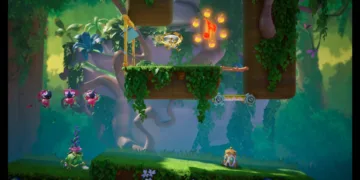
The art style favors a cartoony presentation similar to Fortnite, with a cel-shaded look. Visuals stay sharp while detail remains simple enough to keep system requirements modest. Performance holds steady with uncapped frame rates that help during massive enemy wipes.

Some technical roughness remains. Menu elements scale inconsistently, and the gear menu’s aliased character model creates a coarse look. Combat lacks ragdoll physics for enemy deaths, which dulls some of the slapstick energy that could come from seeing knights, foxes, and robots scatter in one wild skirmish.
Current content splits into three era themes: Medieval, Modern, and Wasteland. Each era supplies distinct environments and enemies, which adds surface variety, but mission beats repeat: uncover the map, hit the threshold, and fight the boss. The layouts share a core structure that can make runs feel samey over time.
Infinitopia’s lo-fi music sits against chunky combat effects, and abilities read clearly, yet enemy death sounds cycle often and audio cues lack strong separation, so specific threats can blur inside the noise. Manticore plans free updates with three more Eras — Solar Punk, Prehistoric, and Cyberpunk — that promise new gear and fresh spaces.
Out of Time thrives on the mix of action-roguelite speed and MMO-style progression and serves players who enjoy steady power growth and team coordination. Repeating mission structures and a demanding gear grind hold it back from true standout status, even as the loop delivers plenty of high-energy fights and build tinkering.
The Review
Out of Time
Out of Time successfully marries the chaotic auto-shooter pace with a sophisticated MMO-style progression. The gear-driven ability system promotes deep experimentation, and the Tether mechanic genuinely redefines cooperative action in the roguelite space. However, the game's structural repetition, particularly the identical mission objectives across varied eras, limits long-term appeal. It is a technically sound and enjoyable experience, offering a solid core loop for fans of the genre, provided they are prepared for a deliberate, slower grind.
PROS
- Innovative gear-driven skill system.
- Excellent cooperative dynamics via the Tether mechanic.
- Chaotic, fast-paced 3D auto-shooter action.
- Permanent Mastery Station progression for long-term power.
CONS
- Repetitive core mission objectives.
- Grind-heavy progression, which is slower for solo players.
- Basic visuals and lack of physics spectacle (e.g., ragdolls).
- Minor visual/scaling inconsistencies in menus.