




















![Kingdom Hearts Collection [I-III] Review](https://gazettely.com/wp-content/uploads/2026/10/Kingdom-Hearts-Collection-I-III-1-360x180.webp "Kingdom Hearts Collection [I-III] Review: KHII Holds Steady as Newer Entries Fluctuate 37")





The holiday film genre often leans on big emotional gestures, piling sentiment high and closing with a clear, triumphant payoff. Christmas, Again, the feature debut of Charles Poekel, builds its story on a different foundation. The film treats that familiar template as background expectation and answers it with a quiet, precise study.
Working with an ultra-low-budget setup, Poekel restricts almost the entire narrative to a single 24-hour Christmas tree stall on a Greenpoint, Brooklyn street corner. For the span of the film, this narrow strip of pavement, strung with lights and crowded with balsam firs, functions as an entire dramatic universe.
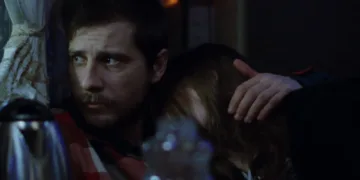
Inside that small world stands Noel (Kentucker Audley), a Christmas tree salesman returning for his fifth season, now assigned to the solitary night shift. From the opening scenes, the film plants itself firmly in a grounded indie register: naturalistic performances, unvarnished New York corners, and a muted emotional temperature that runs against the usual seasonal excess.
Poekel steers away from the broad emotional swings associated with Christmas melodrama and shapes something closer to a stately observational piece. The project plays as a character study of a man steeped in loneliness, moving through a season marketed as communal and warm while he occupies a space of quiet withdrawal. The familiar idea of “holiday movie” is stripped down to something small, human, and solitary.
The Character of Stillness and Subtle Exposition
Noel’s story avoids the clean lift of a conventional three-act redemption arc. The film instead settles into a long, steady look at a man who treats daily life as a form of emotional stasis. Noel arrives on screen weary and shut down, still visibly shaken by a recent breakup with the girlfriend who shared the stand with him the year before. His isolation operates on several layers. Emotionally, he has pulled inward. Physically, the job keeps him in the cold all night, then confines him to a cramped, icy caravan parked beside the rows of trees where he grabs short stretches of sleep.
Poekel builds this situation with narrative techniques that rely almost entirely on accumulation. Exposition is present, yet rarely spelled out in full. Information arrives through rhythm and repetition. Customer after customer asks about “that nice girl from last year,” and each casual question cuts through Noel’s attempt to stay sealed off. These recurring lines of dialogue work as structural beats: they underline the breakup’s recency, keep the wound open, and quietly define the emotional space in which Noel operates.
The film asks Kentucker Audley to hold nearly every shot, and his performance becomes the primary engine of the piece. His work is marked by understatement and a strong sense of inner life. Whole passages unfold with little or no dialogue from him; the emotional story sits in his eyes, his posture, the slight drag of his movements. This is the portrait of a man who has stepped back from his own feelings and tries to keep them behind thick glass, yet the hurt remains visible. Poekel constructs a performance-driven narrative in which stillness and silence carry much of the dramatic weight, and Audley meets that demand with precise, controlled choices.
Narrative motion arrives from repetition as much as from change. Poekel, drawing directly on his own experience as a tree salesman, anchors Noel in the mechanics of the job: slotting holly into wreaths, cutting and tying trees, dealing with cash, keeping the stand functional through the night. The camera repeatedly returns to these tasks, treating them as part of the storytelling grammar. Alongside work duties, the film tracks Noel’s personal routines: his solitary swims at the local Y and his methodical use of pills stored in an Advent calendar. The repetition of these actions functions as character architecture, giving the audience a clear sense of how he tries to manage grief and winter as daily work.
That routine is interrupted at intervals by an array of customers who rotate through the stand. They form a loose gallery of New Yorkers who briefly enter Noel’s small orbit: some demanding, like the shopper who insists on a tree to match the Obamas’, others curt or impatient. These short, transactional scenes puncture the quiet of Noel’s nights and underline the gap between the holiday cheer his trees symbolize and the chill that defines his own emotional state.
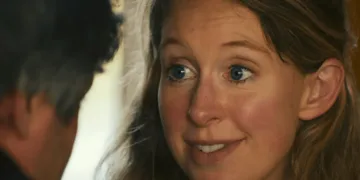
The most significant structural shift arrives with the appearance of Lydia (Hannah Gross), whom Noel finds passed out on a park bench nearby. His decision to let her stay in his trailer functions as a key turning point in the narrative. The film treats that choice as a small gesture on the surface that carries large implications for the story’s emotional map. Poekel resists turning Lydia into a simple, healing figure whose presence magically repairs Noel’s life.
She clearly has her own complicated situation, and the film acknowledges her separate reality. As Noel and Lydia share scenes, a relaxed, believable rapport develops between Audley and Gross. Their conversations and quiet moments together operate as slow, careful increments of movement, hinting that Noel’s emotional ice might begin to soften without promising a sweeping transformation.
The Textural Language of 16mm Film
Poekel’s direction grows directly out of his experience in documentary work and his first-hand knowledge of this seasonal job. He approaches the material with a calm sense of process, allowing time for tasks, routines, and small interactions to register. The pacing feels patient, matching the slow rhythm of long winter nights at a street stand. Selling trees, sweeping stray needles, adjusting lights: each action is treated as part of the narrative rather than mere background business.
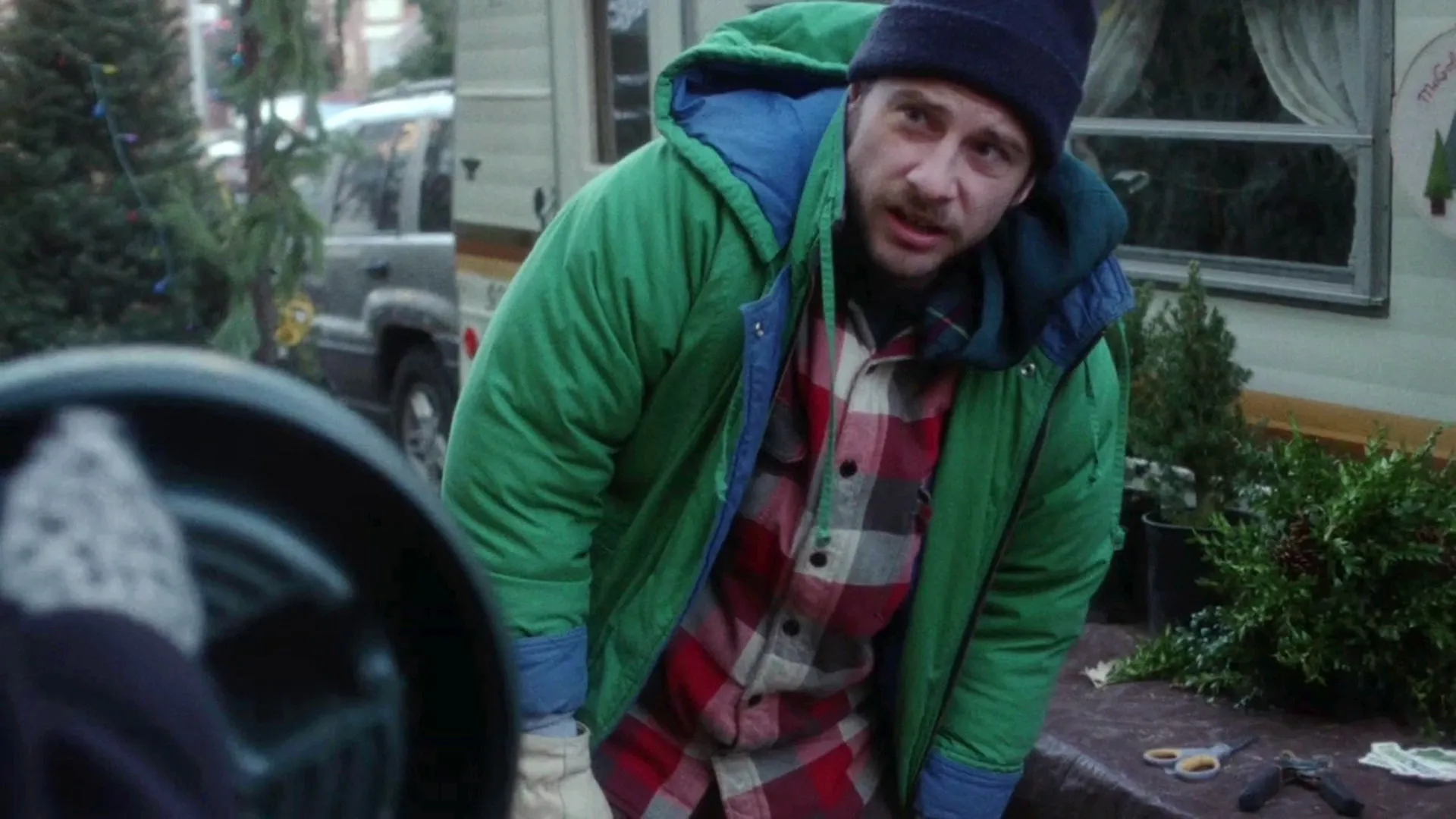
The film’s visual identity rests heavily on Sean Price Williams’s cinematography. The choice to shoot on 16mm film defines the look. The format supplies a textured, slightly rough surface, where grain and muted winter colors combine to create a persistent undertone of melancholy. Williams frames the stall and its surroundings with careful attention: reflections in a damaged screen door, the repeated flicker of strings of lights, the thickness of the dark air around the stand. These details enrich the sense of place and mirror Noel’s interior stillness.
The Greenpoint corner becomes a small pocket of the city sealed in its own late-night atmosphere. Williams captures the quiet that can settle over New York during the deepest hours of December. The Christmas lights that drape the space do not appear as soft, glowing comfort. At certain moments, the camera shapes them into something harsher, closer to the washed-out glare of “police lights,” which suits Noel’s emotional fatigue.
Yet the film also allows small traces of color and sparkle to appear at the edges of the frame, faint hints of warmth pressing against the cold gray outside and the tight, dim interior of the trailer. This visual tension between chill and faint warmth gives the film a distinctive texture.
Sound design supports that mood. The track uses older Christmas songs in slightly unexpected ways, pairing familiar melodies with the film’s low-key, nocturnal energy. The occasional waver of a theremin adds a faintly otherworldly touch. Together, these choices contribute to a quiet, wistful sonic landscape that reinforces the image of Noel moving through a season that feels out of sync with him.
Subtle Arc and Realistic Resolution
Christmas, Again organizes its story around themes of seasonal labor as duty, the corrosive effect of deep loneliness, and a cautious, tentative openness to renewal. The film observes how the holidays can register for many people as a period of endurance rather than celebration, a time to get through rather than a time of easy joy.
From a structural standpoint, Poekel resists the typical escalations that drive many holiday narratives. The film builds on mood, tempo, and the careful observation of work and routine instead of large, orchestrated dramatic peaks. Information about Noel’s past and present arrives slowly, and the film invites the audience to lean in, watch his reactions, and piece together his emotional history from small decisions and quiet shifts in behavior rather than from direct explanation.
The main arc remains subtle. Noel’s gradually deepening connection with Lydia marks one line of change, as their interactions suggest the possibility of human contact that feels genuine rather than forced. The other key structural movement appears in a late sequence of Christmas Eve tree deliveries. This stretch takes Noel, and the viewer, away from the confines of the stand and through a series of New York apartments.
In these homes, families and individuals, both young and old, show simple delight in their trees. The scenes form the film’s closest brush with classic “good cheer,” even as that joy sits at a remove from Noel’s own unsettled state. The deliveries expand the physical map of the film while underscoring how far Noel still feels from uncomplicated happiness.
The closing passages of Christmas, Again contain its strongest storytelling work. The final movement favors realism over spectacle and leaves Noel’s future deliberately open. The film refuses a grand redemption beat that would neatly solve his grief. Instead, the story hints at the chance that he might slowly begin to step back into life. That suggestion fits the film’s commitment to emotional honesty: recovery appears as a gradual shift, uncertain and incomplete, rather than a single decisive moment.
In this view, moving past sorrow can start with modest elements: a person who meets you halfway, a brief sense of shared understanding, or a small satisfaction found inside a complicated reality. The film ends in that modest, truthful register, staying faithful to the quiet, carefully constructed arc it has been building from the first frame.
Christmas, Again is a low-key American indie drama that premiered at the Locarno International Film Festival in August 2014 before receiving a limited release in the United States in December 2015. The film follows a heartbroken Christmas tree salesman working the night shift in Brooklyn. Though it is over a decade old, its restrained, authentic style has kept it relevant within independent cinema. As of today, December 10, 2025, the film is available to watch on various digital platforms and streaming services specializing in art house and independent films, such as MUBI.
Full Credits
Title: Christmas, Again
Distributor: Factory 25, MUBI, Bulldog Film Distribution
Release date: August 12, 2014 (Locarno International Film Festival); December 3, 2015 (United States)
Running time: 80 minutes
Director: Charles Poekel
Writers: Charles Poekel
Producers and Executive Producers: Charles Poekel, Eleonore Hendricks, Robert Greene, William Poekel
Cast: Kentucker Audley, Hannah Gross, Jason Shelton, Oona Roche, Mario Cantillo, Heather Courtney, Martin Courtney, David Gauld
Director of Photography (Cinematographer): Sean Price Williams
Editors: Robert Greene
The Review
Christmas, Again
Christmas, Again is a quiet triumph of observational storytelling, skillfully prioritizing mood and character interiority over forced sentiment. Poekel and Audley deliver an affecting, realistic portrait of loneliness and the potential for hesitant renewal during a difficult season. It is a necessary counter-narrative to holiday melodrama, subtle and true to life.
PROS
- Wrenching, subtle, and carries the film's emotional weight without relying on dialogue.
- The 16mm cinematography and location shooting create a highly textured, grounded, and melancholy visual mood.
- It avoids the clichés and grand emotional arcs of typical holiday films, offering a more nuanced study of resignation.
- Poekel's meticulous attention to the job's process and details feels genuine and earned.
CONS
- The narrative can feel extremely slow or deliberate, which may test the patience of some viewers.
- The resolution is realistic, but its open-ended nature may leave some longing for a more definitive sense of closure.
- The film's focus is intentionally narrow (mostly one street corner), limiting the broader context of New York City.
- Though effective, her character functions primarily as a catalyst, and she is given less depth than Noel.