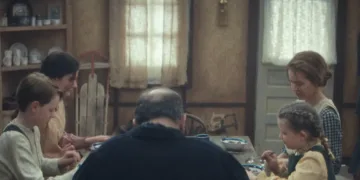








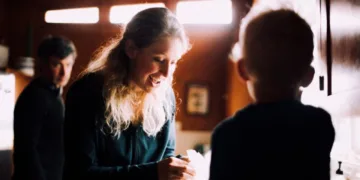





















The Great Plains can feel like an ocean of grass, and in March of 1920 that ocean becomes a frozen, white void. In North Dakota, history books still mark the Great Blizzard of March 15 as a day when the frontier’s harshness exacted a terrible price. Thirty-four people died after a warm, sixty-degree weekend snapped into a lethal gale.
Within those accounts sits the story of fifteen-year-old Hazel Miner, carried through the years as a piece of regional folklore. This film captures the frightening speed of that shift. Hazel appears as a quiet, watchful girl on a farm near Center, drawn to her books and her faith, uneasy with the social pressures around her.
Her immediate worry is a school presentation on the love verses of 1 Corinthians 13, even as she imagines a life in Bismarck, away from the hard demands of her father, William. When the storm arrives, it hits with a physical force that feels intimate. The sled carrying Hazel and her younger siblings, Emmet and Myrdith, disappears into the whiteout after their horse bolts. The movie keeps its attention on the tight, suffocating reality of three children stranded in a world where every landmark has been erased.
The Architecture of a Rescue
The narrative builds momentum by splitting time between the children and the community. We stay with the overturned sled as Hazel works to keep Emmet and Myrdith calm, then shift to the frantic search led by William. The writing steps away from a straight line to press the psychological weight of each passing hour.

Hazel moves from a “sickly” and shy teenager into a pillar of resilience, and the earlier scenes with her father complicate what follows. William comes across as a man of few words and strict expectations, and his pain sharpens as he learns the phone lines have gone down and the visibility turns a night search into a fatal gamble.
The film introduces Rufus, a newcomer in town, and a small kindness he offers Hazel that morning lingers like a warning. They share an apple, and his invitation to a birthday party gestures toward a future the blizzard threatens to wipe away.
The story’s tension lives in the elements and in human friction: the schoolroom dynamics, the Miner household’s strain, the quiet pressures that sit alongside the life-or-death stakes. As the temperature falls, Hazel makes a careful, selfless choice to shield her siblings with her own body. She uses songs and the Lord’s Prayer to keep them awake and fighting off the deadly pull of hypothermia. The film tracks the long night through slowed time, thinning hope, and searchers who feel the hours closing in.
The Texture of the Whiteout
On a technical level, the film creates striking immersion, grounded in its independent roots. The production design reconstructs the 1920s through tactile details of prairie life: the weight of wool blankets, the sting of wet clothing, the way ordinary materials become dangerous under cold and wind.
Filming on a soundstage in North Dakota gives the crew control of the visual field, producing a convincing “continuous whiteout” that seems to stretch without end. Wardrobe and set pieces carry a lived-in quality, sidestepping the polished look that period dramas often chase. Madelyn Dundon anchors the emotional arc, playing Hazel with quiet dignity and letting her eyes carry terror and determination in equal measure.
Sound matters just as much in the final stretch. The score holds back, leaning into a subtle, melancholic mood that fits the sound design rather than overpowering it. One of the film’s most chilling details is the bark of a distant dog. The children hear it and understand a farmhouse sits nearby, while wind and snow keep them from locating it. That single sound becomes its own form of cruelty.
During the climax, the imagery stays sharply focused: the dark interior of the sled set against the blinding white outside, a visual strategy that mirrors the children’s disorientation. When the search party reaches them the next afternoon, the discovery lands with stark clarity. Hazel is found frozen, while her siblings survive because of her protection. The film’s precision makes the emotional release feel earned, guided by craft rather than manipulation.
The Weight of Love and Legacy
The film’s themes land through faith treated as a practical instrument for survival. Hazel studies the verses of 1 Corinthians 13 for school, then uses them as an anchor when the cold starts to dull her mind. The “Love Chapter” becomes a guide for her behavior, with patience, kindness, and perseverance taking shape in her refusal to claim the blankets for herself.
The film frames this as “Christ-like sacrifice” without sliding into sermonizing, staying close to the bodily reality of choosing another person’s life over your own. The story points to a moral world where family and community function as the first line of defense against a hostile environment.
William and Rufus change through the ordeal, shaped by shared desperation and by the recognition of Hazel’s courage. The movie presents Hazel as a humble girl whose heroism lives in domestic duty and steady resolve. That angle matches the historical sense of the plains, where survival often hinged on quiet endurance carried out away from any grand stage.
Hazel’s sacrifice remains central to North Dakota’s identity, and the film treats the tale with sincerity. The community’s gathering at the end stands as proof of how one act of love can echo outward, and the filmmakers focus on the spiritual and emotional weight of the tragedy to show a generational moment when faith served as the everyday language of resilience.
“Hazel,” also known under the national title “Hazel’s Heart,” is a survival drama based on the true story of the 1920 North Dakota blizzard. The film follows 15-year-old Hazel Miner and her siblings as they fight to survive a sudden, lethal whiteout after becoming stranded on their way home from school. Following its successful world premiere in Bismarck on September 26, 2024, the movie makes its national digital debut today, December 23, 2025. It is currently available for rent or purchase on major VOD platforms such as Apple TV, Amazon, Google Play, and YouTube Movies, with exclusive streaming access provided by Angel Studios.
Full Credits
Title: Hazel
Distributor: Samuel Goldwyn Films, Angel Studios
Release date: September 26, 2024 (Premiere), December 23, 2025 (Digital Debut)
Running time: 89 minutes
Director: Daniel Bielinski
Writers: Daniel Bielinski
Producers and Executive Producers: Daniel Bielinski, Kayli Schadler, Dave Diebel, Carson Nordgaard, J. Brockton Holbert, Rachel Morrison, John Mahoney, Ann Mahoney, Stelio Savante
Cast: Madelyn Dundon, Stelio Savante, Genevieve Bielinski, Xavier Bielinski, Timothy E. Goodwin, David Michael Reardon, Franni Cash, Todd Terry, Laurie Fortier
Director of Photography (Cinematographer): Carson Nordgaard
Editors: Daniel Bielinski
Composer: James MacMillan
The Review
Hazel
Hazel stands as a powerful tribute to a historical act of devotion. By focusing on the intimate terror of the blizzard, the film avoids the bloat of traditional epics. The performances are grounded. The technical execution creates a palpable sense of isolation. It is a sincere, moving depiction of the values that define prairie life. While the pacing reflects the slow, agonizing reality of the storm, the emotional payoff remains profound. This is a vital piece of regional storytelling that honors its source material with grace.
PROS
- Authentic period production design and wardrobe.
- Powerful lead performance by Madelyn Dundon.
- Effective, claustrophobic sound design that heightens the tension.
- Sincere handling of spiritual themes without feeling preachy.
CONS
- The deliberate pacing reflects the slow passage of time in the storm, which some viewers might find taxing.
- The focused, single-location nature of the survival scenes limits the scale of the action.