




















Marina Zenovich approaches comedy like an examiner arriving at a well-worn artifact. Her documentary, I’m Chevy Chase and You’re Not, traces the trajectory of Saturday Night Live’s first true breakout star and then studies the residue that fame leaves behind. Chevy Chase appears as a bifurcated figure: the comedian who defined a decade of subversive wit through Caddyshack and National Lampoon’s Vacation, and the professional known for decades of bridge-burning.
Zenovich anchors the film in a contemporary interview with the 82-year-old icon, threading that conversation through archival clips and peer testimonials. This release arrives alongside the 50th anniversary of SNL, giving Chase a sharp, sometimes painful backdrop for reflection on a legacy that can feel peripheral.
Zenovich weighs his comedic precision against a persona often described as prickly and hostile, keeping the genius of the pratfall in the same frame as the toxicity of the performer. The film keeps returning to a man trying to locate his place after the culture has shifted, even as he keeps refining the same familiar sneer.
A Study in Static and Shadow
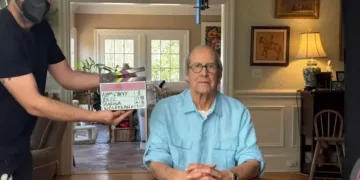
The contemporary interview passages play like a psychological thriller where the subject refuses to cooperate. Zenovich stays off camera, yet her presence presses into every pause. Chase adopts a cat-and-mouse posture, greeting inquiries with immediate deflection. He snaps back with dry, practiced cruelty, including insults aimed at the director’s intelligence. Zenovich films these exchanges with a clinical eye. The compositions lean into stillness, letting tension collect in the negative space. Chiaroscuro hangs over the frame, hard light and shadow turning personality into a moral question.
Physical decline deepens the unease. The film shows significant physiological decay and attaches it to a specific rupture: heart failure in 2021 that led to an eight-day medically induced coma. Zenovich points to genuine neurological gaps afterward. Chase’s recurring “I don’t recall” becomes the narrative hinge. The line can operate as a shield against past damage. The line can also register as damage, the mind dropping frames. Zenovich keeps both possibilities active, and the ambiguity stains every exchange.
Zenovich then cuts to Bedford and the quiet contours of Chase’s daily life. The lighting softens and the image relaxes. These moments catch him with less edge in his posture, a person shaped by age, habit, and routine. The return to the interview tightens the frame again. That alternation works on audience psychology with sly precision. Suspicion turns into pity, then another barb lands and the mood snaps back. Pacing becomes a tool of manipulation, and the film uses silence and timing to keep perception unsettled.
The Cost of the Subversive Sneer
Archival footage reminds you why the industry once knelt at Chase’s feet. His work with Richard Pryor stands as a high-water mark of racial and social satire. Zenovich also foregrounds his rhythmic, expressionistic physical comedy, a body that understands timing as a musical measure. The clips function like exhibits, proof of craft and proof of charisma. They also underline how naturally he could play superiority as an attitude, then treat that attitude as comedy’s oxygen.

The talking heads supply the counterweight. Lorne Michaels and Dan Aykroyd sketch early camaraderie. Goldie Hawn and Beverly D’Angelo offer affection that stays guarded, warmth that still measures distance. Zenovich keeps the friction in view. John Carpenter’s disdain during the filming of Memoirs of an Invisible Man sits in the film like a warning about what happens when a star turns a production into a test of endurance. Jay Chandrasekhar offers a lonely perspective on the fractured environment of Community.
Mike Ovitz enters with the blunt psychology of power. The agent suggests Chase failed because he refused to take his own talent seriously. Zenovich lets that claim sit beside the industry’s own behavior: indulgence remained easy while box office returns stayed high. The documentary sketches a system that values the product over the person, then pretends surprise when the person becomes collateral. Celebrity appears here as a genre that feeds on arrogance and collapses under it.
The Architecture of Defense
Zenovich turns to Chase’s past and looks for the roots of his misanthropy. The film explores an abusive upbringing and a history of substance abuse, presenting both as materials that hardened into psychological armor. His “punching down” approach to humor reads as a survival tactic in this framing, a way to seize control before a room can turn on him. Zenovich offers these details as a route toward sympathy. Discomfort remains, and the film leaves that friction visible.
Other wounds enter the frame. Chase’s depression after the swift demise of his talk show appears beside his current memory lapses, and both complicate any neat moral accounting. The documentary also carries notable silences. The absence of Community cast members he allegedly alienated creates a vacuum where direct confrontation could have clarified the record. Zenovich reads from oral histories, and the missing live voices underline the difficulty of holding a fading icon to account.
Even the title works as a tragic echo. It riffs on his “Weekend Update” catchphrase, once a statement of effortless superiority, now a line that sounds like a lonely admission. Zenovich’s portrait leaves Chase held in high esteem by his family and met with exhaustion by peers. It is the image of a genius who mistook his platform for a fortress and discovered, late, that fortresses can also trap the person inside.
I’m Chevy Chase and You’re Not is an authorized yet unfiltered feature documentary that examines the complex legacy of the legendary comedian. Directed by Marina Zenovich, the film charts his rise from the early days of Saturday Night Live to his massive box-office success and eventual professional challenges. The film is scheduled to premiere tomorrow, January 1, 2026, at 8 p.m. ET on CNN. It will also be available for streaming on HBO Max starting January 31, 2026, and through CNN’s on-demand services for subscribers.
Full Credits
Title: I’m Chevy Chase and You’re Not
Distributor: CNN Films, HBO Max, Sky Documentaries
Release date: January 1, 2026
Running time: 97 minutes
Director: Marina Zenovich
Writers: Marina Zenovich, P.G. Morgan
Producers and Executive Producers: P.G. Morgan, Isabel San Vargas, Austin Wilkin, Ben Silverman, Howard T. Owens, Amy Entelis, Courtney Sexton
Cast: Chevy Chase, Jayni Chase, Dan Aykroyd, Beverly D’Angelo, Goldie Hawn, Lorne Michaels, Ryan Reynolds, Martin Short
Director of Photography (Cinematographer): Wolfgang Held, Nick Higgins
Editors: Greg Finton
Composer: Jeff Cardoni
The Review
I'm Chevy Chase And You're Not
Marina Zenovich delivers a restrained, clinically observant portrait of a comedic titan in decline. The film avoids easy hagiography, choosing instead to linger in the uncomfortable space between Chase’s undeniable brilliance and his well-documented hostility. While the narrative occasionally leans on his health crises to soften past transgressions, it remains a piercing look at the industry's role in enabling difficult genius. It is a poignant, if fragmented, study of a man whose sharpest weapon eventually turned inward.
PROS
- Candid modern footage that captures Chase’s current physical and mental state.
- Insightful industry perspectives from peers like Dan Aykroyd and Mike Ovitz.
- Effective use of archival clips to remind viewers of his technical precision.
CONS
- Notable absences from key modern collaborators, particularly the Community cast.
- A tendency to use memory loss as a convenient shield against accountability.
- Relies on reading existing oral histories rather than securing new, difficult interviews.