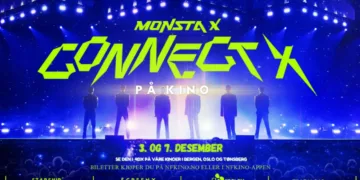






























The year 2025 brings plenty of cinema that feels like it was excavated from a hard drive, then politely framed. MONSTA X: CONNECT x in CINEMAS arrives with a different texture. It documents a three-day residency at Seoul’s KSPO Dome, serving as a visceral record of a ten-year milestone. The film operates as a time-bridge for a group whose recent years have been split by the mandatory cycles of military service. The reunion of Shownu, Minhyuk, Kihyun, Hyungwon, Joohoney, and I.M carries the weight of an existential homecoming.
Director Yeji Lee keeps the genre’s camera-from-row-Z habits at arm’s length. Her approach stitches stadium-sized spectacle to the quiet, claustrophobic reality of the rehearsal room, building presence through both scale and constraint. Available in 4DX and ScreenX, the production aims to erase the line between digital projection and the viewer’s physical sense of being there. The irony is hard to miss: high-tech immersion used to capture a group whose appeal has long leaned on raw, almost analog grit. The film positions itself as a definitive declaration of presence.
Chiaroscuro on the KSPO Stage
The visual design leans into noir grammar: blinding white light in the “white suit” b-roll, then stage images carved by deep, expressionistic shadow. That swing in luminance carries narrative weight. The art direction sets the members’ current bodies against towering, peeping projections of their debut selves. Scale does the haunting work here. The past feels present, watching, a monolith the present keeps answering. Framing keeps the bodies small beneath those enlarged faces, then returns them to command of the frame, a visual rhythm that turns memory into a moving pressure.
Performance sequences carry a precise technical charge. “BEASTMODE” and “GAMBLER” gain bite through a live band session that pares back the polished veneer of studio production. The timbre shifts toward a jagged, rock-oriented edge, and the vocals cut through with startling clarity. Curiously, the setlist steps away from the safety of global chart-toppers and leans toward the dark, rhythmic complexity of “Queen” and other deep cuts. The choice reads as a reward for the observant, a move that values artistic continuity over commercial accessibility.
Sound becomes its own close-up. The mix catches the minute friction of sequined jackets, turning a massive concert into a series of intimate, high-fidelity portraits. This is the rare stadium film that remembers fabric is part of the score. Somewhere, a Foley artist grins and files a quiet claim of authorship.
The Mechanics of Survival
The documentary material provides a psychological counterweight to the dome’s grandeur, stripping the idols of mythic distance. In rehearsal and backstage passages, the film studies the labor of staying legible under pressure. One sees the friction of perfectionism in Kihyun and the meticulous, almost forensic gaze Minhyuk applies to the filming monitors. These moments stop reading as simple preparation and start reading as identity work, the daily craft of maintaining a public self that still has to hold up in private.

Yeji Lee handles the group’s history with a quiet, nearly noir somberness. Archival footage from their rookie days serves as a reminder of the “No Mercy” survival instinct that forged them. The film refuses to turn that origin into a sanitized anecdote. It lets the past remain sharp. Even the subtle cropping of old photographs carries weight, a visual admission that a decade-long career leaves unavoidable scars.
The members discuss their path with weary but resolute honesty, embracing a “just do it” philosophy that sits close to the stoic. This bond reads as something built for function. A survival mechanism refined through years of shared isolation and collective ambition. It sounds simple. It looks hard-earned.
Longevity in the Neon Void
In an industry defined by the ephemeral, this work explores the philosophical implications of staying power. The relationship between the group and their Monbebe reads as a mutual pact of endurance, extending past the typical parasocial transaction. The film highlights a persistent hunger that remains unchanged alongside the comforts of success, a restlessness that refuses to be soothed by victory laps.
There is a specific tension in the theater, a localized “fomo” that the directors manipulate through sweeping camera movements and immersive soundscapes. Perception gets guided, nudged, tightened. Pacing turns into pressure. The audience leans forward, then realizes it has been leaning for minutes. A small trick, executed at scale.
This cinematic experience acts as a psychological precursor to their upcoming global tours, reminding the audience that the 10th anniversary is a pivot. The group views their history as a foundation for a new brand of artistry, one that accepts its origins while aggressively pursuing a fresh aesthetic. We see a group that has learned to manage the industry’s artificiality by leaning into their own objective reality. They look back at a decade of work. They prepare the stage for the next.
Released globally on December 3, 2025, MONSTA X: CONNECT x in CINEMAS serves as a definitive chronicle of the group’s ten-year journey and their first full-lineup performance in six years. The film captures the electrifying energy of their three-night residency at the KSPO Dome in Seoul, featuring a live band session and never-before-seen interviews. Audiences can experience this landmark event in theaters worldwide, with immersive screenings available in 4DX, ScreenX, and Ultra 4DX formats.
Full Credits
Title: MONSTA X: CONNECT x in CINEMAS
Distributor: Trafalgar Releasing, CJ 4DPLEX
Release date: December 3, 2025
Rating: G
Running time: 118 minutes
Director: Yeji Lee, Yoon-Dong Oh
Producers and Executive Producers: David Tu Sun Song, Jun Bang, Marc Allenby
Cast: Shownu, Minhyuk, Kihyun, Hyungwon, Joohoney, I.M
Composer: MONSTA X (Musical Performances)
The Review
MONSTA X: CONNECT x in CINEMAS
The film is a calculated, high-octane celebration of artistic persistence. By prioritizing a gritty live band sound and psychological depth over mere pop artifice, it manages to capture the weight of a decade without sinking into sentimentality. It serves as an essential record of a group that has mastered the mechanics of survival. For those seeking to understand the grit beneath the polish of the genre, this production offers a rare, clear-eyed perspective.
PROS
- Exceptional sound design that emphasizes the raw power of the live band session.
- Authentic interview segments that reveal the members’ rigorous work ethic and perfectionism.
- Creative use of archival imagery to emphasize the group’s growth and physical presence.
- A daring setlist that highlights artistic range by including complex B-sides and new tracks.
CONS
- Intentional omission of past group configurations in historical footage can feel jarring for long-term viewers.
- Visual cropping in certain archival scenes may distract from the otherwise high-definition experience.