






















Thin, silver mist hangs over the wide Dniester river, softening the ice into a pale, uncertain sheet while two tiny figures step forward to test its surface. Their cautious movement, small against the white expanse, opens Dmytro Sukholytkyy-Sobchuk’s debut feature-length documentary Silent Flood with an image of fragile balance.
The film avoids the clipped urgency often attached to recent wartime stories and settles into a patient, contemplative rhythm that favors atmosphere and visual poetry over overt conflict. Its focus is an isolated pacifist religious community in Western Ukraine, nicknamed “the hat-wearers” by outsiders.
They follow rigorously traditional habits, keep their distance from modern conveniences, and live without electricity, phones, or cars. The great river that runs beside them sustains daily life and at the same time threatens it, setting the pulse of their existence. Silent Flood traces a cycle of peace and catastrophe, where rising water and approaching war gradually encircle this rural Eden. Shaped as a sequence of deliberate chapters, the work frames the community as part of a long reflection on history and resistance.
Isolation Challenged: Pacifism and the Crisis of Solidarity
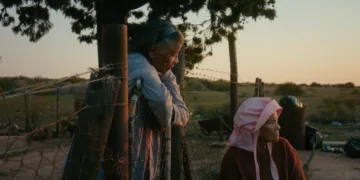
The group’s existence rests on firm, principled separation, grounded in strict traditionalist Christian doctrine and a declared commitment to pacifism. The film observes self-sufficient households that plow fields by hand, scrub clothes in the river, and share meals by candlelight. Their rejection of the modern world reaches into politics and military service, preserving a spiritual gap between the community and the state.
Shared ancestry with the Amish highlights the depth of dedication to this austere path. The 2022 invasion arrives as a test that their physical and spiritual distance cannot entirely shield. Shockwaves from the war travel into the river canyon and demand a response to the outside world, and this intrusion shapes the film’s central tension.
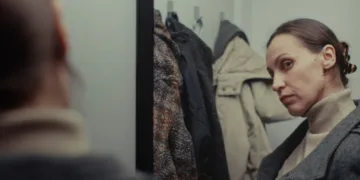
The conversation about that response reaches the viewer through cool, detached voice-overs that carry the weight of the film’s narrative layering. Anonymous members describe a life lived under God’s authority, which they place above any earthly command to defend the country. The same channel also brings the words of skeptical neighbors, who express deep resentment and question the choice to move along public roads and rely on public services while refusing to contribute to national defense through taxes or military service.
Silent Flood makes a decisive formal choice here by setting these positions side by side without an explicit verdict. The film holds them together as coexisting realities within the same nation. A chapter titled “Bread” provides a fragile bridge across this ideological distance. The community refuses weapons and offers dense, nourishing loaves for soldiers at the front line, shaping a non-violent gesture of concrete solidarity.
The Measured Aesthetic: Juxtaposition and Cinematic Form
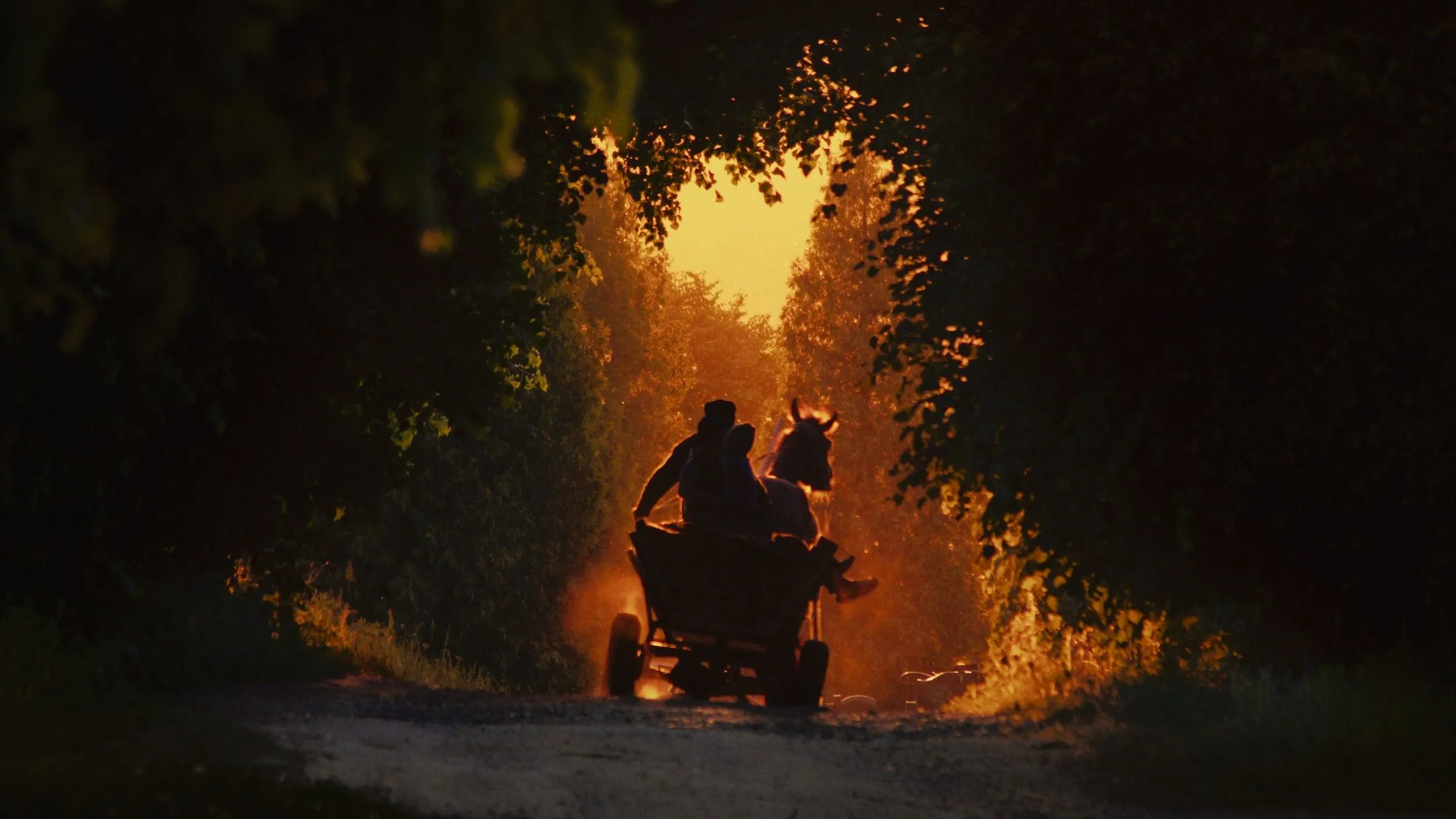
Sukholytkyy-Sobchuk works with an exacting, highly composed visual style, using careful framing that lifts the film far beyond routine documentary reportage. The IDFA-winning cinematography favors expansive views and static painterly tableaux that feel both controlled and quietly attentive. This visual distance protects the community’s privacy while allowing the landscape they inhabit to fill the frame with calm intensity.
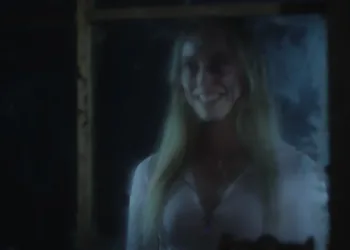
The style never slips into hard, sterile formalism; it sustains a sense of patient, searching observation. A recurring pattern of obscured sight anchors the film’s visual language. Bodies appear through bonfire smoke, figures emerge as blurred silhouettes in morning fog, and children are glimpsed through the narrow opening of a half-shut door. These images function as metaphors for the group’s reclusive habits and the narrow access the outside world holds to their inner life.
The disembodied voice-overs form another crucial aspect of the structure. They carry necessary historical detail and emotional reflection from unseen speakers, preserving anonymity while widening the story’s frame. Silent Flood draws strength from quiet juxtapositions and carefully chosen parallels. Elders describe losses from the 1941 flood that coincided with the violence of World War II, binding one catastrophe to another and tying that chain of memory to the current conflict.
The film echoes this history through two candlelit meals, one held in a sparse communal home, the other unfolding in a cramped billet near the front. Warm light, close bodies, and shared bread link these distant spaces through a simple ritual. A deliberate progression from the western river canyon to positions near the Kramatorsk region broadens the film’s thematic range and situates the community’s seclusion inside the unfolding national war.
Ritual, Resilience, and a Shared Future
Sustained attention to routine anchors the portrayal of this community’s commitment to ritual. The camera lingers on slow, exact movements of labor: turning soil with simple tools, rinsing garments in the river, and preparing food with steady concentration. Its gaze remains careful and respectful, never prying. Children receive special emphasis.
Girls in headscarves and boys who play with horses or rough handmade toys appear again and again, suggesting a generation that carries both inherited tradition and the pressure of a changing world, one that may not allow the same degree of separation their parents chose. When soldiers accept the loaves sent from the river valley, the scene becomes a quiet reflection on pacifism inside a militarized environment and hints at multiple forms of contribution and protection.
An elderly medic describes the villagers’ role as a continued support for the shared home. Silent Flood stands as a significant cultural work. It offers an unfamiliar angle on the war in Ukraine, stepping away from immediate combat images to observe the country’s varied cultural fabric and the intricate, shared character of national resilience.
Silent Flood is the feature-length documentary debut from Ukrainian filmmaker Dmytro Sukholytkyy-Sobchuk, whose previous work, Pamfir, premiered at Cannes in 2022. The film had its World Premiere at the International Documentary Film Festival Amsterdam (IDFA) in November 2025, where it won the IDFA Award for Best Cinematography. The film follows a traditionalist, pacifist religious community living by the Dniester River in Western Ukraine, observing how their isolated way of life is tested by both historical floods and the 2022 Russian invasion. As an international documentary, it is being distributed by Filmotor, with involvement from broadcasters MDR and ARTE.
Full Credits
Title: Silent Flood
Distributor: Filmotor (International Sales), MDR, ARTE (Broadcasters)
Release Date: World Premiere: November 2025 (IDFA)
Running Time: 80–90 minutes (Sources vary between 80′ and 90′)
Director: Dmytro Sukholytkyy-Sobchuk
Writers: Dmytro Sukholytkyy-Sobchuk
Producers and Executive Producers: Karina Kostyna, Eugene Rachkovsky, Tanja Georgieva-Waldhauer (Co-Producer)
Director of Photography (Cinematographer): Dmytro Sukholytkyy-Sobchuk, Ivan Morarash, Oleksandr Korotun, Viacheslav Tsvietkov
Editors: Dmytro Sukholytkyy-Sobchuk, Mykola Bazarkin
The Review
Silent Flood
Silent Flood is a stunning, essential documentary. It masterfully uses visual poetry and deliberate narrative structure to explore the complex intersection of faith, war, and isolation in contemporary Ukraine. By focusing on a pacifist community, the film offers a rare, profound meditation on what constitutes home defense and solidarity. It is a work of exceptional aesthetic control and deeply felt cultural commentary.
PROS
- Immense visual beauty; every frame feels like a painting; won the IDFA Award for Best Cinematography.
- Offers a compelling, non-militaristic viewpoint on the conflict and national solidarity.
- Artful linking of the pacifist community's life with the soldiers on the front line (e.g., the mirroring of candlelit dinner scenes).
- Rich exploration of cyclical history, the pressures of modernization, and the true meaning of resistance.
CONS
- The deliberate, contemplative rhythm may challenge viewers expecting a faster-paced documentary.
- The community's privacy is respected, meaning some contextual details are deliberately opaque, requiring viewer patience.
- The reliance on disembodied voices for context and commentary creates distance from the individuals on screen.