




















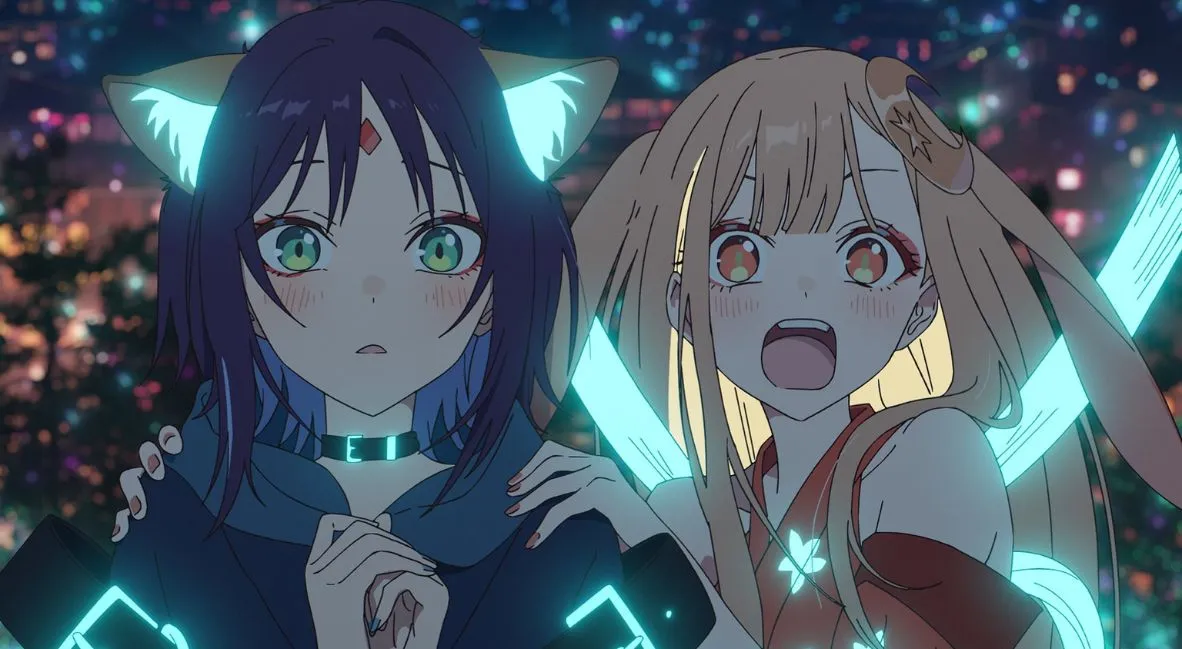

Iroha Sakayori spends her nights in a tiny Tokyo flat, counting coins and clawing her way to six hours of sleep. She has traded youth for survival, living on part-time shifts and academic perfection. That routine snaps the moment a glowing infant appears inside a telephone pole.
The child grows into Kaguya, a teen from the moon who insists Earth suits her appetite. Shingo Yamashita takes an old story and drops it into a world of avatars, where Iroha ends up caring for an impulsive girl while trying to keep her own life from collapsing.
Their path runs straight into Tsukuyomi, a digital space run by an AI named Yachiyo. Kaguya wants to win a challenge there so she can perform with an idol, and that goal reframes the folk tale through the pressure of digital fame and the grind of staying afloat. The film trades bamboo forests for urban sprawl and reframes magic through high-speed internet culture. As the clock runs down, Iroha and Kaguya scramble to stay together, building a shared life that plays out across two realities at once.
The Sensory Split of Two Realities
The film draws a clean line between the physical world and the digital one, and it treats that divide like a ruleset. Tokyo feels lived-in, with backgrounds that read as hand-painted, full of brick texture and rusted train tracks. That grounded look tracks Iroha’s exhaustion. Her body language carries weight, and her steps land with small puffs of smoke rising from her feet. The real-world frames feel packed, with muted gray color that keeps dragging her back into the same loop of work and school.
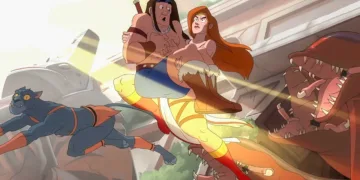
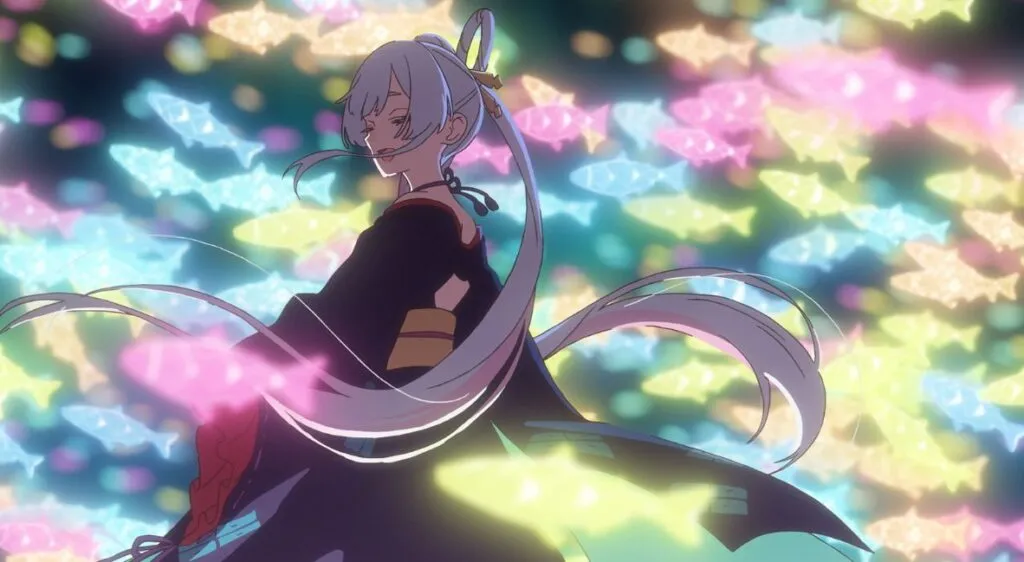
Then Tsukuyomi hits like a mode change. The virtual space plays like a hyperactive video game arena built from cel-shaded models, neon lighting, and constant UI-like noise. Emojis and stickers burst across the screen when Kaguya performs, turning her stage moments into feedback explosions that feel tied to attention and approval. Tsukuyomi reads like social media turned into a playable environment, with the energy of a battle royale aesthetic and the pace of an endless feed. The music leans on Vocaloid software, pushing a synthetic texture that matches the artificial sheen of the space.
Hechima’s character designs reinforce the idea that identity behaves differently depending on the setting. In Tsukuyomi, the leads look sleek and saturated, shaped for visibility. In the real world, they carry messy hair and tired eyes, shaped by fatigue and scarcity. That split affects how the viewer reads the “escape” factor: Tsukuyomi feels like a bright reward loop after the gray weight of Tokyo. The animation also keeps the hand-painted human touch present, even while it captures the speed and clutter of internet culture, which makes the transition between these spaces feel emotionally legible instead of purely cosmetic.
Friction and Fellowship in the Neon Glow
Iroha and Kaguya are built to clash, and the film treats their relationship like a co-op pairing with mismatched playstyles. Iroha has become aggressively responsible, to the point that she has buried her love for music to keep paying rent. Kaguya moves through the world with raw appetite for joy, tossing tantrums and eating expensive food without stopping to count the cost. That gap creates constant friction, and it gives their scenes a rhythm of pushback, retreat, and reluctant compromise.
Tsukuyomi becomes the space where they start syncing up. Kaguya pushes Iroha to play her instrument again, and those nudges work like small prompts that pull Iroha away from pure survival thinking. Their bond grows through shared time in the digital arena, where the idol challenge gives them a concrete objective and a pressure clock. The film leaves room for different readings of their closeness. Some viewers will land on deep friendship. Others will read romance in the quiet beats: they hold hands during fireworks, and they share secrets in the dark.
Kaguya also carries a ticking loss condition. She knows she is a runaway, and she understands her fate leads back to the moon, followed by forgetting Earth forever. That awareness feeds her urgency and sharpens every moment she tries to hold onto Iroha. The voice acting by Anna Nagase and Yuko Natsuyoshi carries the emotional load.
Nagase brings tired firmness to Iroha, while Natsuyoshi gives Kaguya a high-energy chaos that can irritate and charm in the same breath. Their partnership inside the challenge becomes a way of fighting for the relationship itself, with two girls trying to claim a future that the world keeps denying them.
Defying the Celestial Script
The final act turns the story structure into part of the text, and it leans into experimentation. The film starts asking what an ending is supposed to do and who gets to decide it. Yamashita includes a moment where the screen goes black and the credits begin early, a fourth-wall move that signals the creator is actively playing with the medium’s control over the audience.
The last forty minutes move at high speed, and that tempo lines up with the characters’ panic as the moon people close in. The script frames the moon as perfection without feeling, while Earth becomes messy, loud emotion. The film’s thematic argument lands through that framing: being human means living with joy and pain in the same life, without filing either side away.
Some supporting threads, like Iroha’s brother and her school friends, never receive full resolution. That choice makes the narrative feel like a slice of life cut short, keeping attention locked on the two leads. They keep trying to find space to stay together against a myth that already has their ending written down.
The film stresses the value of relationships that exist under time pressure, and it gives its characters agency by letting them fight for a place where they can live on their own terms. That push against a pre-written path gives the story a modern sting, especially for anyone who has felt their life was drafted by someone else long before they had a say.
Cosmic Princess Kaguya! premiered globally on January 22, 2026, offering a neon-soaked reimagining of one of Japan’s most cherished legends. This animated feature is a collaborative production between Studio Colorido and Studio Chromato, marking the ambitious feature directorial debut of Shingo Yamashita. You can currently stream the film exclusively on Netflix, where it has quickly gained attention for its vibrant blend of traditional storytelling and modern virtual reality themes.
Full Credits
Title: Cosmic Princess Kaguya!
Distributor: Netflix
Release date: January 22, 2026
Rating: PG
Running time: 142 minutes
Director: Shingo Yamashita
Writers: Saeri Natsuo, Shingo Yamashita
Producers and Executive Producers: Koji Yamamoto
Cast: Yūko Natsuyoshi, Anna Nagase, Saori Hayami, Rie Kugimiya, Miyu Irino, Yuma Uchida, Yoshitsugu Matsuoka, Yoshino Aoyama
Director of Photography (Cinematographer): Daisuke Chiba
Editors: Ryōta Kinami
Composer: Conisch
The Review
Cosmic Princess Kaguya!
Cosmic Princess Kaguya! succeeds as a bold reimagining of folklore through a modern lens. The relationship between Iroha and Kaguya provides a solid emotional foundation. This film captures the frantic energy of internet culture while keeping the story grounded in human struggle. While the final act feels rushed and the pacing falters, the visual ambition remains high. It is a striking look at how we find connection in a digital age. This story offers a loud, colorful, and sincere experience for those willing to follow its chaotic path.
PROS
- Stunning contrast between the hand-painted real world and neon digital spaces.
- Authentic emotional bond between the two lead characters.
- Energetic musical sequences that drive the narrative forward.
- Creative use of meta-storytelling and fourth-wall breaks.
CONS
- Narrative pacing slows down significantly during the middle.
- The final act contains several confusing plot points.
- Supporting characters receive very little development.
- The length makes the experience feel stretched.