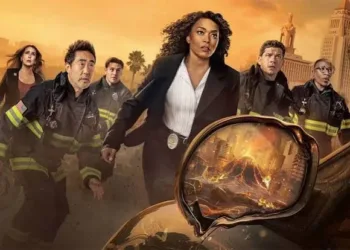


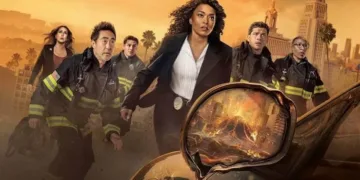









The fourth season of the AMC drama takes a bold leap by adapting The Ghostway, a pivot that moves the action from the familiar, sprawling vistas of the Navajo Nation to the smog-choked sprawl of 1970s Los Angeles. The series stays rooted as a neo-Western, yet the new setting rewires the case’s mood and methods.
The desert held secrets under dirt and distance. Los Angeles hides them in a maze of neon, wood-paneled motel rooms, and closed doors that never look fully shut. The urban shift brings a noir sensibility that fits the era like a tailored jacket. The show swaps cowboy boots for leather loafers and keeps its stride.
The narrative engine ignites with a brutal opening sequence at a local diner. The violence hits a new high-water mark for the series, and it lands as a warning shot for the season’s shape. That bloodshed leads into the search for Billie Tsosie, a young girl missing from a Catholic boarding school. Her disappearance becomes the season’s driving force, pulling the investigation beyond its usual borders and into the California sun.
The script lays out a hard-earned logic for why the Navajo Tribal Police travel so far from home. Joe Leaphorn and his team take the lead because the story treats that urgency as a fact on the ground. Federal agencies have a history of responding to Indigenous runaways with a shrug and a filing cabinet. The season leans into the sobering reality that these characters must act as their own cavalry. Expanding the map highlights the reservation’s isolation and shows how the Navajo Nation’s shadows extend past the Arizona border.
Hearts on the Line and Ghosts in the Machine
Joe Leaphorn starts this chapter in quiet, domestic meditation. Emma has gone to California, and the house carries that absence in every room. Joe tends his tomato garden and practices traditional Navajo rituals, working to mend the fractures left by the previous season.
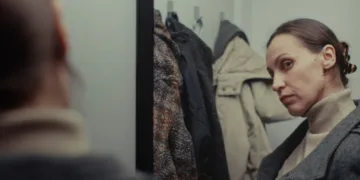
Zahn McClarnon plays these beats with soulful restraint. Joe is a man shaping himself into the person his wife needs, even with no audience for the effort. It reads like a warrior forced into peace, and the stillness becomes its own kind of pressure, right down to the silence of an empty closet.
Jim Chee and Bernadette Manuelito find steadier ground through each other. The series finally cashes in years of slow-burn tension by making their relationship official. Kiowa Gordon and Jessica Matten sell it with chemistry that feels lived-in and urgent, giving the season a romantic pulse that never turns syrupy.
The bond also comes with immediate strain. Joe looks at Bernadette and sees his natural successor on the force, and that trajectory threatens to pull her away from the life she is building with Chee. The push and pull between duty and intimacy plays like a familiar TV engine, sharpened here with a more current sense of nuance.
Chee’s internal reckoning takes shape through the introduction of “ghost sickness.” The Los Angeles trip functions as a psychological trigger, bringing childhood traumas back to the surface after years of suppression. The show leans on horror-inspired imagery to externalize what he is carrying. Pulsating wounds and fragmented memories turn up like visual stutters, hinting that Chee is haunted on multiple levels. Gordon excels in these passages, playing a man losing his grip on reality as the past drags itself into the present with dirty fingernails.
The Assassin and the Obsession
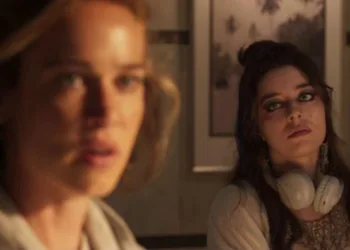
Every noir needs a shadow with real teeth, and Franka Potente supplies one as Irene Vaggan. She is a hired gun who moves with mechanical precision, all business, no warmth. Vaggan speaks little, letting tactical gear, cold efficiency, and clean intent do the work. She registers as a physical threat that feels genuinely overwhelming for the Tribal Police. Potente brings a chilling stillness that makes the character unsettling even in the background. Some villains enter a scene. Vaggan arrives like a power outage.

The writing adds another unsettling dimension through Vaggan’s fixation on Joe Leaphorn. Her presence comments on how white culture can fetishize Indigenous people, and the season frames that obsession as a warped fantasy rather than a response to Joe as a person. She filters him through a Western myth of an Apache chief, treating the Navajo way of life as a curiosity and a prize. That choice sharpens the cat-and-mouse mechanics into a critique of cultural appropriation and entitlement, with every pursuit scene carrying an extra sting.
This mercenary thread connects back to Dominic McNair, a figure of corporate and criminal influence played by Titus Welliver. McNair supplies the structural villainy that ties the missing girl to the larger Los Angeles underworld. The stakes circle old family debts and a mercenary worldview that reduces human lives to ledger entries. Potente brings visceral danger. Welliver brings cold authority. Together they give Leaphorn a two-front war, one with bullets, one with paper.
Retro Tones and Rhythmic Shifts
The production design lands as a triumph of 1970s pastiche. The season avoids the vibe of a costume party and commits to grit and texture, the kind that looks like it smells faintly of stale cigarettes and motel carpet. Jim Chee takes the wardrobe crown again, wearing flare pants and button-down shirts that look lifted from a period-accurate film set. The Los Angeles interiors feel heavy with history, lived-in and worn at the edges. The reservation reads in dusty gold. The city motels glow with sickly neon, like the building itself is trying to sweat out its sins.
Visually, the season runs thick with atmosphere. Red police lights and harsh streetlamp glare carve the frame into uneasy pockets, keeping tension active even in quieter scenes. The score by the Kiner family deepens that feeling, steering away from traditional Western motifs and moving into a whining, industrial soundscape that echoes Trent Reznor. The result makes the action feel immediate and the stakes feel current, even with the 1970s setting doing its own work in the background.
Zahn McClarnon steps behind the camera for the second episode and shows a directorial eye as sharp as his acting. The shift from six episodes to eight changes the rhythm in a way that cuts both ways. Character arcs get extra room, and the middle stretch picks up a looser pace. The mystery thins a bit during the transition to California, yet the performances keep the story moving with purpose. Joe can tend a garden with care, but the season keeps asking what happens to peace when the world outside stays on fire.
The critically acclaimed noir thriller Dark Winds returns for its fourth season on February 15, 2026. The series, which has maintained a perfect score on Rotten Tomatoes across its previous installments, continues the journey of Navajo Tribal Police officers Joe Leaphorn and Jim Chee as they navigate a complex web of crime and cultural identity in the 1970s. This season is particularly notable for Leaphorn’s journey to Los Angeles in pursuit of a missing girl and the directorial debut of series lead Zahn McClarnon. Fans can watch the new episodes weekly on AMC or stream them via AMC+, while the first three seasons are currently available on Netflix and AMC+.
Where to Watch Dark Winds Season 4










Full Credits
Title: Dark Winds Season 4
Distributor: AMC, AMC+
Release date: February 15, 2026
Rating: TV-MA
Running time: 45–53 minutes
Director: Zahn McClarnon, Chris Eyre, Michael Nankin, Erica Tremblay
Writers: Graham Roland, John Wirth, Steven Paul Judd, Max Hurwitz, Wenonah Wilms, Thomas Brady, Erica Tremblay
Producers and Executive Producers: Robert Redford, George R.R. Martin, Graham Roland, Zahn McClarnon, John Wirth, Chris Eyre, Tina Elmo, Jim Chory, Thomas Brady, Max Hurwitz, Vince Gerardis, Anne Hillerman
Cast: Zahn McClarnon, Kiowa Gordon, Jessica Matten, Deanna Allison, A Martinez, Franka Potente, Titus Welliver, Chaske Spencer, Isabel DeRoy-Olson, Luke Barnett
Director of Photography (Cinematographer): Paul Elliott
Editors: Joaquin Elizondo, J. Kathleen Gibson
Composer: Kevin Kiner, Sean Kiner, Deana Kiner
The Review
Dark Winds Season 4
The latest installment of this neo-Western remains a masterclass in atmospheric storytelling. By transplanting the gritty intimacy of the Navajo Tribal Police into the urban sprawl of 1970s Los Angeles, the series successfully broadens its horizons without losing its cultural soul. While the expanded episode count occasionally tests the narrative’s tension, the powerhouse performances from the core trio and a genuinely terrifying turn from Franka Potente provide a steady anchor. It is a rare sequel that manages to evolve while staying fiercely loyal to its origins.
PROS
- Exceptional lead performances by McClarnon and Gordon
- Authentic and stylish 1970s production design
- Gritty, high-stakes noir mystery in Los Angeles
- Poignant exploration of Indigenous identity and trauma
CONS
- Slower pacing due to the eight-episode structure
- Minimal screen time for Deanna Allison's Emma
- Some plot points feel slightly thin in the mid-season
- The villain's backstory could benefit from more depth