






















Vineland comes into view as a gorgeous metropolis where the natural world has taken the city back. Vines climb and constrict the skyscrapers. Moss blankets the leftovers of an earlier era. Life in this place runs on Roarball, a sport that doubles as a social ladder, and everyone seems to know their rung.
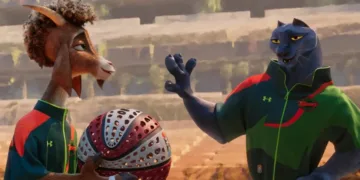
Will Harris, a young Boer goat voiced by Caleb McLaughlin, starts near the bottom. He delivers packages by day and carries a stubborn, almost reckless ambition by night: he wants to become the first small animal to play in the professional league.
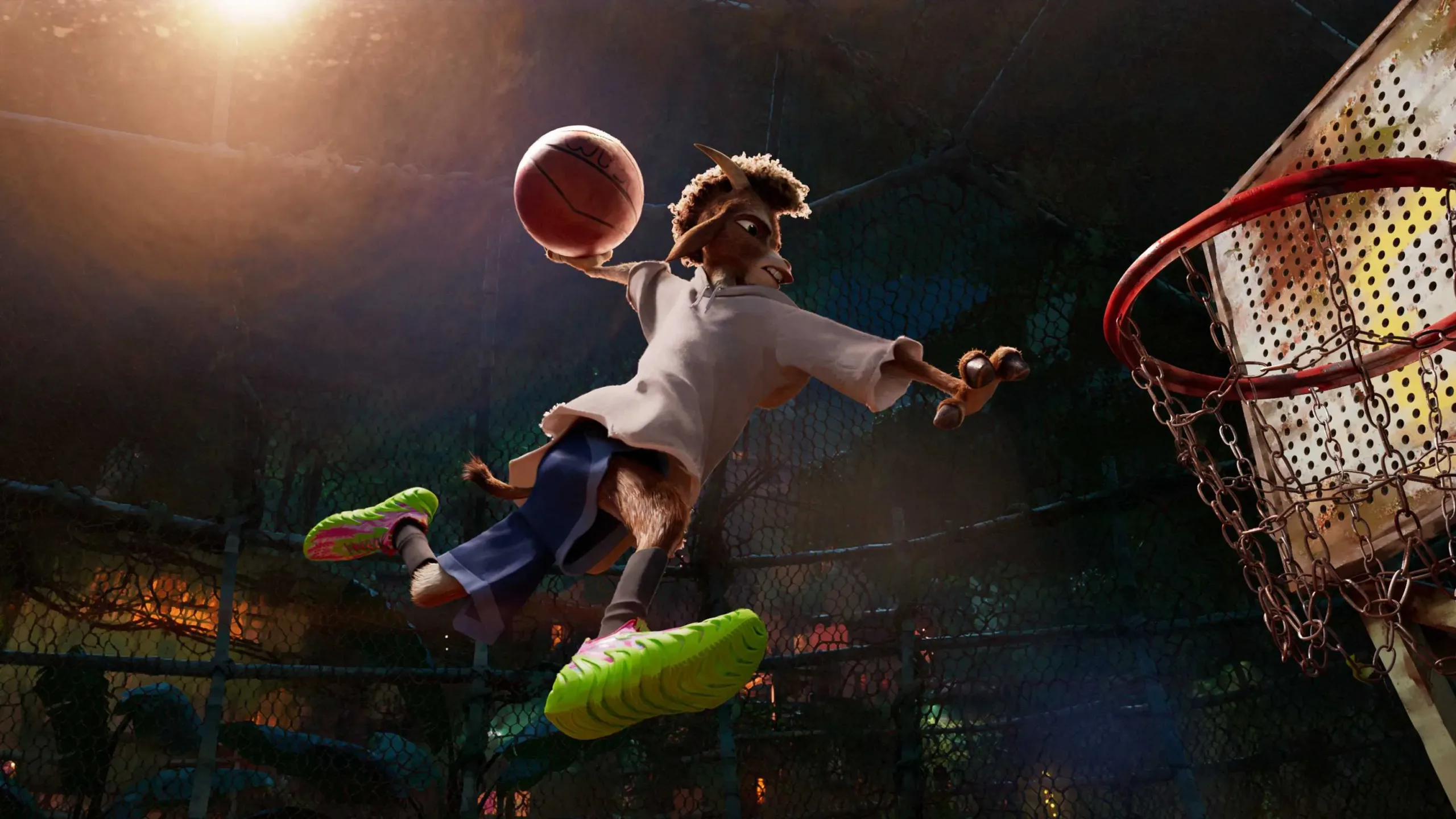
That dream sounds impossible inside a game designed for giants. Leopards, rhinos, and giraffes own the court through sheer mass and reach. Will keeps working anyway, spending his evenings inside a battered chain-link enclosure called the Cage. He turns it into a personal laboratory, drilling shots across a 50-foot range until his routine looks like ritual.
Then a viral street-game clip shifts the angle of his life. Florence, the warthog who owns the Vineland Thorns, sees the footage and takes interest. From there, the film frames a familiar sports story through a sharp social idea: an animal kingdom where species often sets the limit on how far you can go, and one goat decides to treat that limit like a dare.
The Brutal Poetry and Mechanics of Roarball
Roarball plays like basketball pushed through a survival course. The rules still speak the language of spacing, passing, and scoring, yet the environment becomes an active participant, shaping every possession. Each arena carries its own geology and hazards, turning “home court advantage” into something literal and physical. The Vineland Thorns play in the Green House, a living arena packed with dense plant life and creeping vines that get in the way and change angles on the fly. It is a court that refuses to stay out of the game.
Other teams deal with harsher setups. The Magma Court stacks platforms over active volcanic vents, forcing players to track the ball while heat rises and the ground itself feels unstable. The Shivers goes the opposite direction with a solid-ice floor that rewrites movement. Footwork, pivots, and sprints take on a new physics, and every cut carries the possibility of sliding out into dead space. Roarball becomes a sport where strategy includes reading the terrain like a map.
That design choice pays off because the film treats the athletes like specialists working with the tools they were born with. The league has long been ruled by weight and strength, and the action makes that history clear. Rhinos lean on bulk to lock down the interior. Leopards use claws for grip and control during vertical leaps. Giraffes turn height into a defensive system, disrupting passing lanes through reach alone. The film frames these traits as tactics, and the matches start to feel like a clash of styles rather than a simple battle of good guys and bad guys.
The narrative keeps one eye on a different arena too: the feed. Social media and smartphone culture sit right inside the plot, shaping careers in real time. Will’s friends, Hannah and Daryl, cut his street footage into a polished stream of highlights and turn him into the “undergoat,” a nickname built for sharing.
The movie ties that process to our own appetite for digital fame, where visibility can feel like the first step toward legitimacy. Public perception builds pressure quickly, and it reaches owners like Flo. Her decision to sign Will reads as business logic as much as belief, a move designed to satisfy an online audience that wants the story to keep escalating.
The film also has fun with how those sequences look and move. The editing adopts the snap and speed of social feeds, with a rhythm that feels tuned to scrolling. Roarball is a spectacle, and the movie understands that spectacle now happens on screens within screens, with the game itself competing against the noise around it.
The Thorns: A Roster of Misfits and Icons
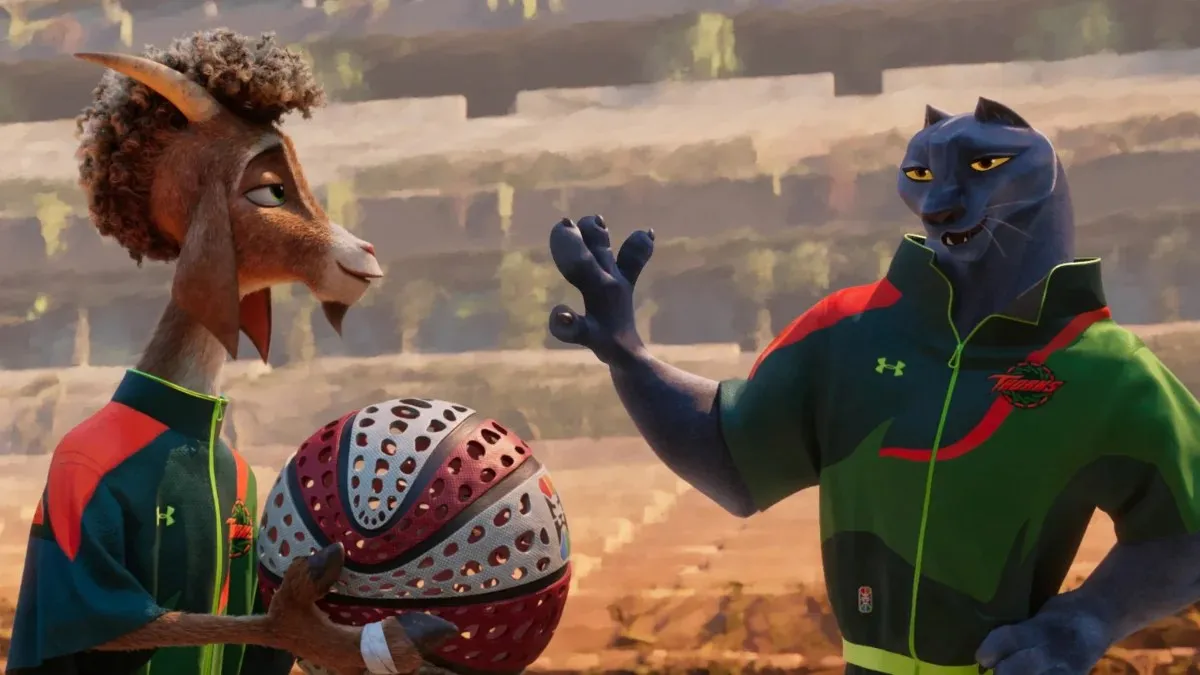
If Will enters the Thorns as a problem and a possibility, Jett Fillmore arrives as the franchise’s living legend. She is an aging leopard superstar, voiced by Gabrielle Union with a performance that carries a sharp ego and a real fear underneath it. Jett has already won. She has already been the name that defines the team. The film paints her as a champion who can sense time catching up, and that awareness makes her territorial about her place in the sport.
The animation gives Jett a string of small, telling behaviors that keep her from turning into a statue. She licks her paws after stretching. She kneads her cushions and makes “biscuits” while browsing social media. Those details land as character work and cultural commentary at once. Jett lives with her own myth, yet she also lives on the same platforms as everyone else, watching her image circulate and mutate.
Around her, the Thorns roster reads like a catalog of personality types and personal burdens, each tied to a clear on-court identity. Archie, a rhinoceros, plays the defensive bruiser role and carries the everyday chaos of single parenthood. The film gives him a recurring visual beat: two young girls clinging to his side during team meetings, a reminder that the locker-room story does not pause for real life.
Olivia, an ostrich, struggles with severe social media anxiety, and the movie turns that into a literal habit. When pressure spikes, she buries her head in the sand. Lenny, a giraffe, would rather rap than grind through the sport’s physical demands, and he brings a rhythmic sensibility that fits his personality even when it clashes with the team’s priorities. Modo, a Komodo dragon with a punk-rock aesthetic, plays with a wild edge, and his unhinged style keeps opponents guessing.
The early team dynamic runs on friction, with Will and Jett as the main source of heat. Jett reads Will as a gimmick and treats his arrival like a threat to the integrity of the sport she helped build. That tension keeps the Thorns from functioning as a unit at first. The group lacks chemistry, and the film uses that broken rhythm to explore a classic sports dilemma: individual brilliance can disrupt collective success when pride and distrust fill the space between players. The movie builds professional respect through conflict, letting personality clashes become part of the season’s architecture.
Visual Language and Environmental Storytelling
Vineland looks like an illustrated memory of a city, painted over by weather and time. The backgrounds carry an Impressionist feel, and the color palettes suggest the influence of artists like Cézanne. The film plays the grit of urban decay against the thick green of reclaimed wilderness, and that visual push and pull makes the setting feel lived-in, layered, and old in a way animated worlds rarely attempt. You can sense a past under the present, like the city has stories embedded in its walls.
Sony Pictures Animation uses digital tools to make the world feel tactile rather than slick. Movement stays fluid and exaggerated, with visual choices that borrow heavily from anime and 2D styling to emphasize speed and impact. The Roarball sequences move at a hyper-fast pace, and the directors lean on dynamic camera angles that mimic the chaos of a live broadcast. The result feels like courtside viewing, with the viewer pulled into the action as a spectator who can almost hear the crowd inhale before a shot.
Character design stays grounded in animal biology, and that grounding shapes the film’s visual rhythm. Jett moves with predatory grace in motion, her body language built for quick strikes and controlled aggression. Lenny’s height brings awkwardness into his movement, and that awkwardness becomes part of his identity on the floor. Each player carries a distinctive cadence, and the film keeps returning to those physical signatures as part of the storytelling.
Sound design matches that physical specificity. Hooves land with a heavy thud. The Komodo dragon comes with a sharp hiss that cuts through the mix. Those choices give weight to a world that could have floated into pure fantasy. Watching it, I kept thinking about the first time I saw independent animated shorts that valued texture over spotless finish.
This film leans into that same preference for an artisanal look, stepping away from the polished sheen associated with standard studio features. Its technical ambition sets it apart from typical family fare, and it treats style as part of the narrative voice.
Breaking the Caste System: Parity and Identity
The story’s conflict between small and big animals carries clear metaphorical weight. Will stands in for athletes who get told their bodies disqualify them before they even begin. His arc pushes back against that gatekeeping logic, arguing for skill as the measure that should matter most. The film frames that message as timely, tied to a culture that still loves to sort people into categories and then act surprised when someone breaks out.
Roarball’s co-ed design adds another layer of inclusion while keeping the league’s focus on performance. Gender never becomes a source of friction in this world. Jett sits at the sport’s peak, and her struggle focuses on age and legacy. The film also includes a bisexual defensive specialist, and the storytelling treats that identity as part of the fabric of the league rather than a spotlight moment. The message of belonging comes through with a light touch, and diversity reads as normal life inside this setting.
Animal biology becomes the film’s way of talking about human bias without switching into lecture mode. The story suggests that heart and dedication should decide who gets to participate. Rules and inherited categories often exist to keep talent out. Will’s presence shifts the Thorns’ spirit, pushing the giants toward a different kind of play and a different kind of teamwork.
He does not need to grow into a giant to win. He needs the giants to recognize his value, and that recognition changes the team from a collection of names into a unit. The narrative bends the familiar hero path toward institutional change, showing how persistence can reshape an entire system from inside the court.
GOAT is an original animated sports comedy from Sony Pictures Animation that follows an underdog goat named Will Harris who dreams of conquering the high-intensity, co-ed sport of roarball. The film is scheduled for a wide theatrical release on February 13, 2026, strategically coinciding with the NBA All-Star Weekend. Following its exclusive run in theaters, the movie is expected to be available for streaming on platforms such as Netflix and Disney+ later in the year.
Where to Watch GOAT (2026)








Full Credits
Title: GOAT
Distributor: Sony Pictures Releasing
Release date: February 13, 2026
Rating: PG
Running time: 100 minutes
Director: Tyree Dillihay, Adam Rosette
Writers: Aaron Buchsbaum, Teddy Riley, Nicolas Curcio, Peter Chiarelli
Producers and Executive Producers: Michelle Raimo Kouyate, Stephen Curry, Erick Peyton, Adam Rosenberg, Rodney Rothman, Rick Mischel, Fonda Snyder, David Schulenburg
Cast: Caleb McLaughlin, Gabrielle Union, Stephen Curry, Nicola Coughlan, Nick Kroll, David Harbour, Jenifer Lewis, Aaron Pierre, Patton Oswalt, Andrew Santino, Bobby Lee, Eduardo Franco, Sherry Cola, Jelly Roll, Jennifer Hudson, Ayesha Curry, Don Cheadle, Wayne Knight, Dwyane Wade
Director of Photography (Cinematographer): John Clark
Editors: Clare Knight
Composer: Kris Bowers
The Review
GOAT
GOAT works because it anchors its kinetic roarball energy in a world that feels both ancient and immediate. It explores how we define greatness in a society obsessed with physical categories. The film manages to be an engaging sports fable while offering a thoughtful reflection on inclusivity. Although the plot beats are recognizable, the technical execution and sincere character growth provide a satisfying depth. This is a beautiful piece of digital artistry that understands the cultural pulse of modern competition.
PROS
- Stunning, painterly animation style that moves away from standard digital aesthetics.
- Creative world-building with environmental hazards that influence game mechanics.
- Authentic voice performances that humanize animal characters through biological quirks.
- A progressive, co-ed take on professional sports that prioritize skill over gender.
CONS
- The narrative follows a predictable sports movie formula.
- Occasional reliance on juvenile humor and social media tropes.
- Early pacing feels slightly sluggish before the roarball action begins.