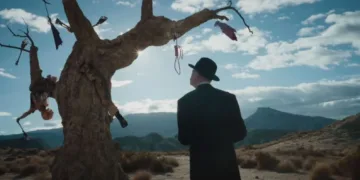



















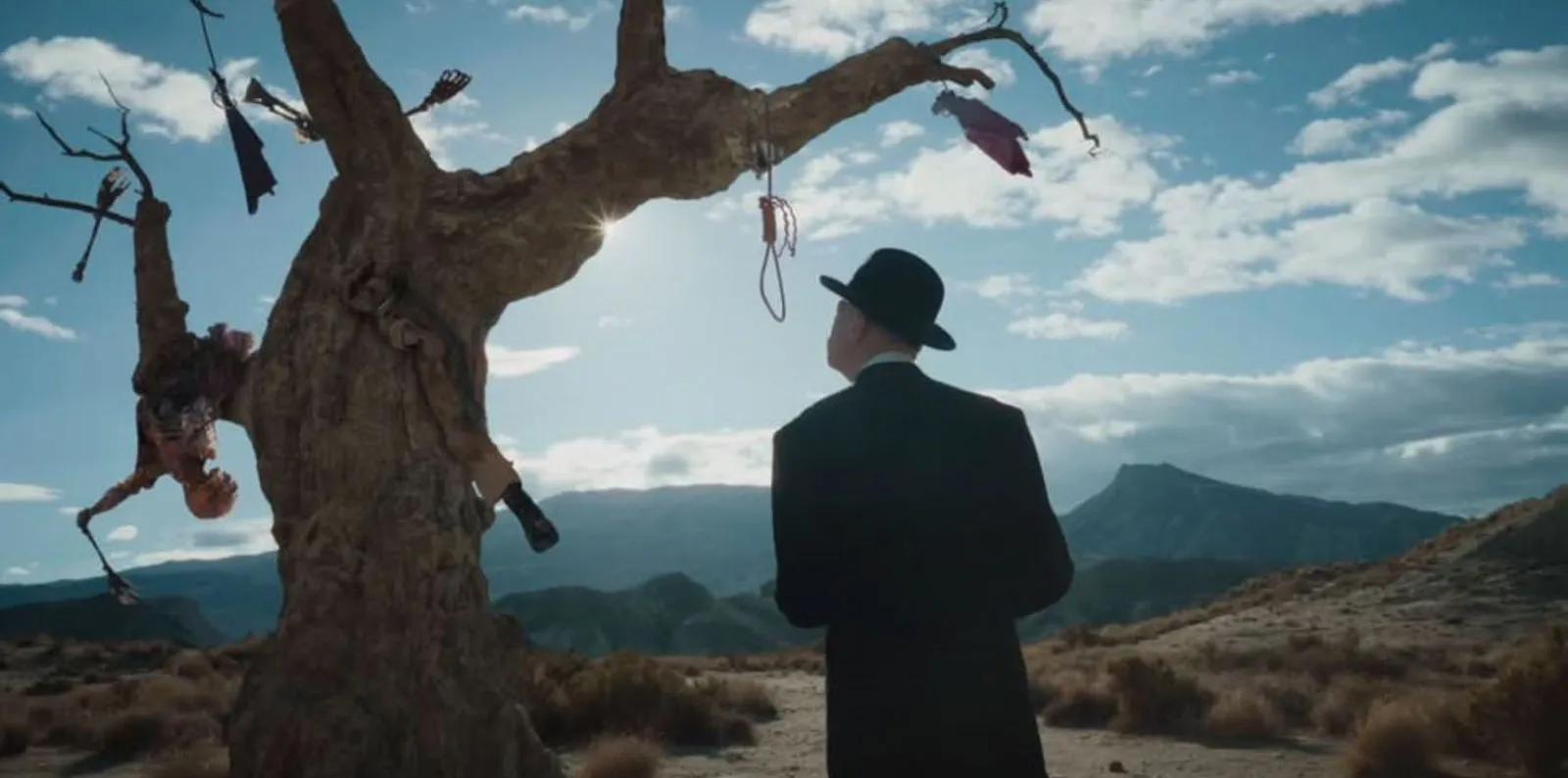

The sun-blanched plains of the 1890s Arizona borderland set a stage of dust, weary rituals, and institutional rot. Into this baked terrain rides Strindler, dressed with a fastidious precision that reads like a provocation: a neat suit, a bowler hat, and a cadaverous spindly frame that makes him look half removed from the living town he has come to court. His purpose carries the same chill.
He wants to buy the names, birth dates, and hometowns of dead Mexican laborers. Gold coins change hands for lists of the departed, a “dead souls” scheme that draws loose inspiration from Nikolai Gogol’s 19th-century Russian satire. Strindler works the town by swapping faces as easily as he swaps stories. He plays preacher for one audience, government official for another, tailoring each pose to the anxieties of whoever holds the keys.
The mayor and sheriff slide into his flattering card games and closed-door exchanges, lured by the promise that paperwork can be turned into profit. The film builds its narrative on a con game where the commodity is memory itself, and the people being bartered are the ones the frontier already treated as expendable.
The Handcrafted Texture of a Desert Fever Dream
The film’s aesthetic takes the shape of a deliberate, theatrical chamber-piece sensibility, converting a limited budget into a clear storytelling choice. Shot on the rugged plains of Almeria, Spain, the production tips its hat to spaghetti western tradition while leaning into grainy, tactile cinematography. The result is a fever-dream atmosphere where the past feels touchable and slightly off-kilter, like a photo left too long in the sun.
The movie keeps puncturing standard western momentum with surreal detours, including sudden bursts of stop-motion animation that give the storytelling a handmade pulse. A musical interlude led by a singing corpse swings the tone toward the absurd, asking the genre to make room for the strange and the morbidly playful.
These swings land because the film supplies concrete period textures, even as it exaggerates them into something cartoon-adjacent. Characters wrestle with snuff addiction. Facial hair becomes its own form of performance. Dynamite shows up with a whimsical disregard for consequence.
Also Read






Anachronisms scatter across the landscape, making the era feel like a stylized meeting point of multiple times. That strategy keeps the film feeling like a living collage, assembling history out of mood, gesture, and craft instead of treating the setting as a museum display.
Archetypes of Greed and Frontier Weariness
Alex Cox plays Strindler with weary charisma and courtly formality, giving the film an anchor in a character who can smile while tightening the trap. Cox sells Strindler as a man who understands every angle of a crooked system, even as he carries the air of someone who will never fully belong inside it.
At his side is Borracho, played by Zander Schloss, a singing guide and accomplice who keeps the story tethered to the town’s harsher truths. Borracho functions as a pressure valve in the narrative: he translates Strindler’s calculations into something the audience can feel in their gut.
The local elite arrive as distinct shades of opportunism. Mayor Avery carries a soft gullibility that makes him easy to steer. Sheriff Purdy watches everything with the practiced focus of someone tracking his own advantage. Oso, the mine head, completes the trio, viewing the world through the logic of extraction. Their scenes sketch a moral economy where even corpses become line items, the dead treated as a way to square accounts.
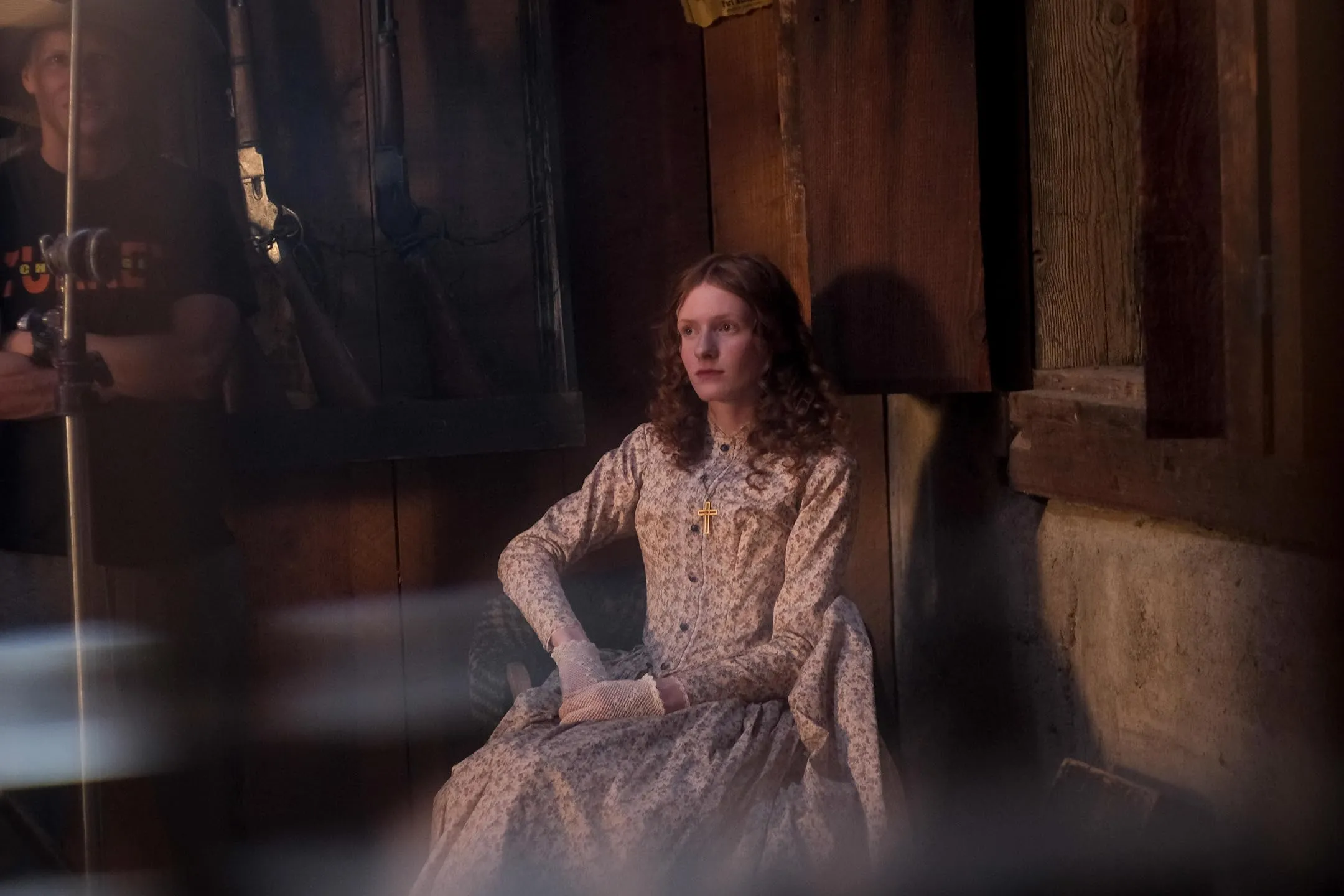
Into this brittle network steps The Kid, a jolt of volatility whose unhinged energy breaks the etiquette of Strindler’s parlor-room negotiations and drives the story toward a climactic gunfight. In the middle of all this corrosion, Rose reads as a brief flare of sweetness and heart, her presence throwing the surrounding coldness into sharper relief. She stands as a reminder of what gets lost when people are reduced to entries in a ledger.
The Commodification of the Departed
As a story engine, the “dead souls” trade operates as pointed political allegory, linking its 19th-century setting to modern anxieties about state power and immigration. The plot’s obsession with lists and records becomes a critique of bureaucracies that treat human lives as data to be sorted, stored, and sold. By grounding the scam in the identities of deceased laborers, the film presses on how the rights and legacies of marginalized people can be erased or reshaped for administrative gain.
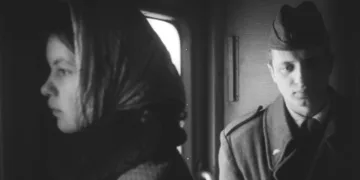
That argument takes on a jarring dimension through a flash-forward set inside a military bunker. The time jump reframes history as a repeating cycle of conflict and census-taking, with borders and recordkeeping presented as recurring fixations. The film also takes aim at the western habit of “printing the legend,” showing official documents as tools that can bury truth just as easily as they can preserve it.
The genre frame becomes a way to examine the mechanics of classification: how a system tags people, assigns value, and then lets them slip into forgetfulness. The satire stays trained on the absurdity of trying to own the names of people who have already passed beyond the reach of law, commerce, and the paperwork that pretends to contain them.
This movie premiered in January 2024 at the International Film Festival Rotterdam. It moved through various independent venues such as the SF IndieFest and the Roxie Theater. Viewers can find it at specialty festival screenings or through specific independent cinema platforms.
Full Credits
Title: Dead Souls
Distributor: Alex Cox Films
Release date: January 26, 2024
Running time: 88 minutes
Director: Alex Cox
Writers: Alex Cox, Gianni Garko
Producers and Executive Producers: Alex Cox, Tod Davies, James Siewert
Cast: Alex Cox, Zander Schloss, Eric Schumacher, Brendan Guy Murphy, Ted Falagan, Shayn Herndon, Amariah Dionne, Maria Robles
Director of Photography (Cinematographer): James Siewert
Editors: James Siewert
Composer: Zander Schloss
The Review
Dead Souls
Dead Souls is a handcrafted, eccentric farewell that thrives on its own oddity. While its low-budget constraints and blunt political parallels occasionally cause the narrative to sag, the film succeeds as a soulful deconstruction of the Western. It is a textured, surreal exploration of how bureaucracy commodifies the marginalized, anchored by a weary, charismatic performance from its director. It won’t satisfy those seeking a traditional shootout, but for fans of subversive, indie-spirited cinema, it serves as a fittingly strange and thoughtful curtain call.
PROS
- The blend of stop-motion, musical interludes, and Spaghetti Western aesthetics creates a unique visual identity.
- Alex Cox brings a dapper, ghostly charm to the role of Strindler.
- Offers a sharp, relevant critique of immigration policy and the dehumanization of bureaucracy.
- Effectively uses deadpan wit and absurdity to balance its heavier themes.
CONS
- Some sequences feel lethargic, particularly in the middle act.
- The political allegory can occasionally feel repetitive or over-explained.
- Beyond the lead, many townspeople remain thin, archetypal sketches.