












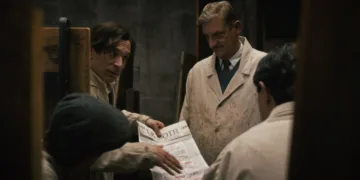










The 2021 dawn raid on Kenmure Street anchors this striking documentary. On May 13, Home Office officials arrived to detain and deport two Sikh men who had been part of their Glasgow community for more than a decade. The move ran straight into resistance from residents of Pollokshields. A small cluster of neighbors grew into an eight-hour demonstration.
The area, marked by red sandstone tenements and a large Muslim population, became a place of peaceful civil disobedience. The date carries its own charge, since it unfolded on the morning of Eid al-Fitr. Director Felipe Bustos Sierra returns to Scottish grassroots action after his acclaimed documentary Nae Pasaran.
He records the way one street in Glasgow became a focal point for an international conversation about immigration and human rights. The film steps away from conventional news framing and stays with the people who refused to move.
The Human Shield and the Power of the Crowd
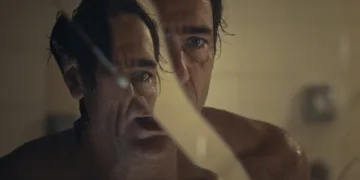
The story turns on a single act of bravery: a man crawls beneath the immigration van and blocks it from leaving. He stays in that cramped space for the full standoff. The film protects his identity through reconstruction, with Emma Thompson performing his words from beneath a vehicle.

Kate Dickie plays the off-duty nurse who remains by the van to monitor his health. These choices keep the day grounded in lived experience, even as the street fills with noise and urgency. I found myself tracking how the film keeps returning to bodies in space, one person pinned under a vehicle, then thousands pressing around it, and how that physical geometry becomes its clearest narrative line.
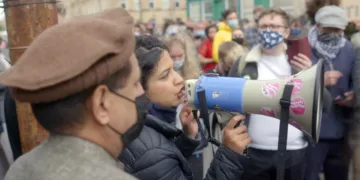
The protest’s scale is startling as it expands from a handful of people into a crowd of more than 2,500 citizens. Local imams, students, and parents leave their routines to join the sit-in. The practical work of the protest takes shape in plain view. A nearby bus stop becomes a distribution point for food and water. The collective organization leads to negotiations involving lawyer Aamer Anwar, and the detainees are released back into their community.
A Mosaic of Digital Witnessing
The film’s visual approach breaks with polished documentary expectations through extensive smartphone footage. The crowd-sourced record depends on shaky, vertical clips captured by hundreds of people on the street. Editor Colin Monie gives this material shape through split-screen sequences that track escalation from multiple angles at once. The result feels immediate and engulfing, the kind of sensory rush that can come from raw images linked together with purpose.
Government interviews and mainstream news reports never enter the frame, so the viewpoint stays with the protesters. When the film shifts into sit-down interviews, it adopts a stylized portrait setup. Residents sit at sharp angles against vivid backdrops, a decision that grants ordinary people a statuesque presence.
Sound and music carry equal weight. Barry Burns of Mogwai provides a score built on layered vocals that evoke a crowd moving together. The music opens with a soulful cover of “Your Sweet Love,” setting an emotional register that holds tension from the police presence alongside the warmth of the community.
Deep Roots and the Duty to Witness
The film opens with a daring seven-minute montage that places the Kenmure Street events inside a longer timeline of Scottish radicalism. Brief images move through suffragettes, anti-apartheid movements, and the union strikes of the 1970s. That grounding frames Pollokshields as part of a local heritage shaped by dissent and collective action. Roza Salih’s presence links the 2021 protest to the Glasgow Girls campaign against dawn raids in 2005.
The director avoids an idealized portrait of the city. He includes Glasgow’s history as a port tied to profits from the slave trade and sugar plantations. That decision strengthens the film’s intellectual charge by insisting that present-day anti-racism sits alongside an honest reckoning with the past.
The documentary frames witnessing as a form of power. Standing together creates a record of resistance that can travel beyond Scotland and influence movements elsewhere. Those themes speak to global anxiety around border policies, echoed by demonstrations against enforcement agencies in the United States and other places.
Directed by Felipe Bustos Sierra and executive produced by Oscar-winner Emma Thompson, Everybody To Kenmure Street is a powerful documentary that chronicles the historic 2021 community uprising in Glasgow. The film had its world premiere at the Sundance Film Festival on January 22, 2026, where it received the Special Jury Award for Civil Resistance. It is scheduled to open the Glasgow Film Festival on February 25, 2026, before its wide theatrical release in the United Kingdom and Ireland on March 13, 2026. This immersive film combines crowd-sourced footage with professional re-enactments to tell the story of a neighborhood that successfully halted a Home Office immigration raid through peaceful solidarity.
Full Credits
Title: Everybody To Kenmure Street
Distributor: Conic, The Party Film Sales
Release date: January 22, 2026
Rating: 12A
Running time: 98 minutes
Director: Felipe Bustos Sierra
Writers: Felipe Bustos Sierra
Producers and Executive Producers: Ciara Barry, Felipe Bustos Sierra, Emma Thompson, Mark Thomas
Cast: Emma Thompson, Kate Dickie, Keira Lucchesi, Aamer Anwar, Roza Salih, Lakhvir Singh, Sumit Sehdev
Director of Photography (Cinematographer): Kirstin McMahon
Editors: Colin Monie
Composer: Barry Burns
The Review
Everybody To Kenmure Street
This film captures the electric pulse of a community in defiance. By blending thousands of amateur perspectives with a deep sense of historical continuity, Felipe Bustos Sierra avoids the dry pitfalls of traditional reporting. The result is a vibrant, urgent piece of cinema that treats ordinary citizens like the architects of history. It proves that collective action is a living tradition rather than a relic of the past. It is a necessary and deeply moving record of what happens when a neighborhood decides to look after its own.
PROS
- Innovative use of crowd-sourced smartphone footage.
- Creative re-enactments featuring Emma Thompson.
- Deeply researched historical and cultural context.
- Powerful, vocal-heavy score by Barry Burns.
CONS
- Visual quality is occasionally rough or low-resolution.
- The rapid editing might feel chaotic for some.
- Absence of opposing viewpoints may feel one-sided.
- Heavy focus on local geography can be specific.