




























Olive Nwosu opens her debut feature with a formal dare. The frame flips the world upside down. Two young girls hang their heads over a jetty in the Makoko floating village, studying water and sky through deliberate disorientation. The shot plants a visual thesis in plain sight: Lady lives in a permanent state of social vertigo. She drives a taxi through the high-voltage chaos of Lagos, where survival codes mutate with every change in the price of fuel.
Lady moves with a singular, clinical purpose. She squirrels away every naira for passage to Freetown, Sierra Leone, a fixed point she treats like a private compass needle. Beyond the windshield, Lagos tightens like a pressure cooker, hot with inflation and dissent. DJ Revolution rides the airwaves with calls for mental decolonization, and Lady hears it the way an exhausted worker hears a sermon: as sound, as static, as one more demand on a depleted body.
Then Pinky reappears, a childhood specter with a proposition that glows in the dark. A well-paying job, ferrying sex workers across the nocturnal sprawl. Lady takes it, and the film steers her out of self-imposed isolation and straight toward the past she tried to leave sealed.
The Fortress of the Steering Wheel
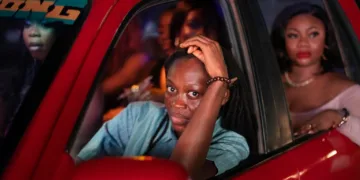
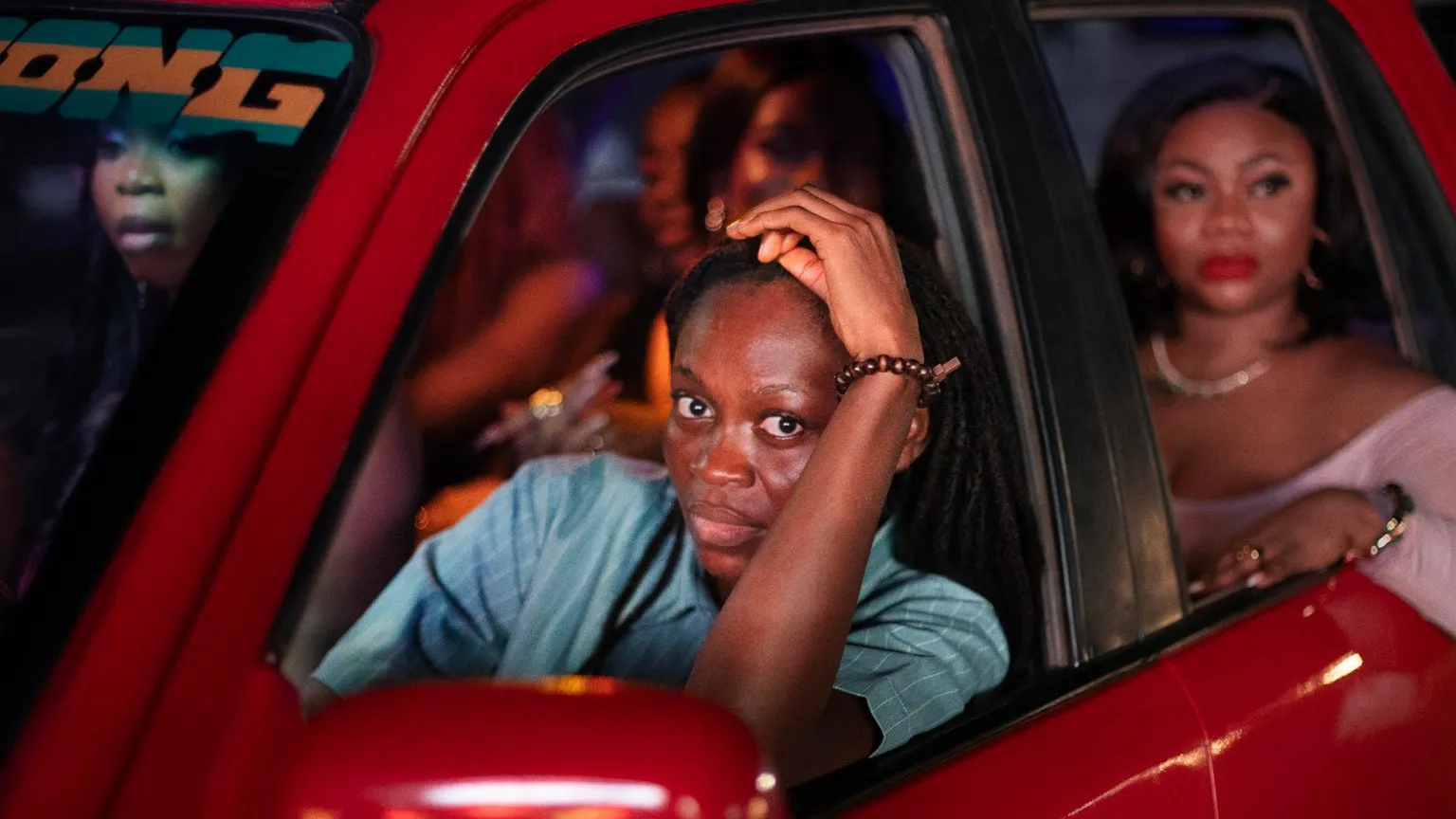
Jessica Gabriel’s Ujah is built around confrontational stillness. Her stare does not flicker. It sits in the driver’s seat like a locked handbrake, daring the viewer to blink first. Lady reads as armored identity made flesh: masculine clothing as camouflage, a brittle front as everyday body armor, dignity carried like a blade kept close to the ribs. The city’s predatory gaze meets a woman who refuses to give it anything soft to grab. She has constructed a wall around vulnerability and keeps company with the role of the lone wolf. Human connection looks messy. Lady prefers clean edges, even if they cut her.
That rigidity carries its own crackle of desperation. In the privacy of her shack, she raps to her reflection, performing dominance for an audience of one. Her Freetown dream lives on a vision board and a “Wish You Were Here” postcard, flimsy paper guarding life savings with the confidence of a padlock drawn in pencil. The psychology here stays tight and tense.
Her recoil from men’s touch and her response to the sex trade register as architecture, not taste. An origin story sits behind the behavior, unaddressed and heavy. Once the night shifts begin, the presence of other women pushes Lady into contact with a sexual phobia that clings to her as firmly as her driving gloves.
Neon Rhythms and Gridlock Grace
The film’s visual language leans hard into urban neo-noir. Cinematographer Alana Mejia Gonzalez shoots in a 2:1 aspect ratio, stretching the Lagos highways into concrete linguine, then finding rhythm inside the gridlock. The camera slides with restless fluidity, then locks down. Those abrupt pauses do real work.
They let the performances land without cushioning, and they turn a face, a hand, a silence into a kind of moral evidence. Daylight arrives as harsh, dust-sharpened glare. Night shifts into neon greens and electric blues, lighting that feels less like illumination and more like a chemical wash. Lady’s red taxi pops against it, a primary-color pulse in a synthetic dark.
Sound follows the same split-brain logic. An Afro jazz score lays down ominous trepidation, while DJ Revolution’s interruptions pin the mood to the street’s political texture. The film also enjoys a god-like camera angle, looking down on the human anthill before plunging into strobe-lit clubs where bodies blur and intentions smear. In the more oneiric passages, visual storytelling moves like a fugue state: rapid editing, jolting cuts, perception slipping out of alignment.
Trauma resurfaces as rhythm. Expressionistic framing turns the city into an extension of Lady’s fractured interior, and the audience gets drafted into her instability. Tension becomes less a plot mechanism and more a sensory condition. The pacing tightens the throat, the sound cues nudge the pulse, and perception starts doing what it does in fear: filling gaps too quickly, trusting shadows too much.
The Fragile Architecture of Solidarity
The women in Lady’s back seat come alive as people, not stock types. They form a loud, breathing community with opinions on agency that vary from weary pragmatism to defiant commitment to this work over the boredom of a domestic trap. Lady meets them with cold, religious distaste. That posture does not hold. Judgment gives way, scene by scene, to a protective instinct that arrives almost against her will. She tries on sisterhood like an unfamiliar garment. It scratches at first. That discomfort is part of the point.
This turn from solitary pride toward collective responsibility becomes the film’s moral spine. Lady likes the idea of singing her own song, and the streets insist on a chorus. The narrative refuses easy sentimental bonding and sticks with the rough edges of lived experience. The finale folds the personal into the political through an act of self-sacrifice, and the ethical gray zones sharpen: duty to self, duty to others, freedom pursued as a private exit route, freedom practiced as a public stance.
The postcard fantasy of Freetown still matters, yet the film keeps returning to a harsher truth. Liberation can live in motion, in refusal, in choosing to fight for the person sitting in the back seat. Even a fortress has doors. Lady learns where hers are, and the camera makes sure we feel the cost of opening them.
Lady premiered to critical acclaim in the World Cinema Dramatic Competition at the Sundance Film Festival on January 22, 2026, where the cast was honored with the Special Jury Award for Acting Ensemble. Following its success in Park City, the film is scheduled to have its European premiere in the Panorama section of the 76th Berlin International Film Festival in February 2026. This UK-Nigerian co-production offers a vivid, neon-drenched exploration of sisterhood and survival in the bustling metropolis of Lagos. While a wide streaming or theatrical release date is forthcoming, the film is represented by HanWay Films and has been associated with platforms like MUBI and Film4 for distribution in various territories.
Full Credits
Title: Lady
Distributor: HanWay Films (Worldwide Sales), MUBI
Release date: January 22, 2026 (Sundance Film Festival Premiere)
Rating: 16+
Running time: 96 minutes
Director: Olive Nwosu
Writers: Olive Nwosu
Producers and Executive Producers: Alex Polunin, John Giwa-Amu, Stella Nwimo, Level Forward, BFI, Film4, Screen Scotland, Amplify
Cast: Jessica Gabriel’s Ujah, Amanda Oruh, Tinuade Jemiseye, Binta Ayo Mogaji, Seun Kuti, Bucci Franklin, Eva Ibiam, Precious Agu Eke, Fadesaye Olateru-Olagbegi, Agu Chinenye Esthyraph
Director of Photography (Cinematographer): Alana Mejía González, Muhammad Atta Ahmed
Editors: Colin Monie, Gareth C. Scales
Composer: Oliver Mayo
The Review
Lady
Olive Nwosu delivers a visual feast that reclaims the noir aesthetic for the streets of Lagos. While the narrative occasionally stumbles over its own thematic ambitions, the sheer magnetism of Jessica Gabriel’s Ujah keeps the film anchored. It is a bracing, sophisticated character study that trades in atmospheric grit rather than easy answers. This is a vital new voice in cinema, offering a portrait of resilience that feels both culturally specific and existentially universal.
PROS
- A commanding, silent performance by Jessica Gabriel’s Ujah.
- Vibrant, neon-drenched cinematography that captures the energy of Lagos.
- A rich, lived-in portrayal of sisterhood and collective survival.
- A rhythmic blend of Afro-jazz and rap that heightens the tension.
CONS
- A rushed third act that leaves some threads feeling thin.
- Some childhood trauma sequences feel slightly tidy or workshopped.
- Certain secondary male characters lack the depth of the central women.