





















The film opens on a white wall inside a Berlin construction office. The space feels scrubbed of history, a worksite of paperwork where Thomas, a construction worker, waits for a call. That sterility shifts to a park bench, and the air changes with it. He finds his wife, Carla, in visible trembling distress, carrying a confession that breaks the domestic quiet into pieces.
She tells him about a car accident that happened while she was traveling with her lover, David. Carla walks away from the wreck physically untouched. David dies. The disclosure lands like a hard blow, and Thomas’s body absorbs it first. The shock is so total that it leads to his hospitalization.
What follows has the shape of aftermath rather than closure. The marriage dissolves into traumatic ripples that spread through memory and through the people around them. A single event stains the shared past, and the film watches that stain seep outward.
Life becomes unrecognizable in small, concrete ways: a familiar routine turns strange, a room turns hostile, a relationship turns into an object that can be examined but never fully held. The story traces the sharp distance created when a hidden world is forced into view, and it treats that distance as a kind of moral geometry, cold and exact.
The Geometry of Stillness
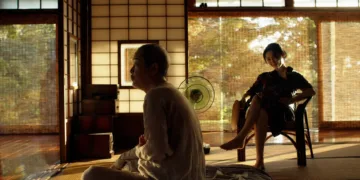
The images live inside a 4:3 aspect ratio, a square frame that tightens the film’s physical and emotional space. The composition imposes a rigorous, almost claustrophobic order. Marius Panduru builds the film from approximately 83 shots, and the restraint carries a heavy weight. Time feels dense. Each sequence stretches long enough for the mind to wander and return, long enough for dread to settle into the body.

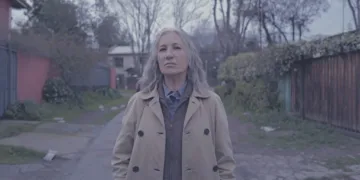
The camera stays largely static and declines the familiar relief of movement. In these severe frames, a stray bicycle, a city bus, and a canopy of leaves hold the same ontological status as the people. The film grants the built world and the natural world a quiet dignity that does not bend to human drama. Long and middle distance shots keep the viewer at a contemplative remove, holding back easy emotional merger.
Real locations, nursery schools and public squares, sit under natural light that reads as cold and frank. There is no musical score, and the silence becomes its own presence. It presses attention onto the small mechanics of being alive. Breath becomes audible as pattern: two bodies in a bed, rising and falling, slightly out of sync.
That stillness carries a philosophical sting. The frame behaves like a boundary line drawn around existence, a reminder that suffering happens inside ordinary architecture. The film asks the viewer to look at a life as if it were an exhibit, arranged with care, stripped of sentimentality, left open to judgment and uncertainty.
The Subjunctive Voice of Grief
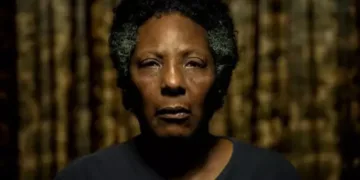
The performances arrive with a remote, Bressonian restraint that rejects theatrical overflow. The actors deliver long monologues in a dry, almost clinical register, and the emotional temperature stays low on the surface. Many cast members speak German as a non-native language, and their lines gather strange melodies and alien cadences. Speech begins to feel slightly dislocated from the body that speaks it, as if language itself has become one more compromised tool.

The dialogue drifts away from realism and leans on the subjunctive mood, shaping each exchange around the hypothetical. Lives fracture into conditional statements, into versions of events that hover beside the real. During Carla’s walk-and-talk monologue, her confession lands with the uncanny calm of a dream being repeated after waking. The film sets these interactions on unstable timing. Conversations stop for long stretches. They resume the next day without greeting, as if the social rituals that stitch time together have lost their force.
Agathe Bonitzer and Vladimir Vulevic inhabit their roles with a profound lack of overt emotion. The emptiness reads as protection, a psychic tactic for surviving an absolute loss that has no proper vocabulary. Words occupy the space between people, and that space remains. The film watches communication fail in slow motion, and that failure feels existential rather than interpersonal. Grief becomes a grammar problem, a world of sentences that cannot deliver the self back to another self.
Orbits of the Solitary Self
A rare release arrives through an interpretive dance set to Leonard Cohen’s “Lover Lover Lover.” The scene registers as a rupture in the film’s impassive surface, while staying solitary in its need. The movement looks like yearning given temporary form, a body speaking in gestures after language has collapsed into formalities.
The narrative widens to take in secondary figures: Sophie, a pregnant teacher, and Andree, who is divorced. Their parallel lines suggest that human arrangements never settle into permanence. Bonds shift, roles slide, attachments loosen, and people continue moving through structures that claim stability. A subtle thread of gender emerges through the androgynous styling of women moving through masculine construction sites, bodies dressed for work, identity shaped by environment as much as desire.
One scene cuts close to the film’s bleakest intuition: Carla tries to arouse Thomas while he sleeps on a couch. The gesture carries desperation and futility, a reach for contact in a relationship that has already hollowed out. The film keeps returning to solitude as a primary condition, not as a mood but as a fact of existence. Intimacy fails without warning. A person once known becomes opaque.
The city itself collaborates with that isolation. Harsh urban sounds, including a distant brass band, swallow human voices, and the effect is almost humiliating. The world continues, loud and indifferent, while private catastrophe tries to speak. Romantic yearning persists as an echo, faint and repeated across an unbridgeable void.
My Wife Cries is a contemplative German drama that premiered in the main competition of the 76th Berlin International Film Festival on February 17, 2026. Directed by the acclaimed auteur Angela Schanelec, the film follows a crane operator named Thomas who receives a distressing call from his wife, Carla, leading to the revelation of a tragic car accident and an emotional affair. Currently, the film is primarily circulating through international film festivals, with its distribution handled by Grandfilm in Germany and SBS Productions internationally.
Full Credits
Title: My Wife Cries (German: Meine Frau weint)
Distributor: Grandfilm (Germany), SBS Productions
Release date: February 17, 2026 (Berlinale)
Running time: 93 minutes
Director: Angela Schanelec
Writers: Angela Schanelec
Producers and Executive Producers: Saïd Ben Saïd, Angela Schanelec, Michel Merkt, Maximilian Kraus
Cast: Agathe Bonitzer, Vladimir Vulevic, Birte Schnöink, Laure-Lucile Simon, Clara Gostynski, Thorbjörn Björnsson, Pauline Rebmann, Ben Carter
Director of Photography (Cinematographer): Marius Panduru
Editors: Angela Schanelec
Composer: Leonard Cohen (featured music)
The Review
My Wife Cries
My Wife Cries is a rigorous meditation on the unbridgeable chasms within the human heart. It is a demanding, often frustrating experience that replaces narrative momentum with a haunting, structural stillness. By stripping away artifice, the film reveals a raw, existential solitude that lingers long after the screen goes dark. It is not a film for the impatient, but for those willing to sit with the discomfort of silence, it offers a rare, unflinching look at the wreckage of intimacy.
PROS
- Stunning, deliberate 4:3 cinematography
- Profound, philosophical approach to grief
- Unique, haunting use of sound and silence
- Memorable, evocative dance sequences
CONS
- Extremely slow pacing may feel like an endurance test
- Remote acting style can hinder emotional connection
- Elliptical narrative is difficult to follow
- Intentional lack of guidance for the audience