
















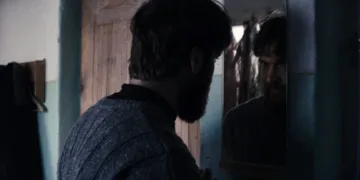













Queen at Sea settles into a heavy mood from its first images of North London, where quiet streets and dense greenery carry a kind of hush that feels protective until it feels complicit. Amanda, a university academic, has stepped away from her post in Newcastle for a sabbatical, and the reason for the return is painfully ordinary: her mother, Leslie, is living with dementia that keeps advancing.
The film keeps exposition spare. The viewer is placed inside a domestic emergency with no gentle runway, as Amanda enters the townhouse and finds her stepfather, Martin, in bed with Leslie. The camera treats the discovery with a clinical chill. It holds its distance, refuses sentimental music, and declines the relief of rapid cutting. What could have been shaped into a single, guiding interpretation becomes an argument with no safe wording. Amanda reads the scene as a violation because Leslie lacks the capacity for informed consent.
Martin argues from decades of marriage and shared history, presenting intimacy as continuity rather than transgression. The opening fixes the tone as rigorous observation, then lets that observation harden into something harsher: a family home, once a site of habitual comfort, recast as a pressure chamber for ethical conflict.
The Mechanism of Intervention
The choice to involve the police turns a private rupture into a procedural project, with steps, forms, and official language standing in for anything like care. Queen at Sea follows the fallout by keeping attention on protocols and the cold surfaces of institutions.

Leslie is taken through a rape kit examination at a hospital, staged as deliberately demeaning and clinical, with the body treated as a repository for evidence while the person attached to it drifts in confusion. The medical system is presented as a machine: functional, meticulous, and indifferent to dignity, especially when the patient cannot track what is happening or why.
Once the authorities arrive, the family becomes secondary to social workers and legal experts who operate inside predetermined categories. Martin continues to frame his intimacy with Leslie as the expression of a long, devoted partnership. Amanda continues to name the act as a crime.
The script sustains moral uncertainty without granting the comfort of a neat verdict. Its focus stays on the limits of a legal structure built for clear binaries of guilt and innocence, a structure that strains when asked to account for a mind that is fading.
Questions of agency stop behaving like questions and start behaving like traps. Helplessness seeps into the story as the state dictates living arrangements for the elderly couple, turning protection into displacement. The move to a care facility arrives as an inevitability, tragic in its finality and born from a call for help that carries consequences nobody can fully control once the mechanism begins to turn.
Portraits of Erasure and Resilience
The film’s emotional weight lands through four performances that hold the narrative in their bodies. Juliette Binoche plays Amanda with controlled desperation, conveying internal exhaustion through a hesitant gait and a voice that catches on difficult words.

The performance is grounded in physical reality, the visible strain of a daughter watching her mother disappear in increments, then encountering her again as a stranger wearing familiar features. Anna Calder-Marshall, as Leslie, carries an extraordinary burden with very little dialogue. Her face becomes a shifting map of feeling: a sweetness that breaks the heart, flashes of terror that arrive without warning, and the blankness that can follow, as if the self has stepped out of frame.
Tom Courtenay portrays Martin as stubborn and painfully misplaced in his resilience. He reads like a figure from a disappearing era, clinging to the remnants of his marriage with a ferocity that brushes against delusion, his insistence functioning as both devotion and denial.
Florence Hunt, as teenage Sara, provides a counterweight through presence and rhythm. Her scenes with her friend James carry an improvisational energy, a sense of life still stretching outward while her grandparents’ world tightens and contracts. Together, these actors build a portrait of a family buckling under a disease that erases the borders of the self, leaving the survivors to argue over what remains, what counts, and who gets to decide.
The Architecture of Isolation
Filmmaker Lance Hammer and cinematographer Adolpho Veloso shoot on 35mm, capturing London in muted, wintry light that flattens color into a kind of quiet austerity. The family home is framed to emphasize distance, as if the building itself has begun to separate its occupants.
Hammer leans on negative space and the sharp lines of the house’s brutalist architecture to keep characters pinned at the edges of their own lives. Stairwells and doorframes become visual barriers, dividing people who share a room yet fail to reach each other.
The camera stays mostly static in scenes focused on the older generation, echoing the stagnation pressing in on them. The visual language shifts in sequences that follow Sara, where the camera becomes more fluid and active and the palette warms. The soundtrack reinforces this partition: Brahms and Schubert shape the grandparents’ cultural world, while irreverent pop music punctuates Sara’s movement through her own.
The aesthetic split makes the generational gap tangible, a life beginning framed beside a life nearing its difficult end. The film closes with stark realism rather than melodrama, offering the sense of a cycle that continues with quiet, indifferent momentum, even after the shocks that change a household’s meaning forever.
Queen at Sea made its world premiere at the 76th Berlin International Film Festival on February 17, 2026, where it debuted in the main competition. As it has only recently completed its festival bow, the film does not yet have a widespread theatrical or streaming release date in the United States or international markets. Audiences looking to watch the film should monitor upcoming festival schedules or wait for a distribution deal to be finalized for platforms like MUBI or theatrical independent circuits.
Full Credits
Title: Queen at Sea
Distributor: The Match Factory, The Bureau, Alluvial Film Company
Release date: February 17, 2026
Running time: 121 minutes
Director: Lance Hammer
Writers: Lance Hammer
Producers and Executive Producers: Tristan Goligher, Lance Hammer
Cast: Juliette Binoche, Tom Courtenay, Anna Calder-Marshall, Florence Hunt, Steven Cree, Michelle Jeram, Cody Molko, Joe Horsford
Director of Photography (Cinematographer): Adolpho Veloso
Editors: Lance Hammer
Composer: Brahms, Schubert, Gavin Bryars (Curated Classical Music)
The Review
Queen At Sea
Queen at Sea is a rigorous, unflinching examination of the intersection between clinical authority and private grief. It avoids the easy sentimentality of traditional dementia dramas, opting instead for a cold, procedural realism that is both demeaning and deeply honest. While the methodical pace may feel grueling, the film succeeds by grounding its philosophical questions in visceral, lived-in performances. It is a haunting portrait of a family caught in an institutional gears, capturing the terrifying moment when love and consent become indistinguishable from trauma.
PROS
- Juliette Binoche and Tom Courtenay deliver some of their most nuanced, emotionally taxing work.
- The use of 35mm and architectural framing creates a palpable sense of domestic isolation.
- The film refuses to provide easy answers to the difficult questions of agency and sexual consent in elderly care.
- The juxtaposition of teenage discovery against elderly deterioration adds a layered perspective on the cycle of life.
CONS
- The detached, procedural tone and lack of melodrama may feel alienating or "slow" to some viewers.
- The methodical, almost repetitive nature of the assessments can make the runtime feel significant.