

























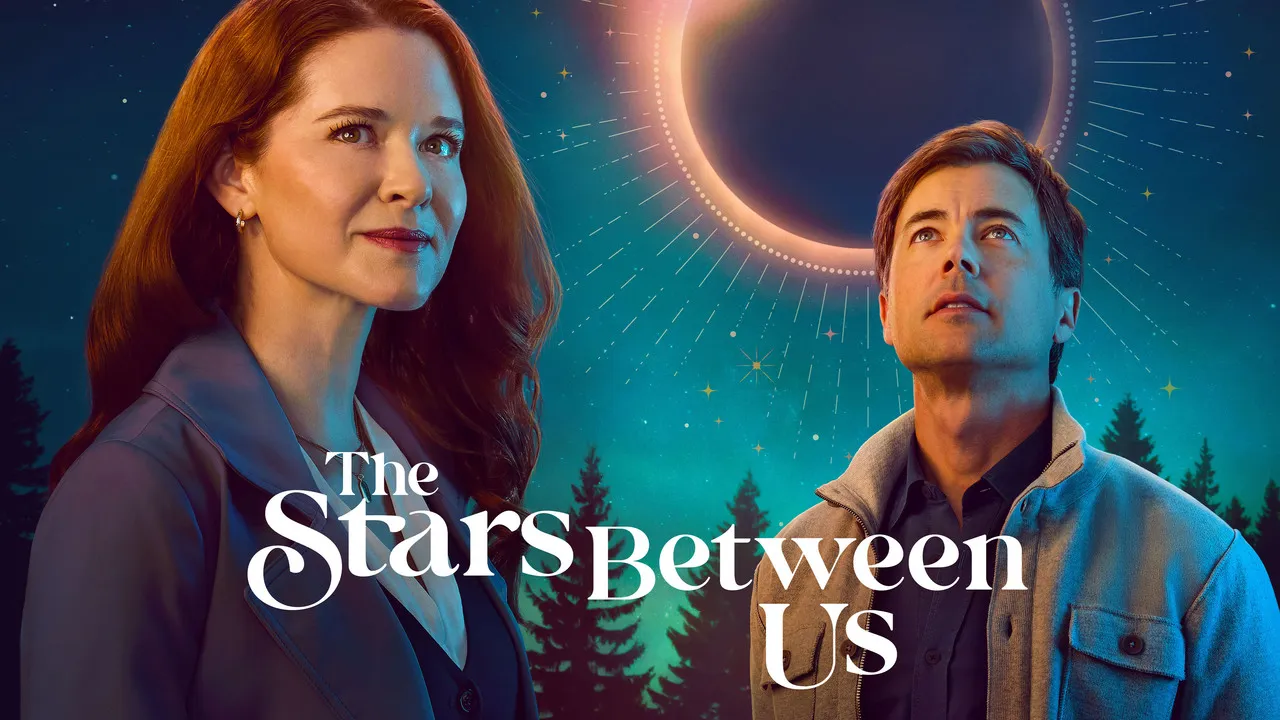

The solar eclipse operates as the narrative’s motor. In Carbondale, Illinois, the sky drops into darkness as Kim Gallagher and Malcolm Brooks share a brief encounter over an expensive telescope. The spark lands fast. Their conversation clicks through a shared respect for the clockwork of the heavens. Then the shadow moves on. They leave without trading a single digit of contact information.
Their meeting sits like a flicker against a much larger timeline. Seven years later, the cosmic schedule loops back as another eclipse approaches. Kim has become a single mother stepping back into the professional world as a reporter for WGZA Chicago.
Malcolm has moved into life as an astronomy professor, still locked on his own standing. Both drift back toward the same coordinate. The film presses a question about agency: can the universe correct a missed opportunity. It frames their history as gravitational pull. Two lives in separate orbits. A long wait for the moment their paths cross again.
Professional Orbits and The Path of Totality
The story moves through ambition and the cost it extracts. Kim carries the psychological weight of a five-year career hiatus. The red light on the camera triggers a familiar freeze, and that fear of failure shapes her arc. She needs to prove competence to a demanding superior while managing the quirks of her news team. Her producer, Reed, becomes a portrait of early-career fumbling.

Her camerawoman, Claire, supplies steadier footing. Malcolm reflects the same drive inside academia’s rigid corridors. He hunts for the approval of Dr. Stanley Longford, since that validation determines the fate of his manuscript. His return to Carbondale plays as a calculated career move. Both leads work inside pressure systems that demand full attention.
Their professional selves keep cutting in front of their romantic possibility. The script treats career goals as the friction that delays reunion. Each character is shaped by what they are trying to accomplish at work. The parallel struggles add a grounded texture, a reminder that life rarely pauses to honor a half-remembered moment. Each fights for a place in their field. Each moves toward a singular event for completely different reasons.
Shadows, Sparks, and The Absent Lead
Sarah Drew plays Kim with grounded vulnerability, balancing parental responsibility against the frantic churn of a news cycle. Matt Long gives Malcolm the quiet intensity of someone who trusts equations more than people. A striking structural choice keeps them apart through most of the runtime. The film leans on near-misses, using the eclipse’s geography to hold them close while denying direct contact.
The absence creates a vacuum, and the supporting cast rushes to occupy it. Claire and Travis carry a secondary romance with sharper immediacy. Their chemistry lands instantly, throwing a bright flare across the slower, more theoretical primary pairing. The film spends substantial time with Kim’s crew and their camaraderie. Reed’s shift from awkward assistant to reliable producer supplies a satisfying secondary arc.
These relationships carry the emotional weight of the middle stretch. The audience watches the periphery bloom while the supposed main connection lingers like a ghost. Keeping the leads isolated feels bold, and a little mischievous. It asks viewers to accept connection where they can find it, even if the film keeps withholding the obvious one. The result becomes a collage of smaller bonds, stitched together by proximity and timing.
Cosmic Metaphors and The Mechanics of Fate
Director Michael Robison treats the Path of Totality as both destination and altar. The cinematography emphasizes the split between Carbondale’s terrestrial bustle and the sky’s cold indifference. Lighting becomes the hinge. Daylight gives way to eclipse twilight, and that eerie shift forms an expressionistic backdrop for the climax, flirting with noir’s love of shadow and moral uncertainty.
Tim Huddleston’s script turns the celestial event into metaphor, a door swinging toward closure. Dialogue moves from technical physics jargon to questions about destiny and what choice can realistically accomplish. The film argues that human decision often yields to a larger plan, the universe imagined as a grand machine that keeps grinding along. Pacing mirrors the moon’s slow advance across the sun, building tension through timing rather than spectacle.
The movie holds the banality of news reporting beside the grandiosity of the stars, letting each sharpen the other. It tracks how seven years reshape a person’s internal terrain. The characters return older, perhaps more cynical, yet the film keeps faith in cosmic precision. Fate registers as mathematical certainty, which feels comforting until you remember that math never asks permission.
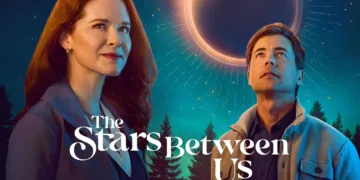
The Stars Between Us premiered on the Hallmark Channel on Saturday, February 21, 2026, as part of the network’s annual “Loveuary” programming event. The film explores the concept of celestial timing through the eyes of two strangers who share a transformative moment during a solar eclipse, only to be reunited by the cosmos seven years later. For those who missed the live broadcast, the movie is currently available to stream on the Hallmark+ platform, which added the title to its library on Sunday, February 22.
Full Credits
Title: The Stars Between Us
Distributor: Hallmark Channel
Release date: February 21, 2026
Rating: TV-G
Running time: 84 minutes
Director: Michael Robison
Writers: Tim Huddleston
Producers and Executive Producers: Sarah Drew, Tim Huddleston, Elizabeth Yost, Gayle Polinger
Cast: Sarah Drew, Matt Long, Donna Benedicto, Grayson Gurnsey, Junnica Lagoutin, Benjamin Wilkinson, Katherine Evans, Kevin O’Grady, Iris Quinn, Phoenyx Ellis, Noah Paul, Greg Rogers
Director of Photography (Cinematographer): Mike Kam
Editors: Richard Schwadel
Composer: Hamish Thomson
The Review
The Stars Between Us
The film succeeds as a theoretical study of destiny but falters in its execution of emotional intimacy. By keeping the leads in separate orbits for the majority of the runtime, it trades visceral chemistry for a philosophical meditation on timing. The supporting cast provides much-needed warmth, yet the central romance feels more like a mathematical event than a human connection. It is a stylistically consistent work that prioritizes the grand mechanics of the universe over the messy reality of being together.
PROS
- Sarah Drew delivers a grounded, relatable performance as a working mother.
- The secondary romance between Claire and Travis offers immediate, engaging chemistry.
- An original narrative hook that utilizes astronomy as a metaphor for life stages.
- Strong character development for supporting players, particularly Reed.
CONS
- Lack of screen time between the two leads prevents a romantic spark from truly forming.
- Occasional reliance on clunky, technical dialogue that feels contrived.
- The antagonist "boss" character feels like a thin, one-dimensional trope.
- The pacing relies heavily on near-misses which may frustrate viewers seeking a traditional romance.