
















Reanimal drops you into a dark, wartorn place and keeps the premise tight. You play as two siblings crossing a grey ocean in a small boat, driven by a single task: find and rescue three missing friends. The island they reach turns that simple goal into a constant threat assessment.
Giant mutated animals roam the terrain. Some enemies resemble human skins, while others take the shape of warped farm animals blown up to monstrous scale. The kids are physically small, and the spaces around them feel enormous and hostile.
That imbalance shapes the tone. The siblings speak rarely, and their tired voices suggest they have lived with this disaster for a long time. The island plays like a nightmare that refuses to warm up. Streets sit under floodwater. Factories stand abandoned.
Silence settles between footsteps, and the air feels cold even when nothing is moving. Every corner reads as a risk. The game keeps pushing the pair to cooperate, improvise, and keep moving, because hesitation carries the same message every time: the island notices.
The Frame of Fear
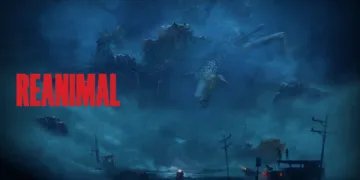
The visual style leans painterly, with a desaturated grey palette that drains life from the scenery. That decision makes the setting feel spent, like the color has been pulled out of it. Crimson red becomes the key accent, and it carries clear meaning. It highlights routes and works like a warning system, tagging danger in a way your eyes learn to chase.
Camera choices reinforce the fear of scale. Reanimal uses fixed 3D angles, and many of them pull back to reveal towering structures or threats that were hidden a second earlier. The effect recalls classic survival horror from the nineties, including Resident Evil, where framing turns architecture into an enemy and distance becomes its own kind of menace. Those pulled-back compositions make the siblings look tiny and exposed. With no HUD on screen, the view stays uncluttered, and your attention stays locked on the imagery the game wants you to read.
Lighting does a lot of work here. Large stretches sink into pitch-black darkness, and progress depends on small, fragile light sources. Dialogue remains sparse, and the children sound exhausted, almost numb from repetition, which makes their situation feel matter-of-fact instead of theatrical.
Audio fills in the rest. Water drips in empty corridors. Heavy footsteps land somewhere out of sight, slow and deliberate, implying something large nearby. The tension comes from these layered cues. The game sustains dread through image, shadow, and sound timing, and the visual direction carries the narrative weight by using transitions that make spaces feel unstable and hard to trust.
Survival Through Stealth and Steel
The moment-to-moment structure asks you to push forward through hostile territory, and stealth sits at the top of the toolset. Much of the time is spent in shadows, watching patrol patterns, waiting for a giant creature to turn its head, then slipping past. When stealth collapses, the game pivots into chase sequences that feel fast, messy, and panicked, often serving as the endpoint for encounters with the biggest monsters.

The creature design keeps escalating your discomfort. One standout segment throws a homicidal cloud of seagulls at you, weaponizing something ordinary into an unpredictable swarm. Elsewhere, you face limp, empty people skins that slither across the ground. Their movement is slow and wrong, and the lack of a recognizable body language makes them unsettling in a different way than the towering animals.
Combat exists, but it carries the same desperation as the characters themselves. The siblings can swing a crowbar or use a knife, and the action feels clunky by design, reflecting how unprepared these kids are for direct fights. That gives the game a different rhythm from typical action titles, where offense tends to be clean and empowering.
Here, attacking reads like a last resort, and even a win feels shaky. Travel and pacing also get support from vehicles. The dinghy functions as your primary way to cross water between major areas, and it even includes harpoons for defense. Certain scenes put heavier tools in your hands, like a WWII placement cannon. Enemy variety keeps spiking into the surreal, too, with a boss encounter built around an ice cream vendor chasing you with a vendetta.
Puzzles keep the structure readable. Many boil down to finding a key or a crank to open a blocked route, giving you short breathing spaces between threat spikes and encouraging exploration. Checkpoints are generous, so progress does not get buried under constant repetition.
The controls also feel tighter than the developer’s previous work, which matters because platforming shows up often. You climb beams, balance over heights, and string together careful movement while the game nudges you to keep momentum and stay ahead of whatever is hunting you.
The Islands of Silent Stories
The wider layout uses a chain of islands, and it resists a straight-line march. You can take different routes, hunt for secrets, and poke into side spaces that reward curiosity. That structure supports the tone, because exploration becomes part of the tension: every detour might hide a useful find, and every detour might hide something worse. The locations shift enough to keep the island hopping feeling purposeful, moving through rail yards, farms, and flooded towns.

Secrets are handled in a tactile way. You find hidden rooms tucked behind cracks in walls, and those spaces often hold collectible masks. Flyers show up as another collectible, and they unlock concept art, tying exploration to extra context without interrupting the flow with long exposition dumps.
Storytelling stays environmental. The game communicates through empty clothing, wrecked buildings, and spaces that look abandoned in a hurry, implying atrocity through what remains. The scale can feel surprisingly big for a short experience, especially when the game opens into massive vistas designed to shrink you.
Lore comes from observation, from reading the objects left behind and building a mental timeline from fragments. That approach trusts the player to connect details and leaves room for different theories about what the island is and what happened there. The priority remains mood, place, and the slow accumulation of dread.
Shared Terror and Artificial Bonds
Reanimal supports co-op play locally or online, and the design leans into it through a shared camera that keeps both siblings on the same screen. That framing forces coordination. Progress depends on actions that require cooperation, like turning heavy valves together or boosting a partner up to a higher ledge. Those tasks are simple mechanically, yet they land emotionally because they create steady reminders of dependence. The horror stays close to the relationship, since the game keeps asking you to protect proximity and timing.

Solo play swaps in an AI partner. The AI stays close, responds cleanly to your actions, and pulls its weight in puzzles and combat without wandering off or breaking the pace. The siblings have the same mechanical capabilities, so neither role carries a special kit that warps the balance. A friend’s pass lets someone join you online for free, which fits the co-op focus and lowers the barrier to sharing the experience.
The tension system reinforces companionship through pressure. Staying near your partner becomes a survival requirement, and separation carries lethal risk. That rule turns the bond into a mechanic you feel in every room, grounding the fear in the simple need for another person within reach. When a second human player is not present, the AI fills gaps without slowing the game down, keeping the experience smooth while preserving the same cooperative structure.
The Review
Reanimal
Reanimal offers a bleak and artistically striking descent into horror. While the simple puzzles and familiar structure might feel predictable to some, the shift to a fixed 3D perspective and the addition of cooperative play provide a fresh sense of scale and tension. Its strength lies in the masterful atmosphere and grotesque creature design, making the journey feel like a coherent, nightmare-fueled spectacle. It succeeds as a refined evolution of the cinematic horror genre.
PROS
- Masterful atmosphere and sound design.
- Striking fixed 3D camera work.
- Seamless cooperative mechanics and reliable AI.
- Grotesque and creative monster designs.
CONS
- Simple, low-challenge puzzles.
- Familiar episodic structure.
- Occasional long loading times after death.