




















Michael Jackson’s life was, by any measure, one of the strangest and most spectacular human stories of the twentieth century. He did not simply become famous; he became a modern myth, scrutinized so relentlessly that by the time he died in 2009, most of his story had already been told, debated, and told again. A biographical film about him arrives burdened with an almost philosophical problem: what can cinema say about a man whose life was already cinema?
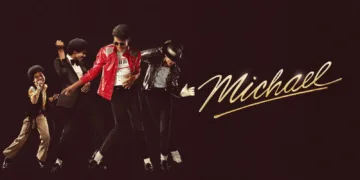
Antoine Fuqua’s Michael, written by John Logan and produced by Graham King, attempts an answer. The film spans Gary, Indiana in the mid-1960s through the 1988 Wembley Stadium concert, tracing the Jackson 5 years and Michael’s solo ascent across Off the Wall, Thriller, and Bad. What it does not cover is arguably the most consequential part of the story. The film was originally shot with a framing device built around the 1993 child sexual abuse allegations, then reshot entirely after the estate’s lawyers determined that releasing it would violate the terms of a prior settlement. What we have is a film shaped as much by legal strategy as by artistic intention, and that fact haunts every frame.
The Body Remembers
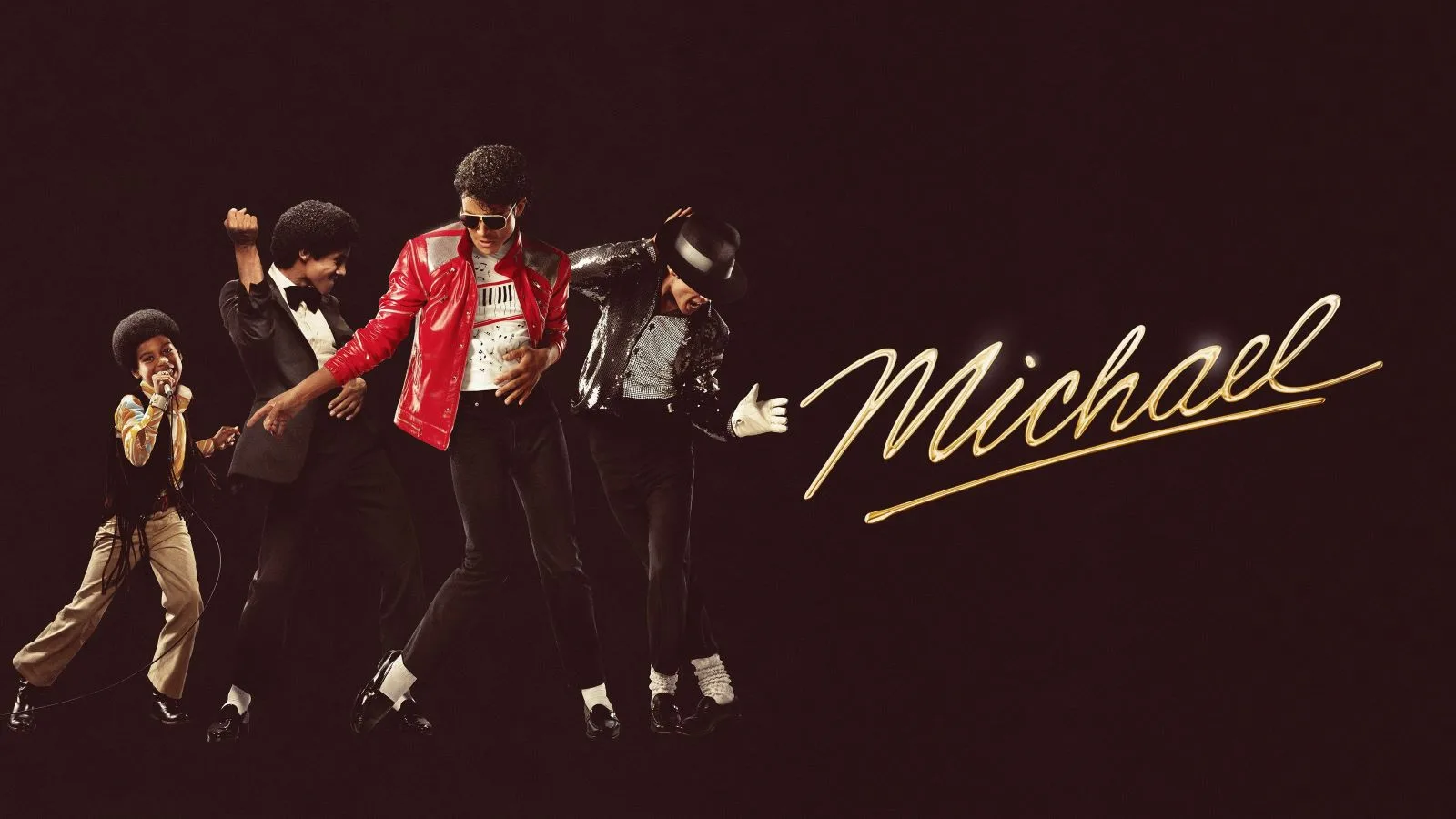
Jaafar Jackson, the 29-year-old son of Jermaine Jackson, came to this film with no meaningful prior acting, dancing, or singing experience. The casting was a risk of the highest order, and what makes it work is something that resists easy explanation: Jaafar carries the physical memory of his uncle in his body. The soft, spectral speaking voice, the shy tilt of the head, the way stillness can suddenly detonate into movement. He does not impersonate Michael Jackson so much as re-inhabit a familiar ghost.
The film uses vintage, remastered recordings rather than Jaafar’s own voice. Some will find this choice distancing; I found it appropriate. Michael Jackson’s voice was so singular that any approximation would have been a constant reminder of absence. The lip-sync is precisely executed, and Jaafar sells it with an authority that occasionally borders on the uncanny. His finest moments come in the dance sequences: the Motown 25 moonwalk reconstruction and the Wembley finale, both choreographed with painstaking fidelity by Rich and Tone Talauega. Off stage, the script allows Michael almost no moral complexity, writing him as gentle, wounded, and essentially innocent. The limitation is not Jaafar’s; it belongs to the film’s wider unwillingness to look its subject fully in the face.
Juliano Krue Valdi, playing the young Michael, is quietly extraordinary. His Gary, Indiana scenes carry a raw ache that the adult section often fails to match. Colman Domingo’s Joe Jackson is the film’s most dramatically liberated performance, fierce and frightening under heavy prosthetics. The risk is that Joe tips into pantomime: a snarling villain whose evil is so squarely framed that the film loses the genuine horror of ambiguity.
Nia Long is underwritten and passive as Katherine. Miles Teller brings smirking energy to lawyer John Branca, a character whose screen prominence feels tidier once you know Branca is also a film producer. Mike Myers, as CBS president Walter Yetnikoff, lands the film’s most enjoyable cameo. Kendrick Sampson is given almost nothing to do as Quincy Jones, a baffling choice given Jones’s centrality to Michael’s greatest creative period. The absence of Janet Jackson and siblings Randy and Rebbie, none of whom are executive producers here, is conspicuous by design.
Portrait Assembled From Known Parts
John Logan’s screenplay moves in strict chronological order from Gary to Wembley, announcing itself as a first chapter with the closing title card “His Story Continues.” The film hits every expected beat of the music biopic form: the tour bus, the recording studio revelation, the chart ascent, the confrontation with corporate gatekeepers. There is nothing wrong with familiar structures when they are inhabited with vitality. The problem is that Logan’s script too often mistakes familiarity for depth.
The father-son relationship serves as the film’s dramatic spine, and here it finds its most defensible ground. Joe Jackson’s abuse of his son is depicted without softening, particularly in the early scenes. The film’s argument, stated and restated, is that Michael’s entire artistic drive, his perfectionism, his need to be the greatest entertainer alive, was the direct product of that childhood terror. Fear was the engine. This is psychologically plausible, and Fuqua presses on it with genuine force in the first act.
The screenplay has real high points. A scene in which Michael enters an LA club, studies the movements of real gang members, and builds the choreography for “Beat It” from what he finds there is one of the film’s rare glimpses of an artist consciously shaping his own vision. The MTV showdown with Yetnikoff is both entertaining and illuminating about the racial barriers Michael broke. The reconstruction of the “Thriller” video shoot captures something of that production’s strange electricity.
What the script cannot do is show us an artist in genuine creative struggle. Michael arrives largely formed, his genius self-evident from the opening frames. Songs emerge without labour; decisions are made without apparent conflict. The narrative contorts itself trying to explain Michael’s eccentricities through the single lens of Joe’s damage, which reduces a complex human being to a reaction. The reshot third act shows its seams: the film’s closing movement feels gear-shifted rather than earned, and the absence of whatever story existed before the reshoots registers as a structural wound.
Surfaces, Luminous and Flat
Antoine Fuqua built his reputation on films with a hard physical tension, Training Day, The Equalizer, works where moral compromise was shot with tactile immediacy. Michael asks something different of him, and the fit is imperfect. Cinematographer Dion Beebe brings a clean, warm visual language to the period recreations, and production designer Barbara Ling reconstructs the passage from 1960s Gary to 1980s Encino with careful period intelligence. The craft is evident. What is absent is a signature.
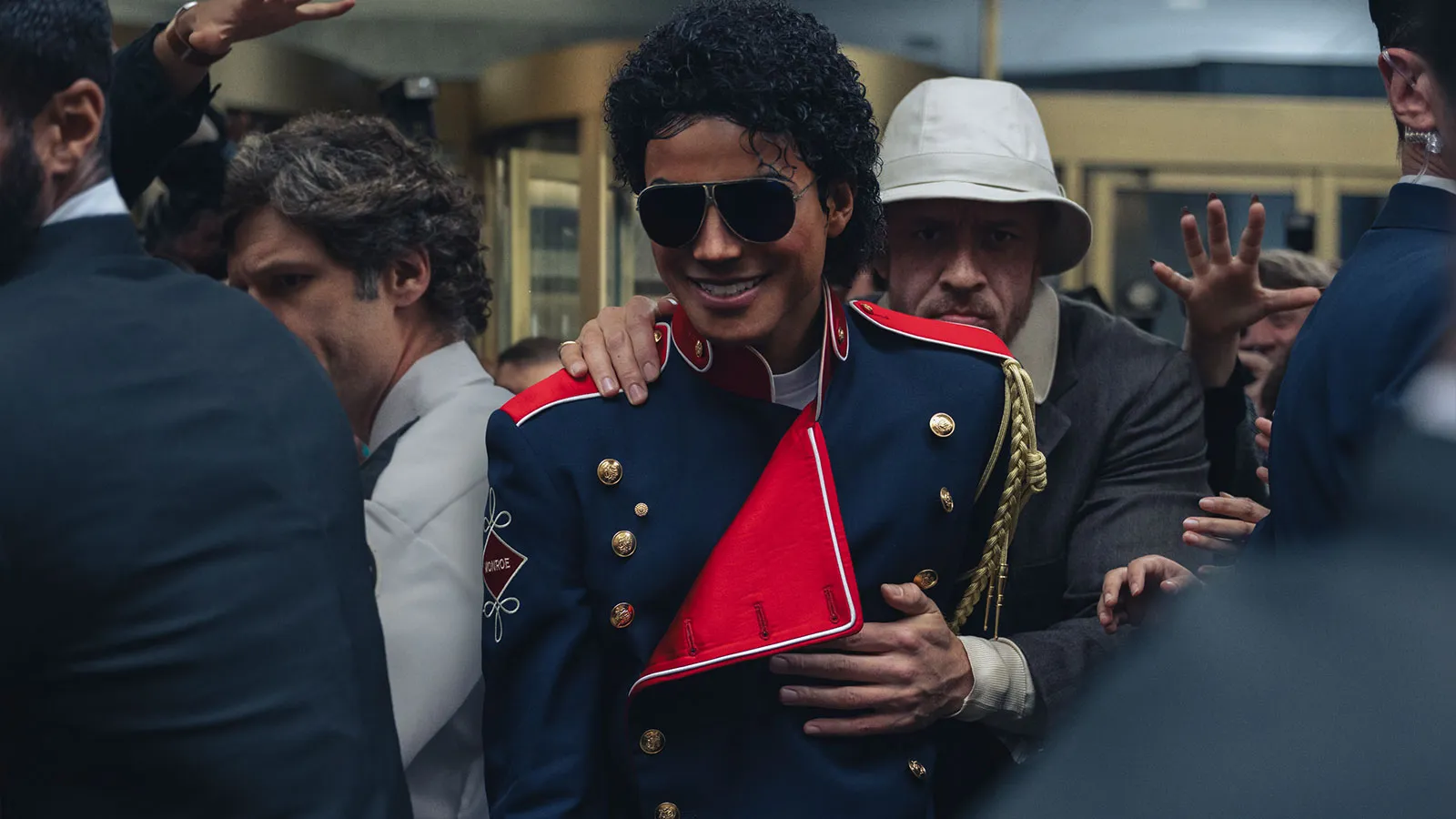
The camera stays close to Michael throughout, his perspective, his reality, with secondary characters existing largely as extensions of his experience. The consequence is that the world he was transforming stays mostly offscreen. The concert and video reconstructions are the film’s most alive passages.
The Motown 25 moonwalk, the “Beat It” and “Thriller” video shoots, the Wembley finale: these sequences carry genuine spectacle, and in IMAX they achieve a scale the surrounding drama cannot match. A tension persists, though. The sequences are so precisely choreographed, so faithfully assembled, that they occasionally feel like a very expensive museum exhibit rather than a living work of cinema. The songs carry the emotional charge that the screenplay has not earned.
Pacing becomes a persistent problem in the film’s middle section. The Thriller and Bad eras, in which Michael should be at his most creatively explosive, lose momentum between set pieces. The film’s register throughout is reverential, which flattens emotional range and keeps its tone cautious and smooth. Michael Jackson made some of the most urgent and emotionally raw pop music of the twentieth century. The film that bears his name is polished and placid, a reflection that captures the surface accurately and misses what was burning underneath.
What the Silence Costs
The child sexual abuse allegations that began in 1993 are entirely absent from this film, and the decision to end in 1988 was not made for artistic reasons. The original version reportedly included a framing device built around those allegations, apparently constructing an argument for Michael’s innocence. That version had to be scrapped after the estate’s lawyers determined it would violate the terms of a prior settlement with one of his accusers. What remains is a film whose shape was determined by legal necessity, and that cannot be acknowledged within the film itself.
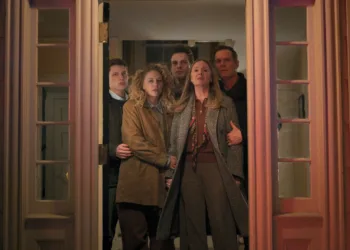
This matters because every scene in which Michael visits children in hospitals, every moment of Peter Pan longing, every exotic animal acquired as a substitute for friendship, lands differently for an audience that knows the rest of the story. The film loads these scenes with reassuring observers, characters positioned in doorways who watch Michael’s tenderness and smile gently. The staging is so deliberate, the innocence so insistently framed, that it draws more attention to the absence than silence would have.
Estate-involved biographical films are structurally biased toward protection. Multiple Jackson siblings, Branca, and other associates serve as executive producers, and their collective interest is preservation rather than examination. The film omits the painkiller addiction that followed the Pepsi commercial accident, minimises the full extent of his cosmetic surgery, and presents Michael’s increasingly strange adult behaviour as the inevitable bloom of Joe’s early cruelty. The philosophical problem with this approach is that it reduces a human being to a victim, which is its own form of erasure.
The film is not without honesty on selective fronts. Joe’s abuse is depicted clearly and without apology. The vitiligo diagnosis and the skin lightening it prompted receive genuine attention. The Pepsi accident is rendered with real physical force. On the matter of Michael Jackson’s talent, the film argues its case with persuasive force.
The closing title card, “His Story Continues,” positions the film as a franchise opener. A sequel would face obligations this one has carefully avoided: the trials, the settlements, the Leaving Neverland documentary and the streaming removal that followed, the opioid dependence that ended his life. The card may be a genuine promise or a legal hedge. What it cannot be, if the filmmakers retain any integrity, is an excuse.
Michael is a highly anticipated musical biographical drama that chronicles the extraordinary life and complex legacy of the “King of Pop,” Michael Jackson. Directed by Antoine Fuqua, the film stars Jaafar Jackson in his breakout role as his real-life uncle, portraying Michael from his early days with the Jackson 5 to his peak as a global solo icon. Initially slated for a 2025 release, the film premiered in Berlin on April 10, 2026, and is scheduled to hit theaters across the United States on April 24, 2026. Audiences will be able to experience the film on the big screen, including IMAX and other premium formats, through Lionsgate domestically and Universal Pictures internationally.
Where to Watch Michael (2026) Onlne









Full Credits
Title: Michael
Distributor: Lionsgate (United States), Universal Pictures (International), Kino Films (Japan)
Release date: April 10, 2026 (Berlin Premiere), April 24, 2026 (United States)
Rating: Pending (Anticipated PG-13 or R)
Running time: 127 minutes
Director: Antoine Fuqua
Writers: John Logan
Producers and Executive Producers: Graham King, John Branca, John McClain
Cast: Jaafar Jackson, Colman Domingo, Nia Long, Miles Teller, Laura Harrier, Kat Graham, Larenz Tate, Jessica Sula, Kendrick Sampson, Kevin Shinick
Director of Photography (Cinematographer): Dion Beebe
Editors: John Ottman, Harry Yoon
Composer: Lior Rosner
The Review
Michael
Michael is a film that knows what it cannot say and builds its house around the silence. Fuqua assembles something genuinely spectacular in its musical sequences, and Jaafar Jackson's physical performance is a remarkable debut. The craft is real. The evasions are realer. A biopic that ends precisely where the difficult questions begin, shaped by legal strategy and estate interests, delivers a portrait that is luminous on the surface and carefully hollow beneath it. Fans will be satisfied. Anyone expecting cinema to do what cinema is supposed to do, tell the truth, will leave wanting.
PROS
- Jaafar Jackson's physical performance and dancing
- Colman Domingo's ferocious portrayal of Joe Jackson
- Spectacular concert and video reconstructions
- Strong first act depicting Michael's abusive childhood
- High production values and period detail
CONS
- Omits the abuse allegations entirely
- Michael is written as saintly and dramatically flat
- Pacing sags badly in the middle section
- Supporting characters, including Quincy Jones, are wasted
- The reshot third act feels structurally compromised
- Estate involvement visibly distorts the storytelling