

























![Kingdom Hearts Collection [I-III] Review](https://gazettely.com/wp-content/uploads/2026/10/Kingdom-Hearts-Collection-I-III-1-360x180.webp "Kingdom Hearts Collection [I-III] Review: KHII Holds Steady as Newer Entries Fluctuate 37")



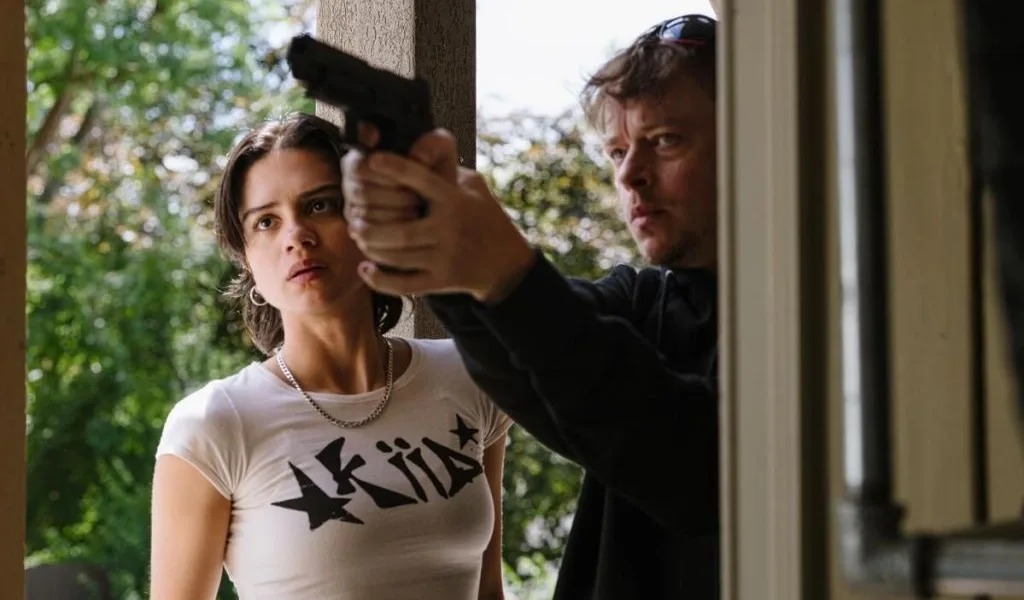

In the hushed, traffic-bound reaches of Salt Lake City, Cole moves like a ghost inside the circuitry. He works as a wardriver, a creature of the night who reads the city as a chain of unsecured entry points. His office is a laptop balanced inside a car. His days, or what pass for them, register in engine vibration, terminal glow, and the stale air of sealed windows.
Cole lives by a rigid code that carries the severity of ritual. He goes after large financial institutions. He steers clear of private citizens. He slips gift cards to a struggling neighbor, as if stolen credit might quiet the noise in his conscience. That sealed routine fractures when Oscar, a local criminal with a talent for forcing doors open, crashes into Cole’s private system.
He drags him into a theft worth eight hundred thousand dollars. The target is Sarah, a woman tied to a mob lawyer whose danger radiates long before he enters a room. Once Cole begins the hack, the clean geometry of the job starts to collapse.
Sarah’s muted desperation changes the texture of the crime. Code turns into panic. Panic turns into a search for moral repair. Cole has to thread his way through betrayal and mortal risk, hoping his skill can shield Sarah from the damage his skill helped create. A neat irony. The machine that fed him may now bury him.
The Banality of the Cyber-Breach
The film treats hacking with a welcome lack of decorative nonsense. Cole does not float through luminous digital corridors or prod holograms that look borrowed from a theme park. He sits in a parked car with a Wi-Fi antenna and waits for information to move through the air at its own stubborn pace.
The labor is dull, tactile, and faintly absurd. He kills time with lollipops, drifts vapor through the cabin, and parks near targets such as the Bambara restaurant while the work inches along. Crime arrives here as repetition. Thursday is his chosen day. He installs fake card readers on ATMs with the steady hands of a field technician.
He photographs hardware, studies angles, and charts routes of entry with patient care. The routine gives the thefts an almost ceremonial cadence. Every step is physical. Every digital act depends on metal, plastic, glass, timing, and nerve. The paradox is clear and sharply drawn. Cole steals through networks, yet he remains tied to pavement, parking lots, driveways, and machines that demand contact.
The film also studies the mental acrobatics of a contemporary outlaw. Cole casts himself as a digital Robin Hood. Anonymous voices in chat threads repeat that myth back to him, giving it the warmth of communal folklore. Through text alone, he sustains the fiction that his crimes spare real people. Banks reimburse the money. Institutions absorb the damage.
That belief gives him enough comfort to close his eyes at night. It never feels secure. His exchanges with the neighbor expose that weakness. They suggest a man trying to purchase moral relief with stolen value, which is a very old human habit dressed in newer hardware. The setup carries the fatalism of noir. A man draws rules for chaos and trusts the mess will respect the lines he has drawn. Chaos rarely shows that courtesy.
Portraits in Heavy Water
Dane DeHaan plays Cole with a weary stillness that settles into the frame almost immediately. His heavy-lidded gaze suggests a man who has exchanged any stable sense of time for a permanent stream of incoming data. The disheveled look feels lived in. Nothing about it seems arranged for effect. Cole moves through the film with strikingly little concern for concealment.
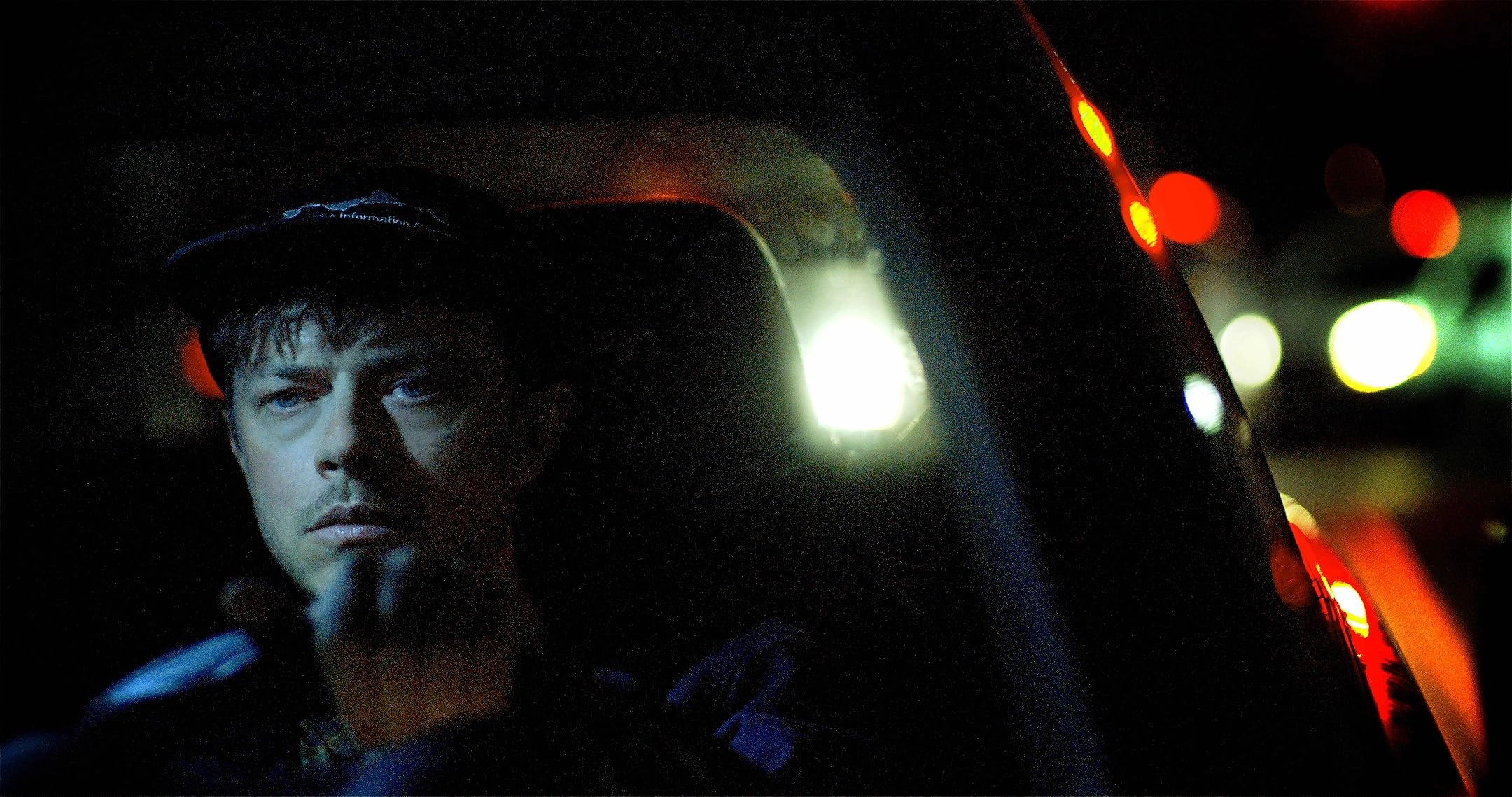
He skims ATMs and approaches homes with his face fully visible, offering cameras a clean look at him. That openness carries an air of resignation. It feels like the behavior of someone who already imagines the cell door swinging shut at some future date. DeHaan keeps the performance free of melodrama. The mood is fatigue, existential and low-burning, the kind that drains urgency from self-preservation without turning into outright self-destruction.
Sasha Calle gives Sarah a hard, mineral stillness that steadies the film each time she appears. She seems guarded to the point of immobility, a woman held in the gravitational field of a dangerous man and conserving whatever strength she can. Her connection with Cole grows through pauses, glances, and held silences, never through theatrical sparks.
The reserve matters. Her cold exterior protects a raw desire to disappear. Calle avoids reducing Sarah to a stock victim waiting to be acted upon. She inhabits her own tragedy with awareness, which gives the role weight and keeps the film from sliding into a simpler register.
The supporting performances tighten the screws. Mamoudou Athie makes Oscar feel volatile and physically immediate, a man whose charm carries its own threat display. As a doorman who uses brute force to redirect Cole’s life, he brings flesh-and-blood violence crashing into a world of passwords and terminals.
Jeffrey Donovan plays Mark Bilson with an unnerving stillness that suits the character’s role in the story. As the mob lawyer looming at the frame’s edge, he registers as consequence in human form. The trio generates a pressure system around Cole that leaves him very little air. Noir has always enjoyed these geometries of entrapment. Three points, one trapped figure, nowhere clean to stand.
Neon Grids and Nocturnal Realism
The film’s visual design draws heavily from Salt Lake City after dark, and the result carries a specific nocturnal texture. Cinematographer Htat Htut shapes the city through storefront glow, traffic-signal flicker, and the abrasive shimmer of artificial light on wet surfaces. Shadows sit thick in the image. Highlights bite. The palette gives the urban landscape a charged, slightly poisoned beauty.
A windshield catching neon becomes its own tiny mural of menace. The city reads as an exterior map of Cole’s inner life, anxious and half-obscured. This is familiar neo-noir territory, handled with confidence. Light functions as psychology. Chiaroscuro returns in updated form through commercial signage and street illumination, while expressionistic framing lets the architecture press inward on the character. Old grammar, current dialect.
Rebecca Thomas directs with an exact sense of compression. The production was completed in twenty days, and that limitation appears to have distilled the film’s method. Scenes hold long enough for emotion to surface, then move on before tension leaks away. The 93-minute runtime helps.
The film stays lean, resisting the swollen shape that thrillers often take. Thomas trusts small gestures, quiet pauses, and spatial tension. She lets a moment breathe, then shuts the window. The effect is raw and controlled at once. A difficult balance. She manages it.
Sound plays an equally active role in guiding perception. The techno score pulses beneath conversations like an electronic circulatory system, echoing the hum of Cole’s laptop and syncing the viewer to his enclosed world. That music merges with engine noise and other low, persistent mechanical sounds, creating dread through repetition and vibration.
The design is subtle in method, pointed in effect. Audience psychology matters here. The film nudges pulse and anticipation through rhythm, restraint, and frequency, steering feeling with a quiet hand. No bombast. No sonic chest-thumping. Just pressure.
The Shift from Data to Blood
The story moves from procedure to personal peril with bruising speed. Once Cole learns the stolen money belongs to Bilson, the moral fiction protecting him disintegrates. The theft now bears the face of a man who kills for a living. That change alters the charge of every scene that follows. Danger stops being abstract. It turns immediate, bodily, and hard to postpone.
Cole now has to replace money already spent or laundered while confronting the limits of the code he once treated as sufficient. The narrative sharpens because his tools remain the same while the meaning of using them changes. Free will enters the frame in a grim key. Cole keeps choosing, though each choice arrives inside a system he helped build and can no longer fully control.
Technology in the film functions as weapon, refuge, and exposure all at once. Characters speak through screens and chat windows that promise safety while offering very little of it. The digital interface gives them distance, and that distance heightens their isolation. They speak across wires like spectral figures, present and unreachable in the same instant.
Cole’s laptop begins as companion, an object that organizes his life and mediates his contact with the world. As events tighten, it becomes a marker, then a threat, then a line leading others back to him. Identity here is inseparable from trace. Every action leaves a residue. Every residue risks becoming fate. Noir would nod approvingly, then light another cigarette.
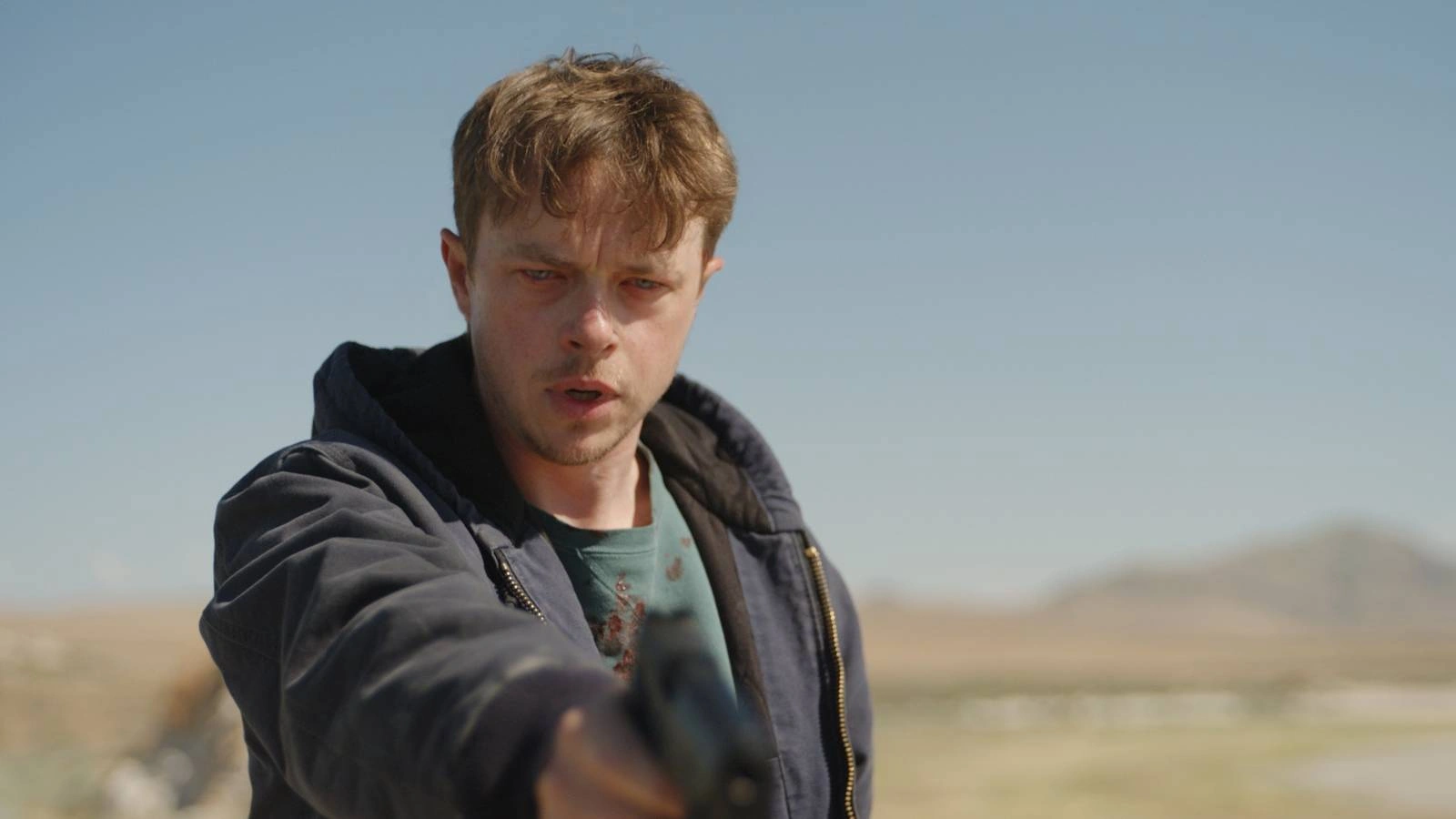
The desert prologue, structured out of sequence, sets a harsh keynote. Cole stands over a bloodied man, and the image fixes violence as the story’s horizon from the opening stretch. It gives the film a fatalistic charge without spelling out the route.
By the closing shot, the camera returns him to the car, looking into the rear-view mirror for pursuit that may exist or may live only in his mind. That uncertainty leaves the final movement suspended, unresolved in the best thriller sense. He stares ahead, checks behind, and remains trapped between motion and memory. Road in front. Ghosts in the glass. A tidy little nightmare.
Wardriver reached theaters on March 20, 2026, through a limited release by The Avenue Entertainment. The film made its global debut at the Cinequest Film Festival shortly before its theatrical launch. A digital and streaming rollout followed on March 27, 2026. This crime thriller follows a tech-savvy thief who finds himself caught between a violent criminal and a lethal conspiracy. Audiences can currently watch the film on major video-on-demand platforms or at participating cinemas across the country.
Where to Watch Wardriver (2026) Online










Full Credits
Title: Wardriver
Distributor: The Avenue Entertainment, Highland Film Group
Release date: March 20, 2026
Rating: R
Running time: 93 minutes
Director: Rebecca Thomas
Writers: Daniel Casey
Producers and Executive Producers: David M. Wulf, Trevor White, Tim White, Arianne Fraser, Delphine Perrier, Daniel Casey, Dane DeHaan, Kevin Matusow, Lee Broda, Santosh Govindaraju, Jack Lehr, Jason Olsen, Morgan Magleby
Cast: Dane DeHaan, Sasha Calle, Mamoudou Athie, Jeffrey Donovan, William Belleau, Chloe Levine, Brian Bowman
Director of Photography (Cinematographer): Htat Htut
Editors: Kristi Shimek
Composer: Mark Hardison Garbett
The Review
Wardriver
Wardriver is a lean, atmospheric entry in the neo-noir genre. It prioritizes the quiet grit of the Salt Lake City sprawl over the flashy tropes of cyber-action. Dane DeHaan anchors the narrative with a performance of weary resignation. The film succeeds by keeping the stakes intimate and the visuals sharp. It is a taut study of digital consequences and the heavy price of empathy. While it adheres to familiar genre beats, the execution remains precise and impactful.
PROS
- Striking night cinematography and urban lighting.
- Grounded lead performance by Dane DeHaan.
- Taut 93-minute runtime that avoids bloat.
- Atmospheric use of the Salt Lake City setting.
CONS
- Predictable narrative beats in the second half.
- Thin character depth for the primary antagonist.
- Limited physical action for viewers expecting high-octane thrills.







